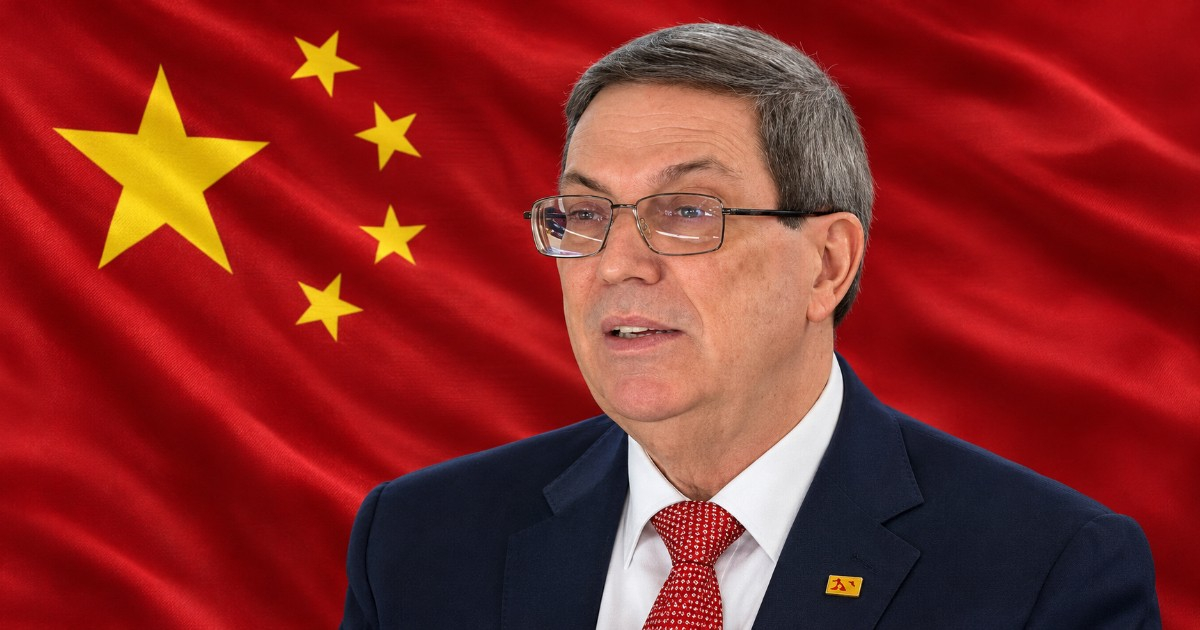
The Cuban Foreign Minister Bruno Rodríguez Parrilla started an official visit to the People's Republic of China this Tuesday, which will last until November 13, in his capacity as a special envoy of the Communist Party and the Cuban government, as confirmed by the spokesperson of the Chinese Foreign Ministry, Guo Jiakun, on Monday.
The Cuban MINREX confirmed the visit through an official card published on social media, which specified that Rodríguez, a member of the Political Bureau of the Central Committee of the PCC, will hold "official discussions with high-ranking" Chinese officials. No agenda has been published and no specific agreements have been announced.
The title of "special envoy" —which implies that the chancellor carries a direct message from Miguel Díaz-Canel to Xi Jinping— and the lack of specific program details suggest that the trip has a high-level political component that goes beyond routine diplomacy.
Guo Jiakun described the bilateral relationship with the usual rhetoric of the Chinese regime: "China and Cuba are good friends, good comrades, and good brothers," and assured that the visit reflects "the high level of mutual political trust between the two countries." He added that Beijing is willing to "strengthen coordination" and "continue building a China-Cuba community of shared future."
This is the second visit of Rodríguez to China in 2026. In February, he traveled to Beijing on an unannounced tour, met with Chancellor Wang Yi and officials from the Chinese Communist Party, and returned via Madrid, where he met with the Spanish Minister of Foreign Affairs, José Manuel Albares. In March, he had a phone conversation with Wang Yi to reaffirm bilateral commitments.
The new journey comes at a time of heightened tension: just five days prior, the U.S. State Department sanctioned two Chinese state-owned companies —China National Electronics Import and Export Corporation (CEIEC) and Beijing H&C Technologies— for supplying surveillance technology and military components to the Cuban MINFAR through the entity Duna S.A.
Beijing rejected the sanctions and described them as an attempt to "sabotage" bilateral cooperation. Rodríguez himself reacted last Friday on X, labeling them as a "sickly policy of economic suffocation" and accusing Washington of attempting to "hinder and sabotage the strategic, multifaceted, and legitimate cooperation that exists between China and Cuba."
Rodríguez's diplomatic agenda in recent weeks has been hectic. In October, he interrupted U.S. Ambassador Mike Waltz several times during the UN debate on the embargo. At the beginning of this month, he led the Cuban delegation at the Ibero-American Summit in Madrid in place of Díaz-Canel, where he denounced the sanctions as "collective punishment." And now he is flying to Beijing.
What the regime is seeking in China contrasts with what it has received so far. The concrete assistance accumulated—80 million dollars in emergency funds approved by Xi in January, 60,000 tons of rice of which the last batch arrived precisely this Tuesday, solar panels, and bus parts—proves to be insufficient in light of the magnitude of the crisis.
Cuba is experiencing its worst energy crisis of the year: electricity availability barely meets 38% of demand, blackouts exceed 20 hours a day in some areas, and the island has suffered at least eight nationwide grid collapses in 2026. The regime relies on imports to cover about 60,000 barrels of oil per day that it does not produce domestically, and according to Russian sources, Cuba "barely imports fuel" since August.
Beijing has not committed to a direct supply of oil or a formal renegotiation of bilateral debt, and its support has been described as "within its capabilities," a phrase that reflects China's cautiousness regarding the risk of secondary sanctions from Washington. What Rodríguez manages to achieve in these discussions will determine whether Chinese assistance moves from symbolic gestures to the tangible support that the dictatorship urgently needs.
Related videos:
Filed under: