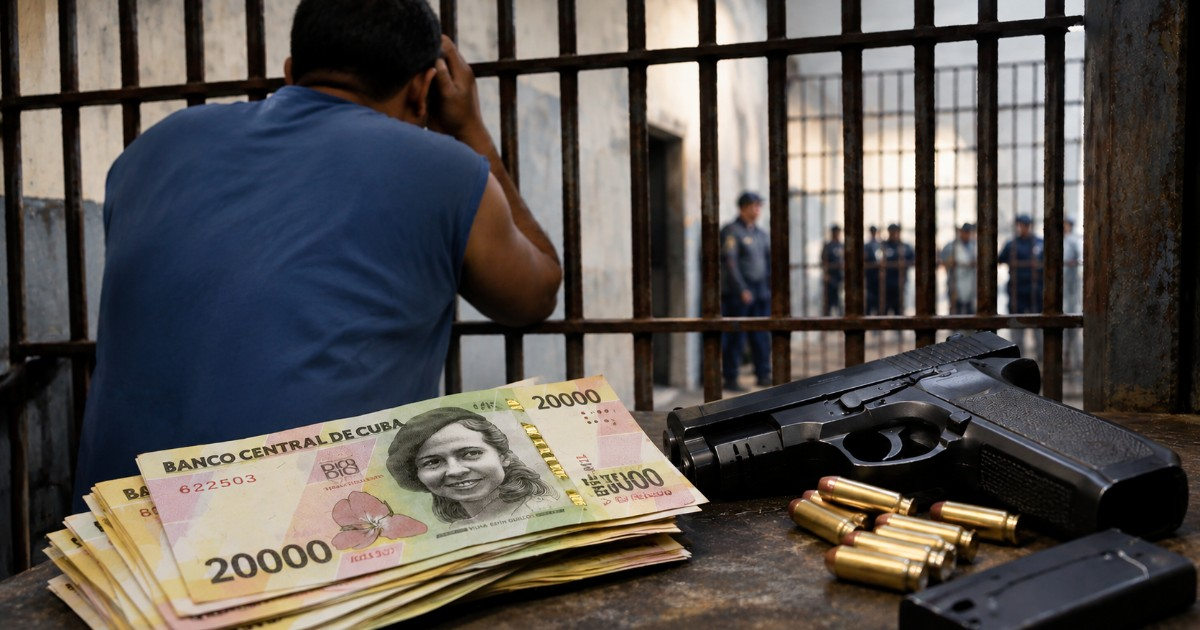
Families of inmates in Cuba purchase handguns on the black market for between 130,000 and 180,000 Cuban pesos and hand them over to prison officials in exchange for sentence reductions, transfers, or changes in regimen, with no guarantee that the agreements will be fulfilled.
This is documented by a report from the human rights organization Cubalex published at the end of October, based on testimonies gathered from 13 prisons and forced labor camps across six provinces.
The price of a gun on the black market is equivalent to between 20 and 28 months of the average Cuban salary, which is set at around 6,500 pesos.
The disproportion compels many families to part with their most valuable assets. Eliober Sosa, a former prison educator interviewed by Cubalex, described cases of acquaintances who "have sold the house, a car" in an attempt to get a family member out of prison.
Laritza Diversent, the director of the organization, recounted the case of a mother who had already sold her refrigerator and other appliances and was considering buying a weapon to achieve her son's release.
The scheme, referred to in prison slang as "The Agreement," has no legal backing whatsoever. The Decree-Law 74/2023, which regulates prison benefits, allows for reductions of up to 60 days for each year served—with an additional 60 days in exceptional circumstances—but its requirements do not include in any case the surrender of firearms.
Far from guaranteeing a benefit, the operation can backfire on those who attempt it. The jurist and former political prisoner Julio Ferrer Tamayo warned Cubalex that the authorities can use the surrendering of the weapon to arrest the family member for receiving stolen goods, while the promise of improvement for the inmate remains unfulfilled. The lack of documents or formal records prevents any subsequent claims.
Juan Luis Bravo Rodríguez reported to the organization that prisoners transferred from Havana to Guantánamo were later able to gain new benefits after surrendering weapons, and that some regained their freedom and lived in a province where no one knew them.
Cubalex also proposes the hypothesis of a circular business: the weapons handed over by families could re-enter the illegal market through the officials themselves. As a precedent, the report cites a ruling from the Military Tribunal of the Havana Region from October 2024, in which a non-commissioned officer was sentenced for stealing six Makarov pistols from his military unit, and four other civilians received sentences ranging from three to eight years for buying and reselling them.
The investigation attributes involvement in the scheme to officials from the Ministry of the Interior, penitentiary authorities, agents from the Technical Investigative Department, prison directors, and, in some cases, prosecutors and members of the Communist Party. Cubalex argues that this practice may violate provisions of the Penal Code regarding illicit arms trafficking and create liabilities for corruption, abuse of functions, and concealment.
This pattern falls within a broader framework of structural corruption documented by the same organization. In September 2026, Cubalex published a report that records 115 deaths in custody in Cuban prisons between February 2024 and June 2026.
Months earlier, in August, the political prisoner of 11J, Fernando Michael Bárzaga Mompié, had reported that in the prisons of Granma the so-called "discipline monitors" control access to doctors, food, and phone calls, and that transfers and benefits are negotiated to the highest bidder.
The Cuban regime has not commented on the allegations contained in the report “State Business: Arms and Prison Benefits in Cuban Prisons.”
Related videos:
Filed under: