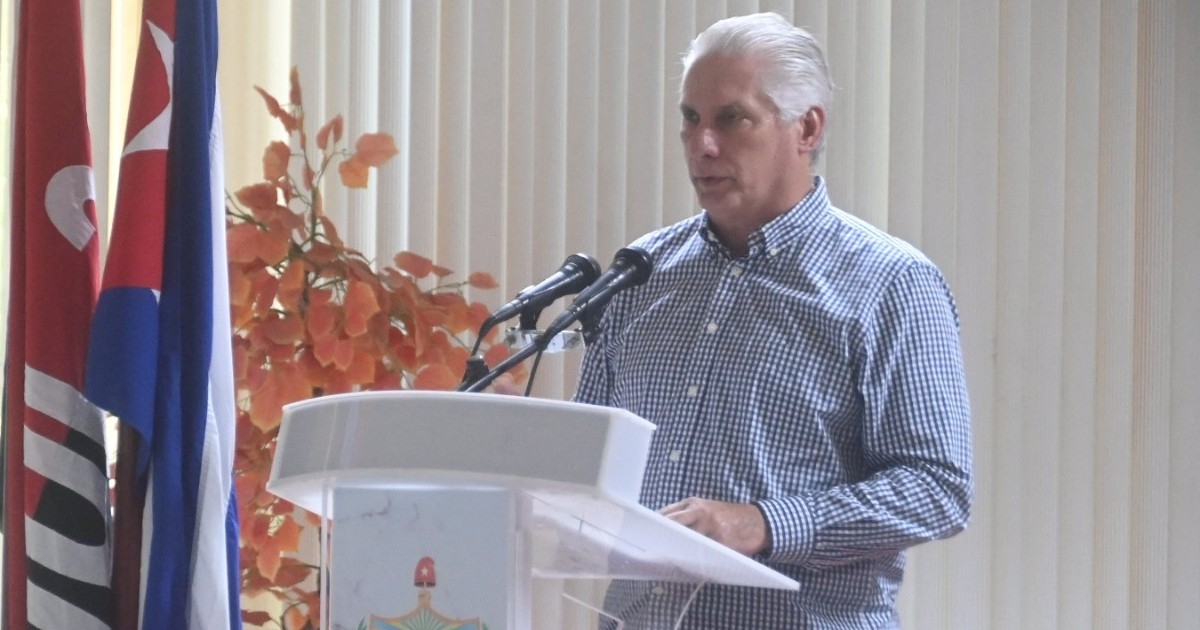
Miguel Díaz-Canel acknowledged this Wednesday that the Cuban population is awaiting concrete results on two fronts that define their daily lives: power outages and food shortages. He made this statement while concluding, according to the official site of the Presidency, the visit of the Secretariat of the Central Committee of the Communist Party to the state and business system of the Ministry of Food Industry (MINAL).
The leader directly linked electricity generation with food production, an argument that the minister of MINAL, Alberto López Díaz, summarized in one phrase: "More kW means more food." López Díaz also reported that the sector will need to implement 100 of the 176 Economic and Social Transformations (TES), distributed across 23 thematic axes, and called for a change of attitude among the system's leaders: "Transformations need to be treated like in a sugar mill, extracting all the opportunities they provide to the business system."
Recognition comes as Cuba faces one of its worst electrical crises of the year. This Wednesday, the Electric Union reported only 1,000 MW available against a demand of 2,250 MW in the early morning, with a forecasted deficit of 1,820 MW for the nightly peak. The previous day recorded a maximum impact of 1,816 MW. The Felton thermoelectric plant will be out of service for three weeks for maintenance.
In terms of food, the situation is no less severe. Following the price liberalization established by Decree 156/2026, local rice reached between 480 and 500 Cuban pesos (CUP) per pound in Villa Clara, eggs reached 130 CUP per unit, and oil exceeded 2,550 CUP per bottle. All of this is occurring in a country where the average state salary was 7,354 CUP in August 2026, equivalent to less than five dollars at the unofficial exchange rate, while the minimum cost of basic necessities is estimated to be about 13 times that amount.
The speech by Díaz-Canel follows a pattern that has been repeating for months. In October, Prime Minister Manuel Marrero Cruz acknowledged in the official podcast "Desde la Presidencia" that the results of the 176 TES — approved in June as the largest structural reform since the Special Period — would not be noticeable until 2027: "We already have the path open to move forward; and in fact, progress is being made and results are already being seen, although improvements in the quality of life for the population are not yet perceived."
Independent data contradict the official optimism. The IX Report of the Cuban Observatory of Human Rights, published in August 2026, estimated that 94% of Cubans live in extreme poverty, 80% have gone without food at some point due to lack of money or resources, and 95% negatively assess the government's economic management. 84% distrust that the package of 176 measures can bring about any change.
The CEPAL projects a contraction of the Cuban GDP of 10.3% in 2026, the worst in Latin America, accumulating a decline of approximately 26% since 2020. The official year-on-year inflation stood at 28.44% in September, with food and beverages rising by 42.66% compared to the same month of the previous year.
The Director of Strategies at the OCDH, Yaxys Cires, was emphatic in presenting the report: "The overwhelming demand for political and economic transformations confirms that Cubans do not want mere adjustments or new promises, but rather a profound change that brings political, economic, and social rights."
Related videos:
Filed under: