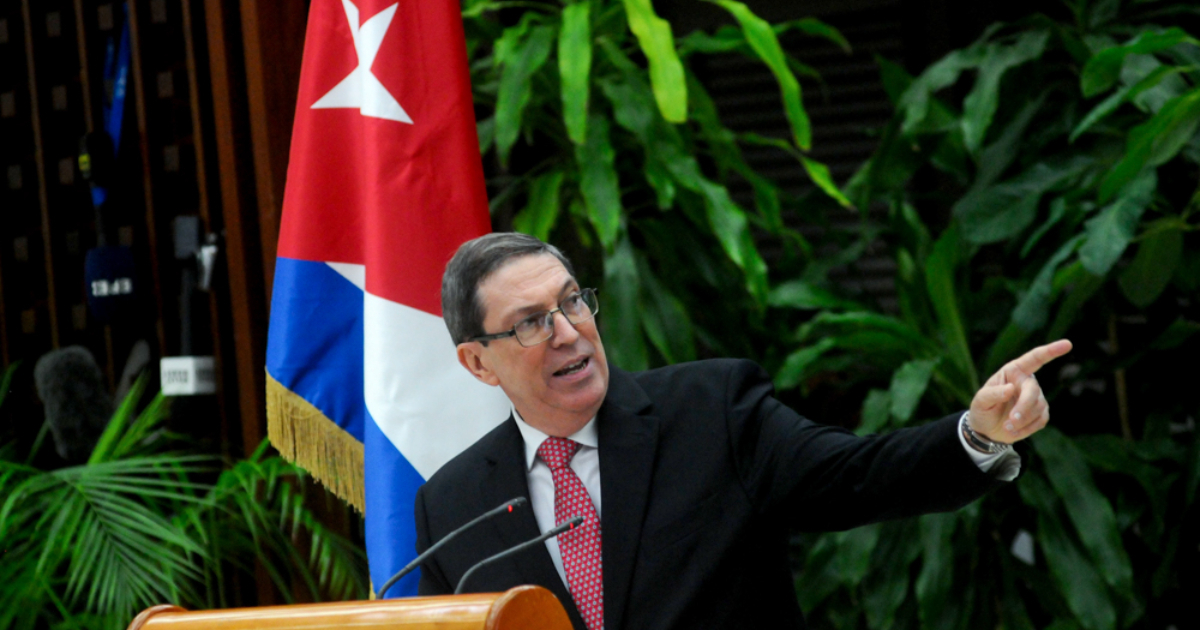
The Cuban Foreign Minister Bruno Rodríguez Parrilla responded this Thursday, from his account on X, to the joint statement issued by the G7 Foreign Ministers following their meeting in Paris.
In his post, he stated that the declaration "omits the reality of the cruel impact of the blockade, the economic war, and the energy siege by the Government of the United States against Cuba, which constitutes a flagrant, massive, and systematic violation of the human rights of the Cuban people and violates the sovereignty of third States."
Rodríguez described the U.S. policy as "genocidal" and accused the G7 of "repeating false arguments fabricated by Washington to justify the criminal blockade," while also reminding that the UN General Assembly recently condemned that policy.
The chancellor's response arrived while he was in China on an official visit as a special envoy of the Communist Party of Cuba and the Cuban Government, accompanied by the Deputy Prime Minister Óscar Pérez-Oliva Fraga and the Cuban ambassador in Beijing, Alberto Blanco.
On Wednesday, Rodríguez had met with Chinese Foreign Minister Wang Yi, who promised that China will support Cuba "regardless of how circumstances evolve" in the face of sanctions and external interference.
What did the G7 say about Cuba?
The statement that prompted the response from the Cuban regime was issued on Wednesday following the meeting of foreign ministers held in Paris on November 9 and 10, under the French presidency of the group, and was signed by the United States, Canada, France, Germany, Italy, Japan, the United Kingdom, and the European Union.
The document expresses concern about "the deep economic crisis and the humanitarian needs facing the Cuban people, including shortages of food, fuel, and medicine."
The foreign ministers urged the Cuban authorities to "promote and implement significant and substantial political and economic reforms to foster prosperity, respect for human rights, and the fulfillment of the legitimate aspirations of the Cuban people."
The text also demanded "concrete measures for a multiparty democratic governance, freedom of the press, and the freedoms of expression and association," and called for "the release of all individuals who are arbitrarily detained."
The statement does not use the word "blockade" nor does it explicitly attribute the Cuban crisis to Washington's policy, and it encourages a "constructive and inclusive dialogue to find a way out of the crisis."
Related videos:
Filed under: