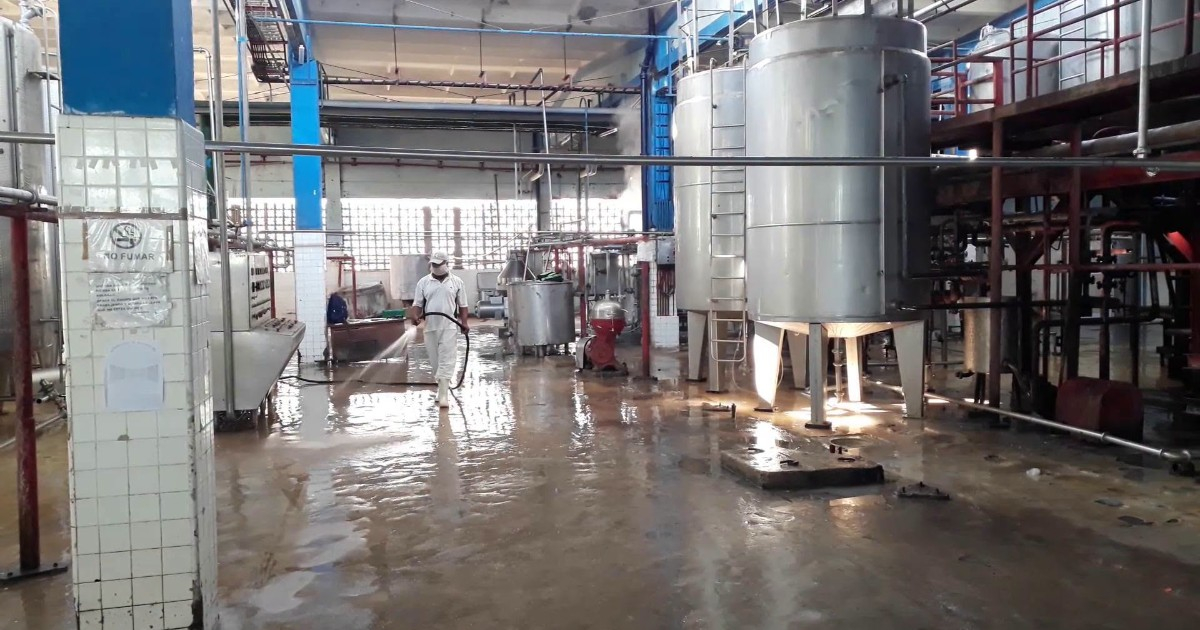
The Matanzas Dairy Products Company is working on the establishment of what could be the first joint-stock trading company in the Matanzas region, a plan that includes the entry of private investors as shareholders —even in a majority position— in its industrial plant, according to statements made by its director to Periódico Girón.
"Let's create perhaps the first commercial company [...] with private economic actors, where they are neither collaborators nor have any other connection with the Dairy sector, but rather their connection is as shareholders, either minority or majority," explained Ariel Hernández Pérez, the director of the entity.
The project is supported by the package of 176 economic and social transformations presented by Prime Minister Manuel Marrero Cruz before the National Assembly on June 18, 2026, the second axis of which authorizes the conversion of state-owned enterprises into joint-stock companies and allows national private actors, Cubans abroad, and foreign investors to acquire shares.
The regime retains majority ownership in sectors it deems strategic; however, the dairy industry is not explicitly listed in that category, which paves the way for private entities to potentially control the majority of capital, as proposed by the company from Matanzas.
The possibility for Cubans and foreigners to purchase shares in state-owned companies has been regulated by Resolution 1/2026 from the National Institute of State Business Assets, published in the Official Gazette in September 2026.
Beyond the shareholding project, Hernández Pérez outlined progress on structural issues that the entity had been facing for years.
The company renegotiated bank commitments for over one million pesos, allowing them to have liquidity to reinvest in production. "For several months, we were not using a small profit of a few million pesos. That profit was limited by the interest we had with the bank, which has now been renegotiated," clarified the executive.
The nonpayment to ranchers, which the director himself described as the company's historical "Achilles' heel," would also have been reversed. "Today we are paying, meaning that today the nonpayment to producers is practically zero," emphasized Hernández Pérez.
To support this settlement, the entity established billing and payment reconciliation tables in all municipalities, composed of the company, ANAP, Agriculture, and BANDEC. It is also managing a new bank credit to advance payments to producers.
In the municipality of Perico, a cooperative production has already been agreed upon with a private actor, settling previous debts and initiating joint projects, while progress is being made in Pedro Betancourt and Unión de Reyes to settle outstanding commitments.
The Colón unit, currently operating at a loss, is the main focus of the economic recovery strategy for the end of the year.
The company has secured fuel through contracts with state entities and is working on changing its energy matrix and rehabilitating wells to ensure a water supply to its facilities.
"In November and December, we must have uninterrupted productions of several products," the director stated, referring to the final stretch of 2026.
The announcement comes more than a year after more than five thousand children in Matanzas had their milk supply reduced or interrupted, a crisis that highlighted the collapse of the provincial collection system. Analysts like Carlos Saladrigas from the Cuba Study Group have warned that these privatizations could become "piñatas" if carried out without transparency or independent legal guarantees.
Related videos:
Filed under: