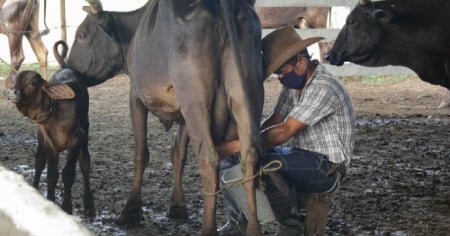
More than 5,000 children and an unspecified number of cancer patients are left without the milk the government should provide them in Matanzas.
Thus, it was acknowledged by the local state-run press in an article discussing the efforts of provincial party leaders to revitalize the livestock industry.
During a meeting with the First Secretary of the Communist Party in Matanzas, Mario Sabines Lorenzo, cattle ranchers expressed their concerns about experiencing shortages of fuel and electricity, which are essential for an activity that requires vital inputs such as pumped water.
They also complained about "the subjective factors" that affect the decline in milk and beef production: the theft and slaughter of cattle, which they described as a "devastating and unsettling phenomenon," as well as the mismanagement of the livestock population.
Additionally, they criticized private producers, who have the largest number of livestock in the province, for their reluctance to adopt artificial insemination.
At the meeting, they called to "contain the advance of the marabou and regain cultivable areas by reintroducing grass and forage varieties, along with the introduction of protein-rich plants such as tithonia and mulberry."
They also mentioned state plans to revitalize the genetic industry or the rescue of seven dairy farms.
Milk crisis in Matanzas
At the end of last year, it was reported that in Matanzas, children aged between 1 and 2 years currently receive 917 milliliters of liquid milk daily. However, those aged between 3 and 6 years now only receive 917 milliliters every other day, waiting for "the situation to become more favorable."
Reynaldo Ramírez Martínez, commercial director of the company Productos Lácteos de Matanzas, explained that the adjustments directly affect thousands of children, who are now receiving reduced amounts of liquid milk, depending on their age.
The magnitude of the deficit is estimated at around 6,000 liters per day just in the province.
The situation is particularly severe in Matanzas, where approximately 38,000 liters are needed daily to meet demand. However, limitations in production and distribution have led families to face long wait times and alarming food insecurity.
The executive indicated that, due to the lack of a cooling system in the factory, liquid milk must be pasteurized and distributed on the same day, with deliveries that may extend until 10 PM.
"Currently, milk is being distributed on most routes every third day, and it is expected that with the implementation of these measures, delivery can be regularized, which has been delayed due to the deficit," Girón stated.
These improvised measures reflect the critical state of the dairy industry in Cuba, unable to ensure a regular supply even for the most vulnerable groups, such as children.
Frequently Asked Questions About the Milk Crisis in Matanzas, Cuba
Why have more than 5,000 children in Matanzas been left without milk?
The shortage of milk in Matanzas is due to structural problems in livestock production, such as the lack of essential supplies, cattle theft, and poor handling of the animals. Furthermore, the lack of fuel and electricity further complicates the situation, affecting the production and distribution of milk.
What are the main problems facing the livestock industry in Cuba?
The livestock industry in Cuba faces issues such as disorder, unpaid debts, and a lack of incentives. Additionally, there is an institutional neglect that results in contract violations, cattle theft, and a shortage of basic supplies. These factors have led to a collapse in milk production, impacting both producers and the population.
What measures are being implemented to address the milk crisis in Matanzas?
Authorities have proposed recovering arable lands and revitalizing the genetic industry, as well as introducing protein plants such as tithonia and mulberry. However, the effectiveness of these measures remains to be seen, given the context of structural crisis in the Cuban dairy industry.
How is the milk crisis affecting families in Matanzas?
The crisis has led to food insecurity and long waits for families who rely on an irregular supply of milk. The lack of milk particularly affects children, who receive reduced amounts that are insufficient for their basic nutritional needs.
Filed under: