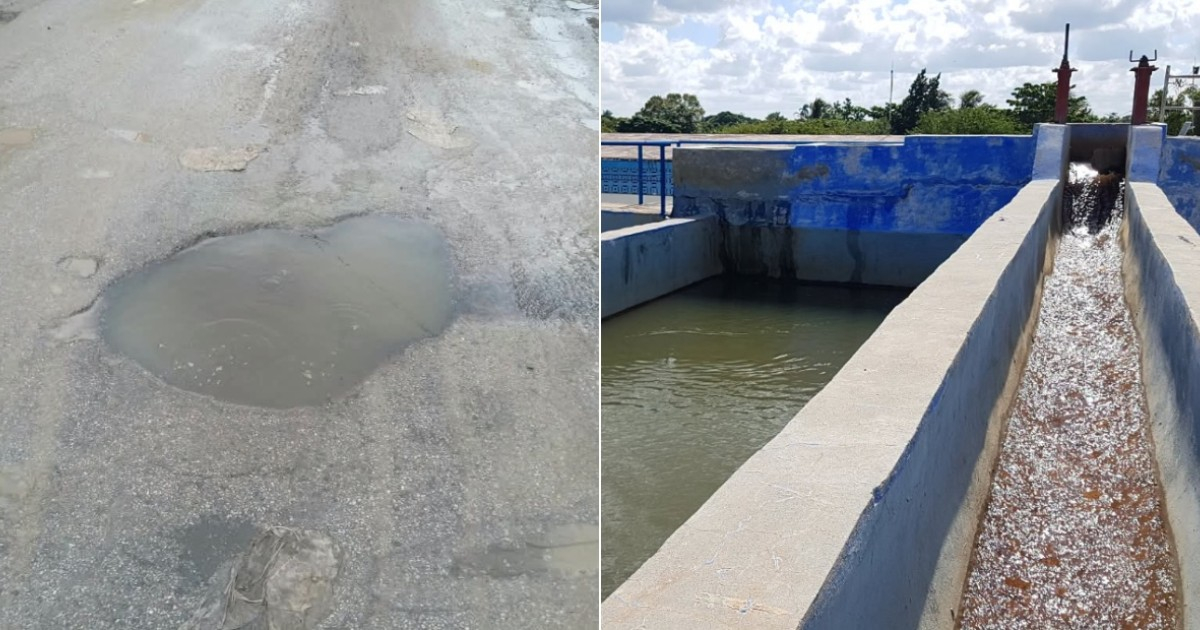
The city of Las Tunas has been without potable water for three days due to a shortage of the necessary chemicals to treat it, according to the local official media Tiempo21Cuba. At the same time, the provincial capital is facing a worsening situation with the discharge of wastewater that is damaging the streets and affecting the quality of life of its residents.
Journalist Ordey Díaz Escalona, the author of the reports, explained that the lack of fuel prevents the transport of purification supplies from the province of Villa Clara to Las Tunas, which has completely halted the supply to the main city of the territory.
Meanwhile, persistent sewage runoff affects the corner of René Ramos and 24 de Febrero streets, where the pavement deterioration due to constant moisture poses a traffic accident risk, in addition to the foul odor experienced by the residents of the area.
Authorities from the National Institute of Water Resources clarified that these discharges are not related to the interruption of drinking water supply, indicating a separate failure in the sewage system that adds to the supply crisis.
The picture painted by Tiempo21Cuba —a media outlet that caters to the interests of the regime— is revealing precisely because it comes from an official source that typically downplays the structural issues of the Island.
The situation in Las Tunas is not an isolated incident. A resident of the city reported on Tuesday that she had been without water for over twenty days, a shortage that was even affecting her baby's hygiene.
The issue of chemical supplies has national dimensions. Imports of products for water treatment have fallen from around 100 million dollars annually to about 10 million, as acknowledged by the National Institute of Hydraulic Resources. Last June, the authorities in Camagüey even advised the public to boil water due to the shortage of chlorine gas and aluminum sulfate at the water purification plants.
The water supply system in Las Tunas also faces a structural deficit: it pumps between 420 and 430 liters per second when it needs between 600 and 700 to maintain distribution cycles every three days. The Water and Sewer Company of Las Tunas operates with less than 60% of the required workforce, which limits both the maintenance of the water networks and the sewage system.
On a national scale, the National Institute of Hydraulic Resources reported at the beginning of November that nearly 2.7 million people were experiencing interruptions in supply from networks, and the UN estimated that the actual figure could reach 3.5 million.
The Cuban government acknowledged on November 4 that the water crisis was "real, serious, and complex" and that it could not be resolved immediately; instead, it would require years and significant investments, without specifying where those resources would come from amidst the economic collapse facing the Island.
Related videos:
Filed under: