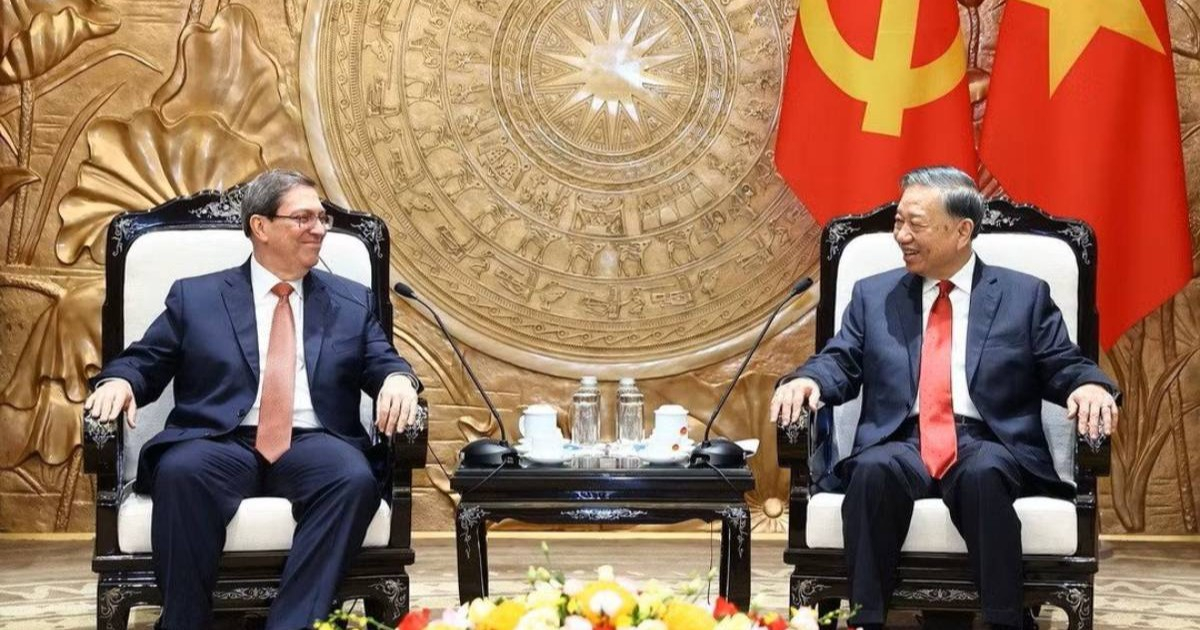
The Cuban chancellor Bruno Rodríguez Parrilla arrived in Hanoi this Friday as a special envoy of the Communist Party of Cuba and the Government.
Rodríguez was received by Tô Lâm, General Secretary of the Communist Party of Vietnam and President of the country, during an official diplomatic meeting photographed by the Vietnamese state agency TTXVN.
" We discussed the severe damage that the tightening of the U.S. blockade, the energy squeeze, and secondary sanctions are causing to the Cuban people," said the Cuban Foreign Minister on X.
Rodríguez conveyed the greetings of Army General Raúl Castro and President Miguel Díaz-Canel to the Vietnamese leader, expressing gratitude for "the enduring solidarity and unwavering support of the Party, the Government, and the Vietnamese people in these current and challenging circumstances."
In addition to the meeting with Tô Lâm, the Cuban diplomat met with the Vietnamese Foreign Minister Lê Hoài Trung to discuss priority projects and political, economic, and cultural cooperation.
Vietnam reiterated its call for the lifting of unilateral measures against Cuba and affirmed that it will continue to support the island within its means.
The Cuban regime noted that Vietnam is its largest investor in Asia and Oceania, with projects in agri-food, essential goods, construction materials, and renewable energies. Rodríguez indicated that Cuba aims to prioritize new joint projects in the production of consumer goods, healthcare, the pharmaceutical industry, and tourism.
The visit comes at the worst energy moment of the year for Cuba. The available generation barely meets between 30% and 40% of national demand, with power outages exceeding 20 hours a day in some areas.
An Asian tour in search of allies
The stop in Vietnam is the second stage of a diplomatic tour that began in China from November 10 to 13, where Rodríguez met with Foreign Minister Wang Yi —who promised support to Cuba "regardless of how circumstances evolve"— as well as with senior officials of the Chinese Communist Party and the international cooperation agency of Beijing.
This is also Rodríguez's second visit to Vietnam in 2026. The first took place in February, again in his capacity as special envoy, as part of a Cuban diplomatic offensive in response to the economic and energy pressures facing the island.
In November 2025, it was reported about the Vietnamese donation of four photovoltaic solar parks, with a total announced capacity of 80 MW, destined for Mayabeque, a direct contribution to the struggling Cuban electrical grid.
The trip also takes place during a time of tension with the West. On Thursday, Rodríguez responded from X to a statement from the G7 —issued after the meeting of foreign ministers in Paris— which called for democratic reforms and the release of political prisoners in Cuba.
He accused the bloc of "repeating false arguments manufactured by Washington to justify the criminal blockade" against Cuba.
Bilateral relations between Havana and Hanoi date back to December 2, 1960, when Cuba became the first Latin American country to establish diplomatic ties with Vietnam.
Related videos:
Filed under: