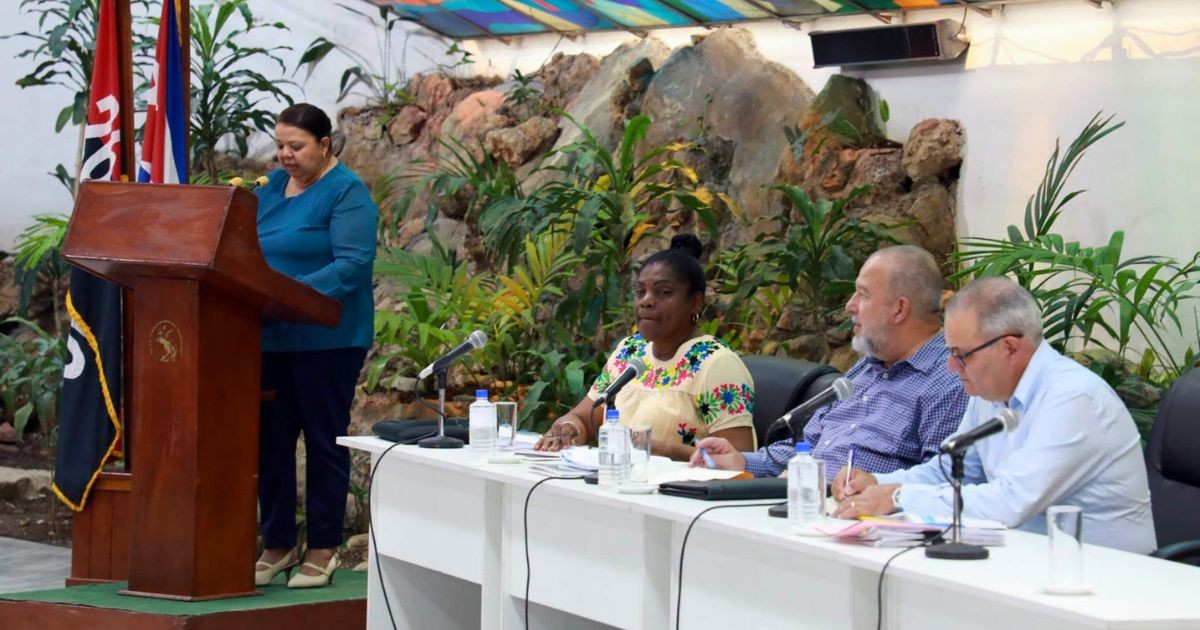
The Prime Minister Manuel Marrero Cruz presided over an extraordinary session of the Provincial Council of the People's Power in Santiago de Cuba this week, where he once again demanded the dismantling of bureaucratic obstacles that paralyze the economy and services, as part of the evaluation of the 176 Economic and Social Transformations approved by the National Assembly in June 2026.
Marrero's speech did not surprise anyone: it is the same one he has delivered in Cienfuegos, in Camagüey, and in half a dozen forums throughout the year. In Santiago, he reiterated that "we achieve nothing with a solid province if the municipality is weakened" and that "the main transformation must occur in the mindset of decision-makers," as reported by the newspaper Granma; words that, by now, Cubans already know by heart.
During the meeting, the real problems of the province emerged: high food prices, tensions in the supply for social consumption, delays in credits for renewable energy projects, and a shortage of financing in foreign currency.
The reaction on social media, in comments on informative profiles that shared the news, such as Santiago de Cuba hoy and CMKC Radio Revolución, was a chorus of skepticism and sarcasm that was hard to ignore. A commenter who captured the collective sentiment was blunt: “Giving out candies with a sedative.” Another internet user summed it up with equal precision: “Here we go again with the Good Pipe story.”
Critics pointed out a fundamental contradiction that the prime minister did not address: "The issue is that those in charge of eliminating bureaucratic obstacles are the bureaucrats themselves, who thrive on those obstacles." Another netizen was even more direct: "In that visit, there isn't a single replacement or a demoted official, etc.; we keep stumbling over the same stone, but no one removes it from the path."
The official reference to Santiago as an "economically solid province" triggered a wave of disbelief. "What is this solidity?" asked dozens of users. "What solid economy is being talked about when there are so many problems delivering the essentials to the everyday people of Santiago?" wrote an internet user.
From Siboney, another person recalled that the landslides caused by Hurricane Sandy—in 2012—remain unresolved, just like the electrical issues that have accumulated since then.
A netizen invoked Tomás Gutiérrez Alea and his film La muerte de un burócrata, released in 1966, to point out that Cuban bureaucratism has been depicted in cinema for 60 years "and it is still deeply entrenched, thriving in tremendous health." The irony is perfect: the regime has spent six decades diagnosing the same disease without curing it.
This Santiago episode fits into a pattern that repeats with mechanical precision. Marrero visited Camagüey previously, with the same message, and did so as well in Cienfuegos and other areas. As summed up by a netizen with the economy of someone who no longer expects anything: "The formula is to make people believe that work is being done, but in the end, life remains the same or worse."
Related videos:
Filed under: