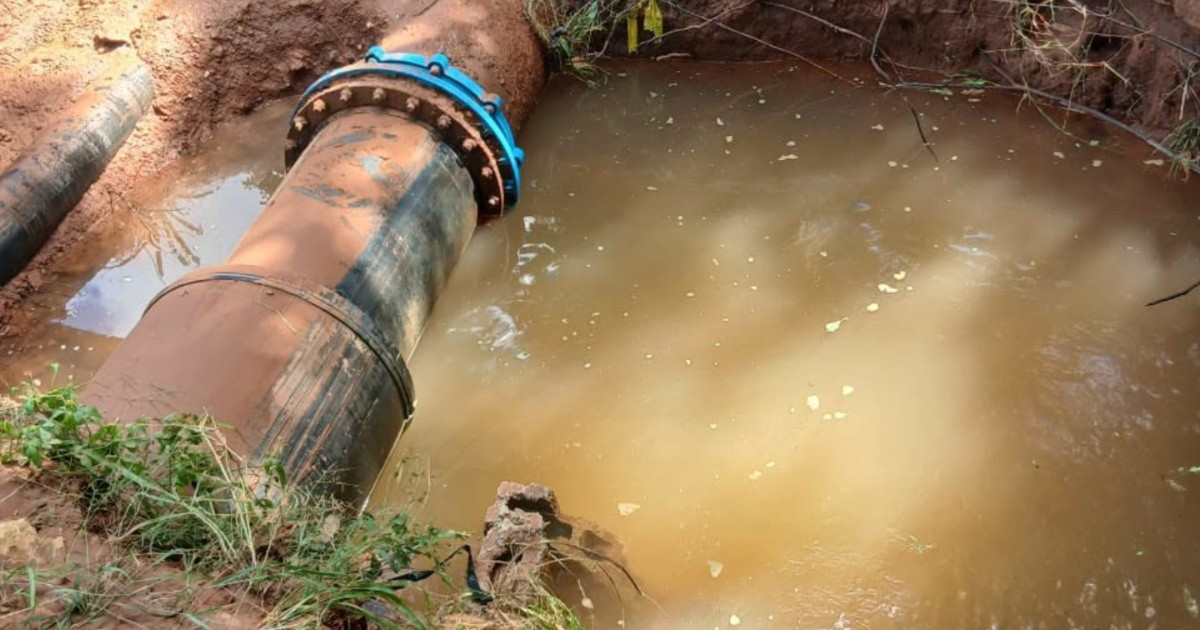
A total electrical failure that occurred Thursday at the Cuenca Sur supply fountain triggered a new water crisis in downtown Havana, causing an increase in leaks from the main 78-inch pipe and necessitating intervention at three points along that pipeline.
Aguas de La Habana informed this Friday that the incident, recorded in the late afternoon and evening, is affecting the service in the five municipalities of the Central System: Plaza de la Revolución, Centro Habana, Habana Vieja, Cerro, and Diez de Octubre, in addition to several areas of Boyeros.
The impacts vary by municipality. In Plaza de la Revolución, the areas of the Letters and the Numbers are without service, as well as those receiving water from the Fifth of the Mills pump. However, the company guarantees pumping to hospitals and neighborhoods near Loma del Príncipe, the Ataré Popular Council, and part of the Latin American Council.
In Centro Habana and Habana Vieja, the disruption is widespread, with a higher incidence in Jesús María, Habana Intramuros, and the areas supplied from Quinta de los Molinos, Peñalver, and Villarín.
In the Cerro municipality, the neighborhoods of Martí, Cepero Bonilla, Casino Deportivo, Santa Catalina, Palatino, Las Cañas, and Cerro are affected.
In Diez de Octubre, the Luyanó low area and the pumping from Víbora Chica. In Boyeros, eight neighborhoods—including Miraflores Nuevos, Alta Habana, Capdevila, Mazorra, and Río Cristal—are experiencing low pressure and a shortage of water.
While repair work continues, Aguas de La Habana urged the public to "take all necessary savings measures in order to minimize the impact" and promised to provide updates on service schedule adjustments once the interventions are completed.
The episode adds to a series of breakdowns that have repeatedly affected the same infrastructure throughout 2026. On October 22, shots on 110 kV power lines caused a complete shutdown of Cuenca Sur and damage at two points of the pipeline; on November 4, another emergency shutdown was declared due to leaks; and just the day before the new incident, the source was operating with only 16 of its 19 planned units.
The 78-inch conductor has accumulated over 70 years of operation without significant renewal, making it particularly vulnerable to water hammer—sudden pressure variations—that cause abrupt electrical outages.
The company itself has acknowledged that 87% of the hydraulic system in the capital depends on electricity, meaning that every blackout almost automatically results in a water cut.
In August, a complex failure with three leaks in that same pipeline left six municipalities without water supply. The crisis has escalated over the year: from about 200,000 residents of Havana affected in April to more than 536,000 in November, within a national total of 2.68 million people without regular access to water, according to the National Institute of Hydraulic Resources.
Related videos:
Filed under: