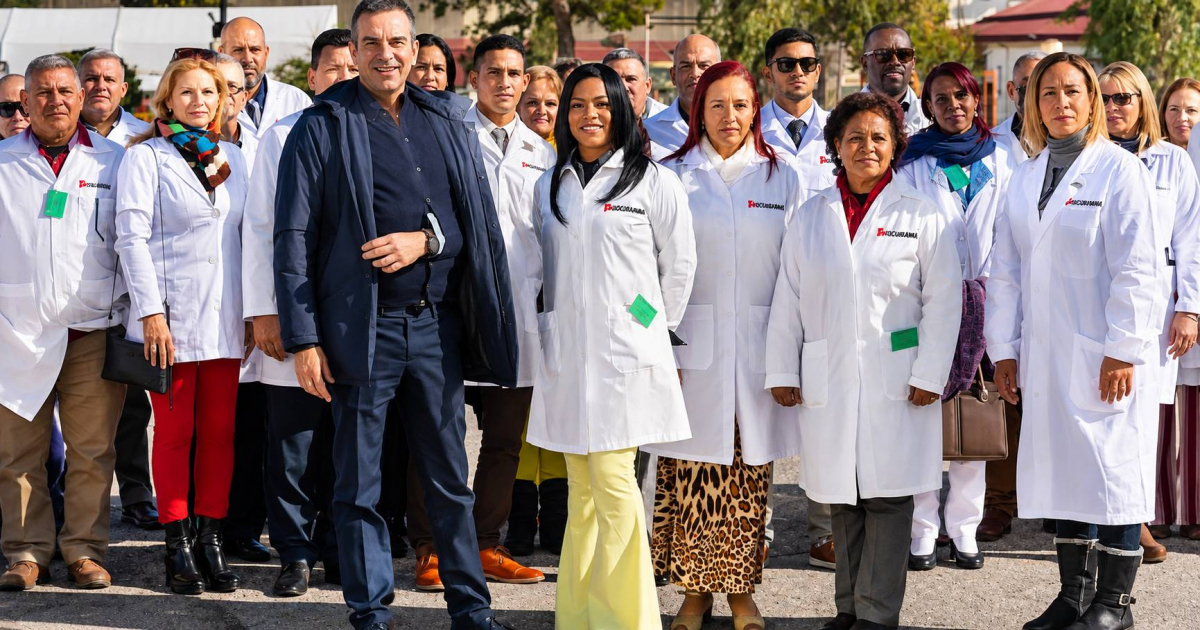
The Cuban Observatory of Human Rights (OCDH) presented a legal report that demands Rome and Brussels to activate and formally assess eight protection and investigation mechanisms in response to indications of forced labor within the Cuban medical mission deployed in Calabria, where approximately 200 healthcare professionals sent by the dictatorship are operating.
The document states that the initial consent of the doctors does not validate their subsequent loss of freedom to leave the service, and it details the coercive tools used by the regime: retention of passports, constant surveillance, confiscation of the majority of their salary, and the threat of penalties of up to eight years in prison under Article 176 of the Cuban Penal Code for those who decide to disengage from the mission.
The figures supporting the complaint are striking. Of the 27.5 million euros paid by Italy to hire 333 doctors until March 2025, the Cuban Medical Services Marketing Company (CSMC) —linked to the military conglomerate GAESA— only transferred 6.2 million to the professionals, approximately 24% of the total.
The agreed base salary is 4,700 euros per month per doctor, but each professional receives a maximum of 1,200 euros, which is 25.5% of the agreed amount.
The situation worsens with overtime: the report documents a double retention of 43% presented as Italian tax, along with the obligation to return 50% of the remaining balance to the CSMC, which leaves the doctor with barely 22.5% or less of what was earned in that regard. In addition, there are 37 binding circulars with more than 30 prohibitions that restrict free movement, statements to the press, and personal relationships.
El OCDH requests the activation of eight specific legal tools: Article 5 of the EU Charter of Fundamental Rights, which prohibits slavery and forced labor; Directive 2011/36/EU on human trafficking; the liability of legal entities provided for in that same directive; the infringement procedure before the European Commission (Articles 258-260 TFEU); the EU's global sanctions regime for human rights violations (Regulation 2020/1998); the GRETA Expert Group of the Council of Europe; the European Court of Human Rights; and the direct judicial and inspection channels in Italy before the Procura della Repubblica, the Polizia di Stato, the Carabinieri, and the Ispettorato Nazionale del Lavoro.
The report arrives at a time of increasing international pressure on Cuban medical missions. In April 2026, the Inter-American Commission on Human Rights published a report based on 71 testimonies that identified signs of forced labor and modern slavery in missions deployed in 109 countries, with salary withholdings ranging from 60% to 90%.
In June, the European Parliament approved a resolution linking Cuban brigades to potential trafficking practices. In July, the U.S. sanctioned the CSMC and the Cuban Minister of Health José Ángel Portal Miranda, which blocked bank accounts of the mission and opened the door for about 63 doctors to seek direct hiring with the Calabrian healthcare system.
The OCDH had already submitted a formal request to the EU in Brussels in September to investigate the brigade in Calabria for human trafficking, and Friday's report recalls that the Cuban missions have a history before the UN Human Rights Council — with joint communications in 2019 and 2023 — and formal observations from the International Labour Organization under Convention No. 29.
The organization demands that Rome and Brussels initiate formal and independent investigations into the signed agreements, verify the voluntariness of the medical professionals, and ensure effective means of protection against reprisals.
The calendar adds urgency: the GRETA has scheduled a technical evaluation visit to Italy as part of its fourth round in early 2027, a window that the OCDH points out as an opportunity for the authorities to take action before that scrutiny.
"Medical cooperation cannot take place outside the rule of law, regardless of the nationality of the cooperator, nor can it serve as a loophole to tolerate labor coercion schemes within the territory of the European Union," the OCDH report concludes.
Related videos:
Filed under: