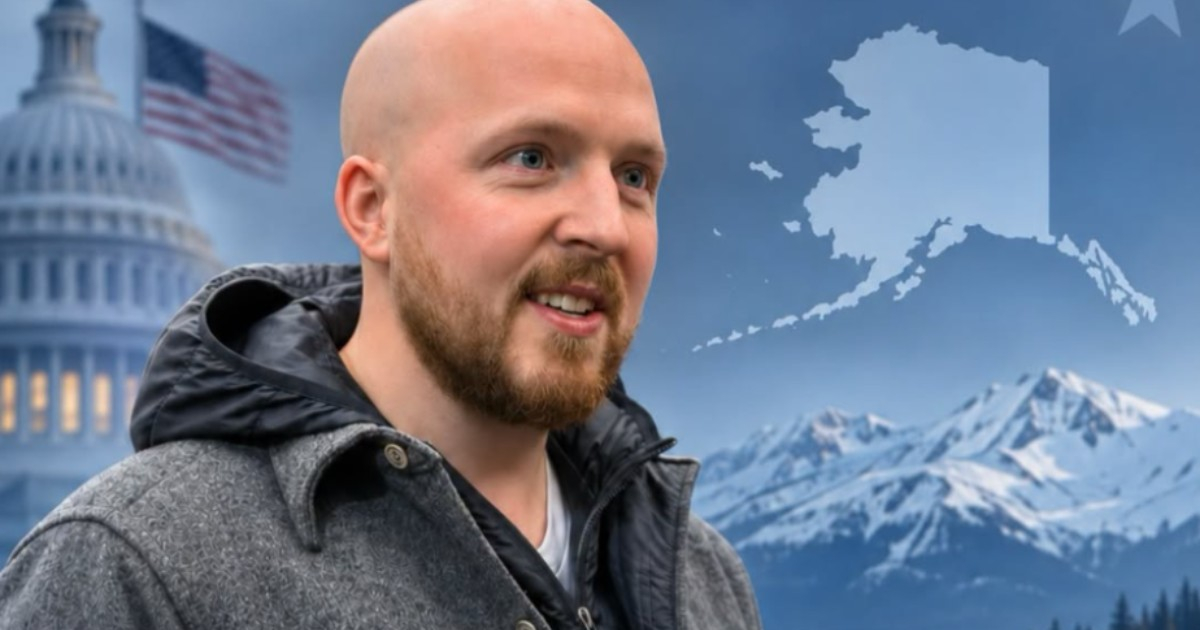
The Democrat Jonathan Kreiss-Tomkins became the first governor from his party elected in Alaska in nearly three decades, following a victory confirmed 10 days after the polls closed on November 3.
According to reported by The Guardian, 37-year-old Kreiss-Tomkins, popularly known as JKT, defeated three Republican opponents, including Bernadette Wilson, who had the support of President Donald Trump.
The Democratic candidate received about 50.8% of the first-choice votes, allowing them to surpass the threshold needed to win without requiring additional rounds under the preferential voting system in effect in Alaska.
Wilson came in second place with 28.1% of the votes, followed by Dave Bronson with 13.6% and Treg Taylor with 7.2%.
Kreiss-Tomkins will succeed the outgoing Republican governor Mike Dunleavy, who could not run for reelection due to constitutional term limits, and will take office on December 7.
With this victory, the Democrat also becomes the youngest governor in the history of the state, and will govern alongside his independent lieutenant governor, Zac Johnson.
The last Democrat to win the governorship of Alaska was Tony Knowles, who was re-elected in 1998 and served until 2002.
During the campaign, Kreiss-Tomkins focused his message on economic affordability, public education, taxing corporate oil and gas producers, and regulating data centers.
He also harshly criticized Dunleavy's administration, pointing out the deterioration of the state ferry system, which is vital for communities in Southeast Alaska that lack road access.
"The residents of Alaska are hungry for change," stated the elected candidate. "We have been running the same campaign since we launched it in February, and I do not take anyone's vote for granted."
Despite his criticisms of the outgoing government, Kreiss-Tomkins promised to form a bipartisan cabinet with Democrats, Republicans, and independents.
The victory in Alaska is part of the historic blue wave of the midterm elections on November 3rd, which transformed the political landscape of the United States.
The Democrats also secured governorships in states that had been Republican strongholds: Georgia, Texas, Iowa, Ohio, Nevada, and Kansas.
In Texas, Gina Hinojosa became the first Democrat to win the governorship in 35 years and the first Hispanic governor of the state.
With the addition of Alaska, the Democratic Party now controls 30 governorships compared to 20 held by Republicans, achieving a majority of governors for the first time since 2010.
At the congressional level, the Democrats regained control of the Senate with eight seats won and achieved a majority in the House of Representatives with over two dozen additional seats.
According to The Guardian, a key factor in the Republican defeat was Trump's unpopularity, with his approval rating at 32% according to a Reuters/Ipsos poll, in a context marked by rejection of his immigration policy, tariffs, and the war with Iran.
In parallel, the Democrat Mary Peltola was leading the race for the federal Senate seat in Alaska this Saturday against the incumbent Republican Dan S. Sullivan, with 49.8% of the votes compared to 46.1%, although this contest had not yet been officially resolved.
Related videos:
Filed under: