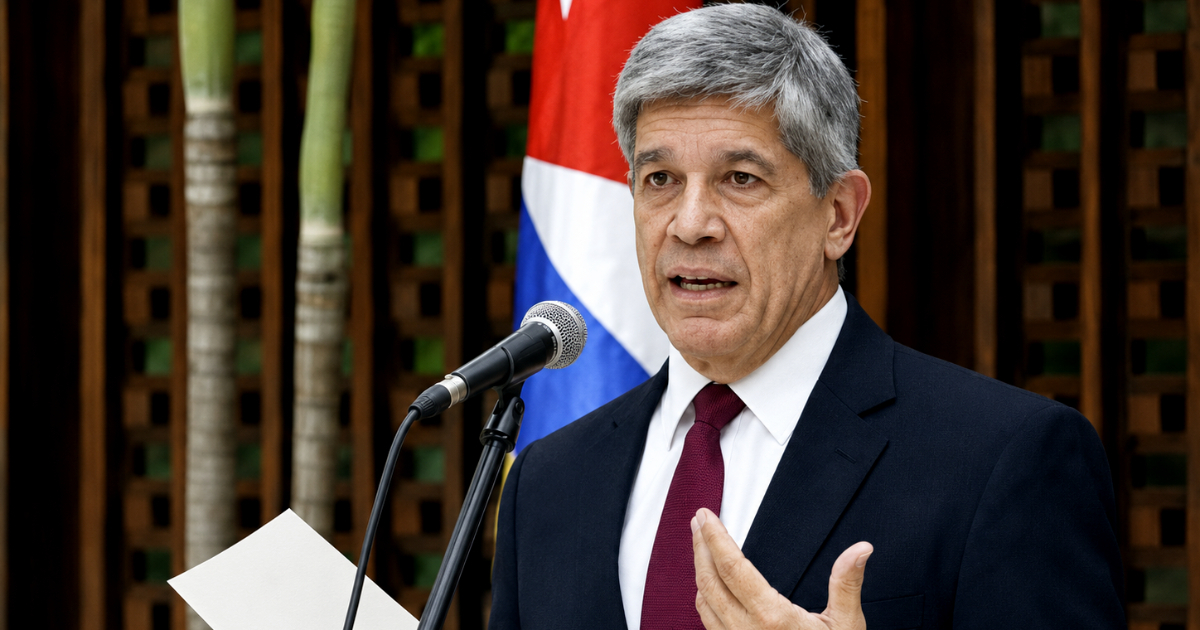
Just two weeks ago, the Cuban Deputy Foreign Minister Carlos Fernández de Cossío acknowledged on '60 Minutes' from CBS News that the Havana government bore "a lot of responsibility" for the country's crisis.
However, amidst international criticism, the regime's diplomat now seems to have moved past that admission: “The problem is not Cuba. The problem is the aggression of the U.S. against Cuba.”
The contrast was highlighted this Friday in a post on Facebook, two days after the G7 foreign ministers called for democratic reforms, respect for fundamental freedoms, and the release of those arbitrarily detained in Cuba.
"It is surprising that international observers, including representatives from various governments and politicians, refer to Cuba with allusions to a 'crisis' without mentioning that it is an induced crisis," wrote the diplomat, who identified the U.S. government as the one deliberately responsible for causing it.
Fernández de Cossío stated that the embargo is applied even from the territories of third countries and against the interests of their citizens and companies. However, he did not mention any responsibility of the Cuban government for the economic and social deterioration of the island.
The omission contrasts with what was stated during the interview aired on November 1 by 60 Minutes, when journalist Matt Gutman asked what responsibility the Cuban authorities had in the deterioration of power plants, wages, and infrastructure.
After initially responding with a comparison about the social issues in the United States, Fernández de Cossío ultimately acknowledged: «Our government has a lot of responsibility because there could have been decisions that might have been better».
Although he also pointed to U.S. sanctions as a decisive factor, that response, captured in the original transcript from CBS, represented an unusual acknowledgment of internal errors by a high-ranking official of the regime.
In his new statement, however, that self-criticism disappears. The crisis is once again explained solely by the actions of Washington, with no reference to the governmental decisions that the vice-chancellor himself had admitted could have been better.
The G7 calls for reforms, and Havana responds with the blockade
The diplomat's statements come after the G7 expressed its concern over the "deep economic crisis" and the humanitarian needs of Cubans, especially the shortages of food, fuel, and medicine.
In a joint declaration published on November 11, following the meeting of foreign ministers held in Paris on the 9th and 10th, the seven countries called for significant political and economic reforms, concrete measures towards a multi-party democratic system, freedom of the press, expression and association, and the release of all those held arbitrarily.
The document also urged improvements to the mechanisms for distributing humanitarian aid and encouraged a constructive and inclusive dialogue to find a resolution to the crisis. It did not mention the U.S. embargo nor expressly attributed the causes of the Cuban situation to Washington.
The first response from Havana arrived on Thursday, when Foreign Minister Bruno Rodríguez Parrilla accused the G7 of omitting the impact of the blockade, the economic war, and the U.S. energy blockade. He also asserted that the group was repeating "false arguments crafted by Washington" to justify the sanctions.
Fernández de Cossío's publication, although it does not explicitly mention the G7, continues the same line of argument the following day: holding the United States responsible for the crisis and questioning those who describe the Cuban situation without pointing out the sanctions.
The Deputy Foreign Minister expressed gratitude for the international humanitarian assistance and stated that the Cuban people only ask to "be left in peace, to be allowed to work in peace, and to build their own future in peace," with the opportunity to "succeed, make mistakes, and readjust if necessary."
But he did not address the international demands regarding political pluralism, freedom of expression, and political prisoners. He also did not explain what internal decisions could have been better, as he had acknowledged before CBS.
The demands of the G7 coincide with a new report from Prisoners Defenders, which counted 1,353 political prisoners in Cuba as of the end of October, the highest figure in its records.
While Fernández de Cossío presents the U.S. intervention as the primary obstacle for Cubans to build their future, the G7 insists that they should also be able to do so with political freedoms, fundamental rights, and without arbitrary detentions. These are demands that Havana's responses have left unanswered, burying them in its propagandistic rhetoric.
Related videos:
Filed under: