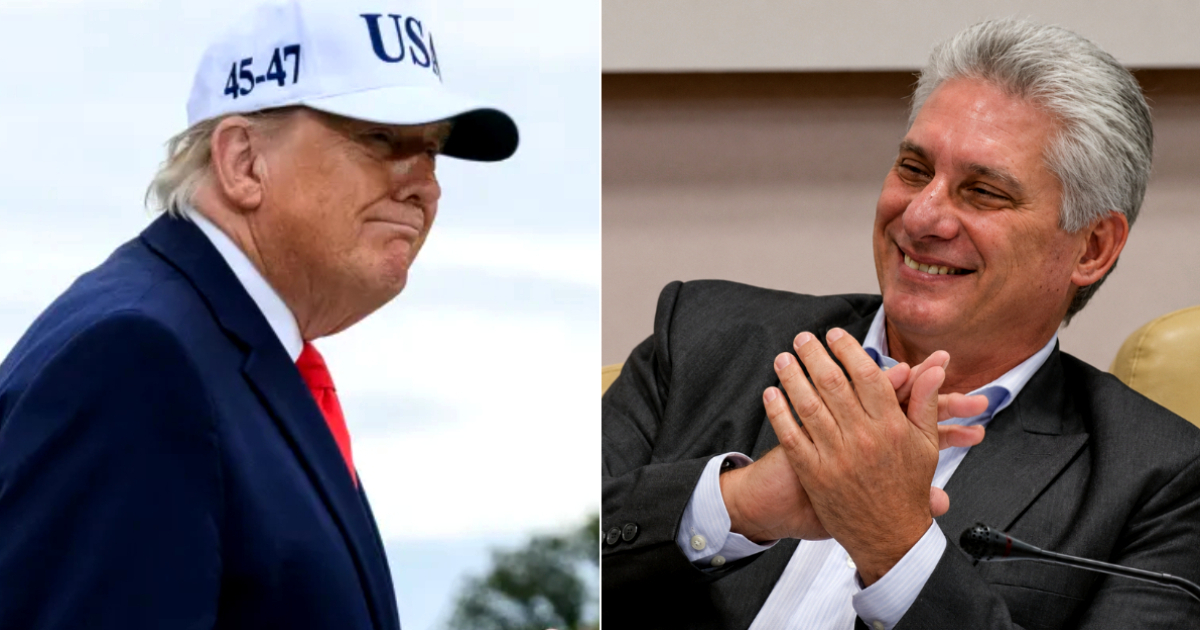
The recent defeat of the Republican Party in the U.S. midterm elections could provide an unexpected reprieve for the Cuban dictatorship.
With just over two years left in the White House, Donald Trump remains intent on driving change on the island, but his internal political difficulties, the war with Iran, and the resistance of the ruling elite complicate his plans.
A report published by the American magazine Newsweek analyzes whether the Cuban regime will manage to withstand the remaining time of Trump's second term.
The article includes statements from the Cuban ambassador to the United Nations and two specialists who examine the possibilities of a political transition and the risks of a military intervention.
The election results from November 3 allowed the Democrats to regain control of both chambers of Congress, while the Republicans suffered losses at various levels of government, including in Florida, where they gave up 17 seats in the state legislature.
Trump and Vice President JD Vance acknowledged that foreign policy issues, particularly the war with Iran and its domestic repercussions, contributed to the defeat.
In Havana, however, the authorities interpret the result as a sign of rejection of Washington's international policy.
The Cuban ambassador to the United Nations, Ernesto Soberón Guzmán, told Newsweek that, according to public information, American voters appeared dissatisfied with the Government's policies and had rejected its aggressive international stance.
The diplomat also accused the United States of maintaining a policy of aggression against Cuba and stated that the majority of Americans would favor a respectful relationship with the island and an end to the economic embargo.
“Any military action against Cuba, of any kind, would be an international crime,” warned Soberón Guzmán, who insisted that the island does not pose a threat to the United States.
Despite the electoral setback, Trump has not abandoned his goals regarding Cuba.
During an interview granted on Thursday to journalist Hugh Hewitt, the U.S. president stated that he would consider using military force to achieve his goals before his term concludes in January 2029.
«I want to resolve the issue of Cuba before I leave. And we have a very good and talented man for Cuba named Marco,» Trump affirmed, referring to Secretary of State Marco Rubio, whose parents emigrated from the island.
The leader also described Cuba as a country going through an extremely difficult situation and assured that he is keeping a close watch on what is happening in its territory.
U.S. pressure has intensified in 2026, particularly through restrictions on foreign fuel supplies to an island that relies on energy imports.
The measure came weeks after the U.S. military operation that resulted in the capture of Nicolás Maduro, then president of Venezuela and one of the main allies of the Cuban regime.
The authorities in Havana attribute much of the economic and humanitarian deterioration to the restrictions from Washington.
The Trump administration, on the contrary, blames the Cuban government system, which it considers inefficient and repressive, and accuses its leaders of prioritizing resources for the ruling elite.
For Theodore Henken, a professor at Baruch College specializing in Cuban studies, the Republican defeat could strengthen the confidence of the Havana leadership in its ability to endure.
Henken explained to Newsweek that the Cuban regime probably feels encouraged by observing Trump politically weakened and with his attention divided between Iran, Ukraine, and internal conflicts with the Democrats.
“Cuba will be an even lower priority”, predicted the scholar, who believes that the U.S. pressure campaign now has fewer chances of achieving its goals.
However, Henken warned that this situation could also create a dangerous scenario. In his view, Trump could attempt to achieve a political victory through a military action against the Cuban leadership, following the precedent set in Venezuela.
The specialist noted that the Cuban government has refused to accept an agreement imposed by Washington, especially if it involves a regime change or political opening.
It was also suggested that the White House may have hoped that social unrest during the summer would trigger a popular uprising that would facilitate an intervention.
That scenario never came to fruition, despite the deterioration of living conditions and the growing discontent among Cubans.
Andrés Sebastián Pertierra, a historian specializing in Cuba at the University of Wisconsin-Madison, stated that the Communist Party is likely at its weakest point since 1959, with extraordinarily high levels of social discontent.
However, he pointed out that fear and desperation continue to be factors that hinder citizen mobilization.
He also warned that it is impossible to anticipate how the Cuban military and security forces would react to a massive protest with numerous casualties.
For Pertierra, one of the main difficulties facing Washington is that external pressure has not caused significant divisions within the upper echelons of the regime.
"The Trump administration has been a blessing for the unity of the regime," stated the historian, who explained that many members of the military, intelligence, and administrative structures believe that the fall of the system would have direct consequences for them and their families.
According to the specialist, those sectors interpret the confrontation with Washington as a defense of national sovereignty and believe that surrender would be catastrophic both for the country and for their own future.
This cohesion differentiates the Cuban case from the Venezuelan one. Before the operation that resulted in Maduro's capture, the United States had established contacts with Delcy Rodríguez, who later assumed the interim presidency of Venezuela.
In Cuba, Pertierra explained, the U.S. pressure has not managed to cause the internal fractures that would allow for an operation similar to that carried out in Venezuela.
Any potential intervention would also increase the political risks for Trump, especially if it led to a prolonged conflict, similar to the one his administration is facing in Iran.
The Cuban regime, meanwhile, continues to seek alternatives to sustain its economy.
Newsweek points out the expansion of private businesses, the increase in solar panel installations from China, and the discreet arrival of fuel from the United States as some of the factors that could help alleviate certain difficulties.
The article recalls that previous forecasts about the collapse of the Cuban system did not materialize, even during the Special Period of the 1990s, when the disappearance of the Soviet Union triggered a severe economic crisis on the island.
Henken also suggested that countries like Brazil and Mexico, whose governments maintain relations with Havana, might be more inclined to assist Cuba if they perceive a weakening of Trump's political position.
The possibility of the regime enduring until the end of the presidential term will depend, according to the consulted experts, on factors that go beyond economic sanctions: the cohesion of its power structures, the evolution of citizen discontent, decisions made in Washington, and Havana's ability to find international support.
For Henken, the most convenient alternative for Cuban leaders would be to independently initiate an economic and political opening. However, he expressed skepticism about that possibility.
"The best thing they could do would be to open the economy and the political system on their own, but that's like waiting for it to snow in Havana," he concluded.
Related videos:
Filed under: