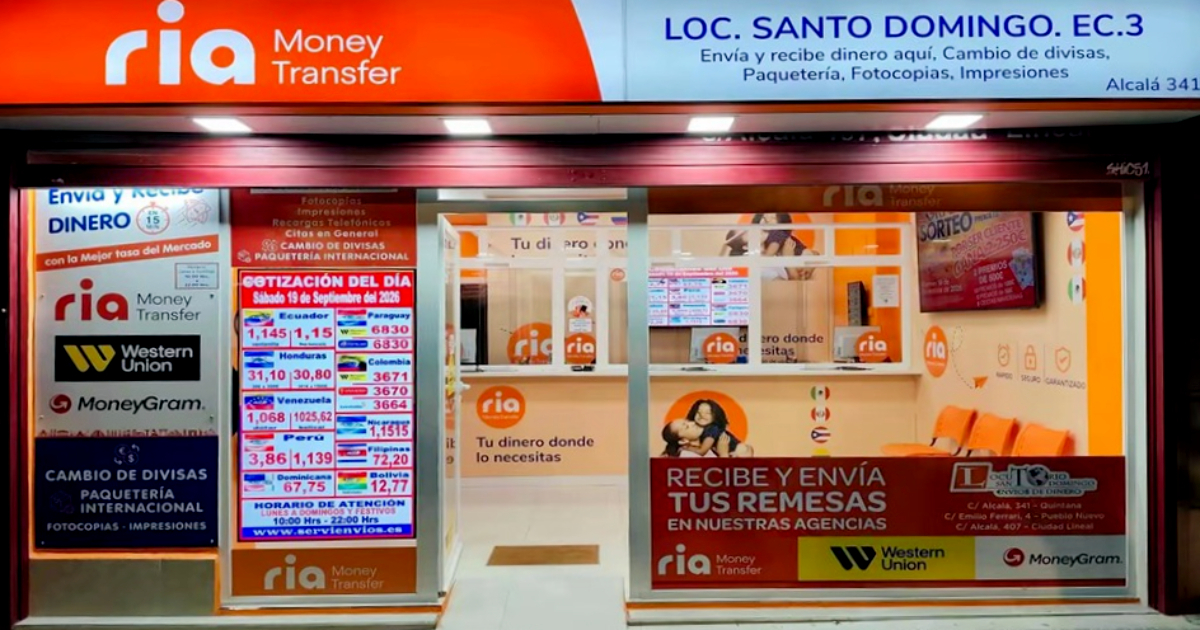
The proposal by Vox to establish a tax on remittances sent from Spain abroad has raised doubts and discussions among Cubans, particularly due to a recurring misunderstanding in the comments on the news published by CiberCuba: many believe that this tax already exists because they currently pay fees when sending money to their relatives.
However, a bank commission and a state tax are different things. And this distinction is essential for understanding what would change if the measure included in the electoral program of Santiago Abascal's party were to be implemented for the general elections on November 29.
The proposal also raises questions that Vox has yet to answer: Why tax money coming from salaries that have already been taxed in Spain? Would it apply to Spaniards who help relatives in other countries? Would a family remittance be treated the same as a transfer intended for investment or savings abroad?
What is currently paid for sending remittances?
Spain does not impose a general tax solely for sending money abroad. However, those who make an international bank transfer or use a money transfer company may have to pay various fees associated with the transaction.
According to the Bank of Spain, these costs may include fees from the sending entity, charges from intermediary banks, and differences arising from the exchange rate.
Specialized agencies also charge for their services, through explicit fees, exchange rate margins, or a combination of both. The amount depends on the destination country, the amount sent, and the procedure used.
This money compensates financial intermediaries, it does not constitute a specific tax that the Spanish government levies on the remittance.
For example, a person who sends money to their parents in Cuba may have previously paid the IRPF on their salary and then a fee for the transfer. The Vox proposal would add a tax burden, although the party has not yet defined its amount or how it would be collected.
The absence of a general tax on remittances does not exclude other tax obligations that may pertain to specific transactions, such as donations, which are subject to their own rules depending on the circumstances.
In the case of Cuba, sending money also presents particular difficulties. Not all international services operate with the island: Wise, for example, excludes Cuba from the countries to which it allows funds to be sent. The availability of intermediaries, delivery conditions, and currency conversion can increase costs or encourage the use of alternative channels.
What exactly does Vox propose?
The measure 21 of the official electoral program of Vox, titled «Tax on remittances to abroad», appears in the section dedicated to «national priority».
His justification can be summed up in one sentence: "The money generated here should improve the economy and services for those living in Spain."
The premise is based on the idea that the resources obtained in Spanish territory should primarily benefit the economy and public services of the country.
However, the document does not specify whether the tax would only affect foreigners or also Spanish citizens, including naturalized Cubans. It also does not establish percentages, minimum amounts, possible exemptions, or differences between bank transfers and remittances through agencies.
Vox also does not explain what proportion of those funds should remain in Spain nor provides an estimate of the expected revenue.
The proposal also coexists with the party's commitment to significantly reduce income tax (IRPF) and other taxes. The issue is why it is proposed to alleviate the tax burden on certain incomes and economic operations while suggesting to create a tax on money transfers abroad.
Is it reasonable to tax money that has already been taxed?
The issue is particularly important for those who send a portion of their salaries to relatives in lower-income countries.
A worker who legally resides in Spain, contributes to Social Security, and pays income tax is already contributing to the funding of Spanish public services. If they later allocate part of their income to help their parents or children in Cuba, a new tax would make that decision more costly.
It would not necessarily be a double taxation in the strict legal sense, because the income tax and the tax on a transfer would apply to different events. However, it would represent an additional tax burden on money derived from income that, in many cases, has already been taxed.
The World Bank specifically addressed this issue in an analysis published in 2017, warning that taxes on remittances can particularly harm low-income households.
It also pointed out a potentially counterproductive effect: the more expensive it is to send money through regulated channels, the greater the incentives may be to turn to informal procedures, which have less transparency and oversight.
This issue is particularly relevant in the case of Cuba, where a portion of family shipments is already circulating through alternative channels due to the difficulties with the available financial pathways.
Which countries tax remittances?
Although it is not a widespread practice in developed economies, there are examples that allow for an examination of their differences.
United States will implement a federal tax of 1% on certain international remittances starting January 1, 2026. According to the Internal Revenue Service (IRS), the tax applies to transfers funded by cash, money orders, cashier's checks, and other similar physical instruments.
It does not generally apply to electronically funded transfers from bank accounts. Therefore, there is also no universal federal tax in the United States on any money sent abroad.
Ecuador, for its part, maintains a different model. Its Foreign Currency Exit Tax (ISD) has a general rate of 5% in 2026, with exemptions and specific treatments.
According to the Internal Revenue Service of Ecuador, the tax is not limited to family remittances: it covers various transfers, payments, and money movements abroad.
The difference is significant. A general tax on capital outflows has a much broader scope than one specifically aimed at family remittances from emigrants.
There are also precedents of countries that decided to eliminate this type of burden. The World Bank notes that Vietnam abolished a 5% tax on remittances received in 1997, a decision followed by a rise in transfers through formal channels.
Why do international organizations promote lowering remittance costs?
Remittances are an important source of income for millions of households, especially in developing countries.
Although these are private transfers and not official development aid, they can and do help finance food, housing, education, and healthcare for the recipient families.
For this reason, the United Nations included in the Sustainable Development Goals the target of reducing the cost of remittances to below 3% by 2030 and eliminating international corridors where it exceeds 5%.
The goal is for a larger proportion of the money sent to actually reach its recipients.
The World Bank has also warned that taxing these operations could be regressive: lower-income families may end up bearing a disproportionately larger burden, while the additional costs reduce the value of the aid received.
The international trend to reduce remittance costs does not prevent states from imposing taxes, but it does provide an economic criterion to evaluate their consequences.
What if the money leaves Spain to invest or save?
This is one of the main uncertainties of the Vox program.
Currently, a person can transfer their own funds from a Spanish account to another account in their name abroad without the mere movement triggering a general transfer tax.
Another matter concerns the obligations for tax reporting, the taxation of income earned, or the taxes that may be applicable to transactions such as purchases, capital gains, or donations.
Moreover, Article 63 of the Treaty on the Functioning of the European Union protects the free movement of capital and payments, both among Member States and, with certain exceptions, concerning third countries.
This includes operations related to bank accounts, investments, and acquisitions of assets abroad.
The Vox program does not clarify whether its tax would be limited to family remittances or if it would also cover other international money transfers.
The distinction raises a fundamental economic question: why should the worker sending money to their parents in Cuba bear a specific tax, while someone transferring their savings abroad to acquire financial assets might receive different treatment?
For now, it cannot be said that Vox intends to establish that difference, because their proposal lacks the necessary development to determine this. It is also not possible to definitively assess its compatibility with European law without knowing how the tax would be structured.
Less than two weeks before the general elections on November 29, the party maintains a fiscal measure whose formulation does not clarify who would pay, how much, or for what operations.
For Cubans in Spain who provide financial support to their families, the difference between a commission and a tax is already clear. What remains uncertain is how much additional money they would have to pay and whether the levy would also affect Spanish citizens who send part of their income abroad.
Related videos:
Filed under: