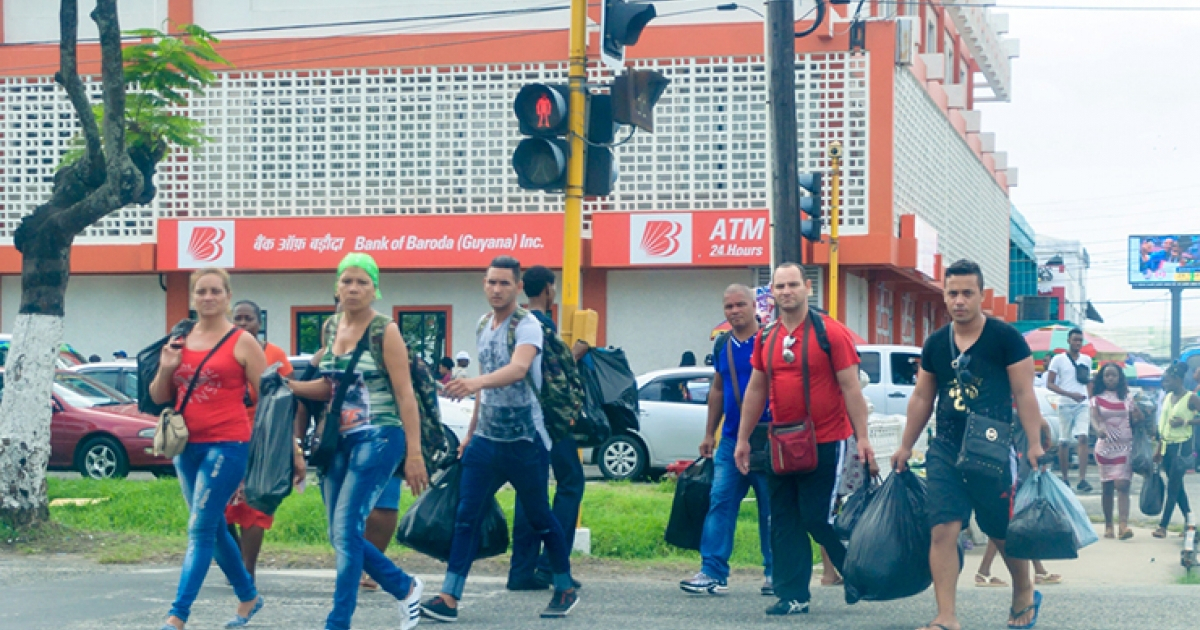
Cuban immigrants have re-emerged in the political debate of Guyana, after opposition parliamentarian Terrence Campbell questioned the immigration policy of President Mohamed Irfaan Ali's government and highlighted the differences in how citizens from Cuba, Venezuela, and Haiti enter the country.
According to the Guyanese outlet Guyana Standard, Campbell, a member of the opposition coalition A Partnership for National Unity, accused the Government of not keeping its immigration and labor policies up to date, which, in his opinion, has left the country vulnerable to the entry of foreign criminal organizations.
During his statements, the legislator maintained that Venezuelan citizens were entering Guyanese territory without documentation, while Cubans were arriving through documented channels.
He also criticized the restrictions imposed on Haitians, despite the fact that Haiti is a member of the Caribbean Community (CARICOM).
Campbell questioned what he considers unequal treatment among different immigrant groups and accused the government of applying discriminatory criteria against Haitians.
Criticism arose after Ali delivered a speech on national security on November 12, in which he warned about intelligence information related to possible movements of members of the Venezuelan criminal organization Tren de Aragua and alleged plans to attack individuals and strategic facilities in the country.
The president also mentioned an attack with incendiary devices against a substation of the electric company Guyana Power and Light, which occurred on November 10.
According to reported by News Room Guyana, the authorities were investigating whether this incident was part of a broader conspiracy. No public connection had been established between the attack and the Tren de Aragua.
Campbell responded that the government could not warn about foreign criminal organizations without assuming responsibility for the shortcomings that, in his view, exist in border surveillance and the regulation of immigrant employment.
The controversy arises when Guyana tries to adjust its immigration regulations to meet the needs of a rapidly expanding economy, driven mainly by the oil industry and large infrastructure projects.
In September, Ali announced that his Government was preparing a new migration policy to address the growing demand for foreign workers.
The president stated that the country needed a more flexible and modern framework, estimating that by 2030 around three million people could be moving through its economy for work, business, and tourism reasons.
Cubans are part of that migratory movement. In August, the Guyanese president himself sent a message to those who wished to work in the country: they were to enter through legal channels and adhere to the same conditions and labor regulations applicable to local workers.
Data cited then by Bloomberg indicated that around 135,000 Cubans obtained legal status in Guyana during 2025, compared to just over 800 in 2020, demonstrating the growth of the presence of citizens from the island in that South American country.
The immigration debate also affects Cubans relocated from the United States. In September, four Cuban citizens arrived in Guyana along with two Afghans, as part of a bilateral agreement to receive specific deportees from third countries.
Campbell himself then questioned that mechanism and called for greater transparency regarding the identities of the individuals transferred and the terms of the agreement.
Her criticisms referred to that specific deportation program, different from the immigration of Cubans who arrive directly in Guyana.
Beyond the political discussion, Cubans also face security issues and risks of exploitation in the country.
At the beginning of November, Guyanese authorities protected 14 Cuban women during an operation for possible human trafficking in the mining town of Bartica. A Cuban citizen was arrested while the circumstances of the case were being investigated.
Related videos:
Filed under: