A total of 614 Cuban doctors have registered to take the MIR 2027 exam in Spain, one of the main pathways to access specialized medical training in that country.
The figure places Cuba in sixth position among Latin American countries with the highest number of applicants, in a call that has reached a historic record of participation, according to data released by Redacción Médica and broken down by Matías Ibáñez, international director of the CTO Group.
The most revealing data about the Cuban contingent is the chosen access route: 544 out of 614 registered candidates are competing through the general route, on equal terms with Spanish and EU applicants, while only 70 are competing for the 10% quota reserved for non-EU doctors without residency in Spain.
This proportion — 88.5% via the general route — makes Cuba one of the few Latin American countries with this profile, alongside Venezuela (579 compared to 338) and the Dominican Republic (149 compared to 92).
The fact that almost nine out of ten registered Cuban doctors compete without quota restrictions indicates that the majority already possesses Spanish nationality or residency permits, reflecting a well-established Cuban medical emigration that has deep roots in Spain.
The overall context of the MIR 2027 is equally unprecedented. For the first time in the history of the exam, foreign doctors surpass Spanish applicants in the number of applications: 12,569 compared to 11,573, out of a total of 24,142 registered —a 37.7% increase over the previous edition—. The provisional admissions reach 21,668, also a historical record.
Latino Americans account for 89% of the registered foreigners, with 11,199 applications. Colombia leads the list with 3,265 applicants, followed by Ecuador (2,597), Peru (1,057), Venezuela (917), and Bolivia (832). After Cuba, Mexico (563) and the Dominican Republic (241) are ranked.
The trigger for this growth is the largest university degree validation plan promoted by the Spanish government: the Ministry of Science, Innovation and Universities validated more than 30,000 non-EU medical degrees in 2025, the highest volume in recent years. In the first half of that year alone, 5,551 Cuban citizens homologated or validated their university degrees in Spain.
This exodus of Cuban medical professionals has a dramatic backdrop. The island's healthcare system concluded 2025 with 71,635 doctors, 3,729 fewer than in 2024 and over 34,000 fewer than in 2021, when the number reached 106,131. The rate fell from 96.2 to 74.7 doctors for every 10,000 inhabitants during that period.
The Minister of Public Health, José Ángel Portal Miranda, acknowledged before the National Assembly in July 2025 a "unprecedented structural crisis" and declared to The Associated Press in February 2026 that the system was “on the brink of collapse”. In April 2026, there was a shortage of 461 out of 651 medications on the national essential drug list—a deficit exceeding 70%—and over 90,000 people were awaiting surgical interventions.
Salaries are another determining expulsive factor. Resolution 17/2026, in effect since last July, established the base salary for non-specialized Cuban doctors at 7,045 Cuban pesos per month, equivalent to less than 16 dollars at the unofficial exchange rate, while a basic basket for two people in Havana exceeds 41,000 CUP. The government itself admitted that this remuneration is insufficient to cover basic needs.
The official Cuban press echoed the situation this Monday: the Girón newspaper from Matanzas published an article titled "Silent Leaks..." that describes doctors leaving their posts to work as electric tricycle drivers or in private businesses, and acknowledges that state compensation remains at a "symbolic" level.
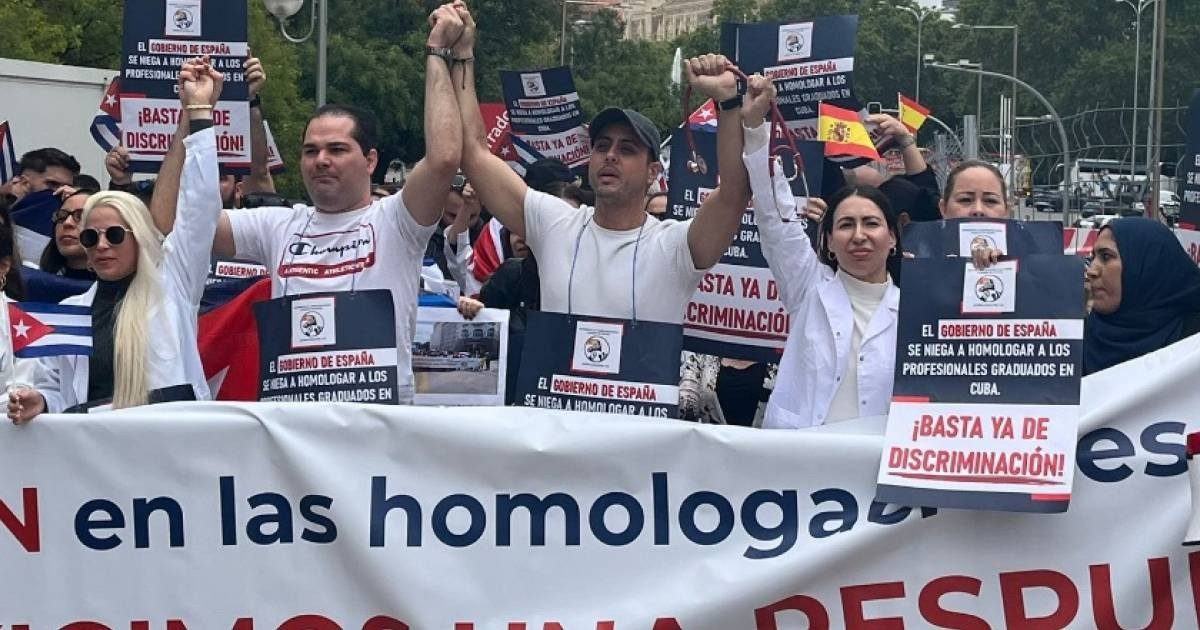
Meanwhile, the community of Cuban doctors in Spain is organizing. The Association of Cuban Doctors in Spain (AMCUBE) and the Spanish Society of General and Family Doctors (SEMG) sealed a collaboration agreement at the beginning of November to promote the training and integration of these professionals.
The I Congress of Cuban Doctors in Spain is scheduled for November 28 in Madrid, at the headquarters of the CTO Group.
Related videos:
Filed under: