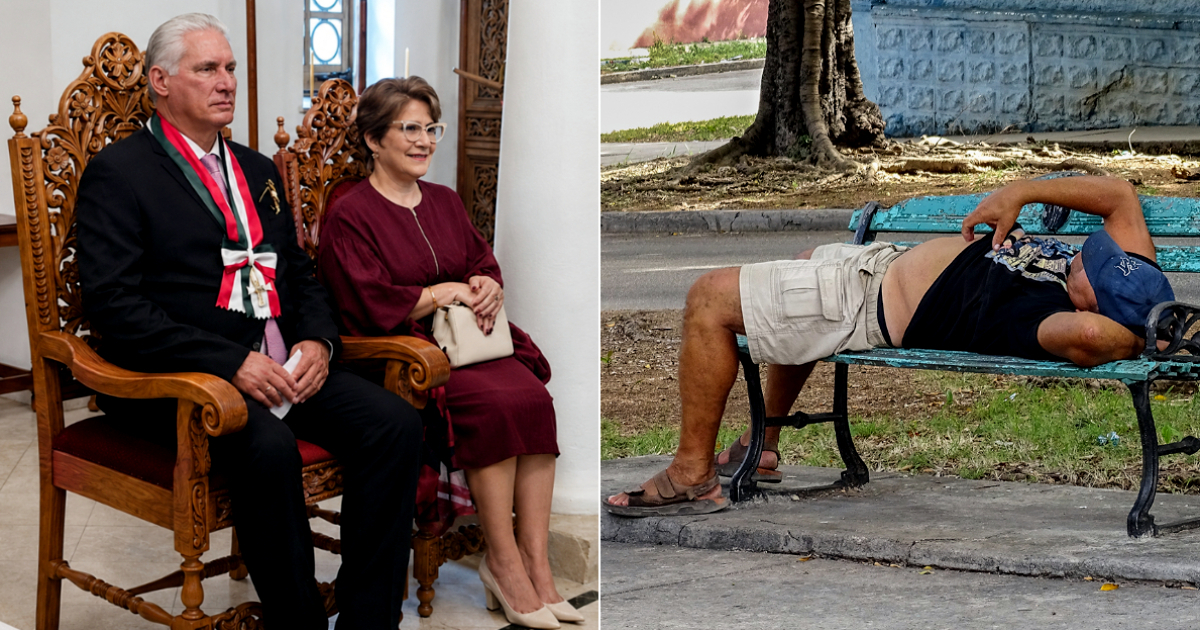
On the 507th anniversary of Havana, Miguel Díaz-Canel took advantage of the celebration to rebuke its residents for their "negligence" and "social indiscipline", in a city plagued by endless blackouts, water shortages, mountains of garbage, and housing deterioration that daily threatens the lives of its residents.
"La Habana celebrates its birthday and reminds us of everything we owe to its residents, as much as possible and even the impossible, to free it from the painful impacts of the blockade, but also from neglect and social indiscipline. The Capital of all Cubans deserves it," wrote the ruler on his X account this Monday.
The message once again combines two common explanations from the official discourse: the U.S. embargo, which the regime refers to as a "blockade," and the behavior of the population. However, the issues that have led Havana to its current state of decline far exceed the individual responsibility of its residents and affect public services that are the responsibility of the State.
This is not the first time that Díaz-Canel has turned to citizens' complaints to explain the dirtiness of the capital. In October 2025, during a follow-up meeting for a sanitation campaign, he criticized neighborhoods where residents had not participated in garbage collection. “There are neighborhoods where no one came out,” he lamented, mentioning areas in Diez de Octubre, Playa, and La Lisa.
The ruler thus demanded popular participation in a task that the Community Services system was supposed to regularly ensure. His own government then acknowledged that it did not have a sustainable solution and that extraordinary mobilizations were not enough to keep the city clean.
Months earlier, in August 2025, the provincial director of Community Services, Mariano Suárez del Villar Farrés, had blamed the population for the disappearance of containers, claiming that some citizens were using them to make containers and even "clothesline sticks." In the same explanation, he acknowledged that the city needed many more bins than the state industry could produce.
The narrative continued in August 2026, when a leader of the Rampa Popular Council described social indiscipline as "a cancer that is slowly consuming us". He made this statement while acknowledging that a project for waste collection using electric tricycles had not managed to operate as expected, partly due to difficulties in charging the vehicles.
Incivility exists and can exacerbate urban hygiene issues. However, it does not explain why a city of over two million inhabitants lacks a stable waste collection system, sufficient fuel for its trucks, and resources to maintain its streets and public spaces.
A city where basic services have become an emergency
Havana reaches its anniversary amidst a energy crisis that has been worsening for years, turning blackouts into a daily torment. The capital, long relatively shielded from the outages that affected the rest of the country, now suffers from increasingly prolonged interruptions, with neighborhoods going entire days without electricity.
The lack of electricity hinders food preservation, complicates cooking and resting, paralyzes economic activities, and worsens other essential services. Last Saturday, residents of Calabazar and Las Cañas, in Boyeros, took to the streets to protest after more than a week without electrical supply. During those demonstrations, the Las Cañas bridge was set on fire, according to the reports circulated.
The water crisis adds another dimension to the suffering of Havana residents. Aguas de La Habana has acknowledged that approximately 87% of its hydraulic system relies on electricity. At the beginning of November, over 536,000 residents were experiencing interruptions in their supply, while in certain neighborhoods families had been going weeks or even months without running water.
Last Friday, a new electrical failure at the Cuenca Sur supply source worsened the situation in several municipalities, highlighting how the deterioration of one service adversely impacts the functioning of others.
The garbage collection provides another example of the collapse. By early 2026, only 44 of the 106 collection trucks in Havana were operational, barely 41.5% of the fleet, due to a lack of fuel and mechanical breakdowns. Meanwhile, the city generates between 24,000 and 30,000 cubic meters of waste per day, a quantity that far exceeds the available collection capacity.
The result is makeshift dumps that remain on the streets for weeks, with an increase in rodents, mosquitoes, unpleasant odors, and health risks. Waste accumulates even near hospitals and schools, while extraordinary cleaning operations provide only temporary relief.
This situation is exacerbated by the deterioration of architectural and residential heritage. According to official figures cited in various reports, in Havana around 1,000 building collapses occur each year. By the end of 2025, more than 185,000 properties were in disrepair, and the rains in September 2026 caused 26 total collapses and 122 partial ones.
The contrast also extends to investment priorities. While thousands of families survive in housing at risk of collapse, the military conglomerate GAESA has allocated substantial resources to tourist facilities, including the Iberostar Selection La Habana hotel, located in the K Tower, popularly known as "López-Calleja", in the heart of Vedado.
Hotel investment has continued to be questioned amid low tourism occupancy and the deterioration of basic services.
From the recognition of negligence to citizen reproach
This Monday's reprimand also contrasts with the statements made by Díaz-Canel on November 4, during the radio program Criterio Compartido, when he acknowledged that the embargo did not justify the negligence or indifference of the officials tasked with serving the population.
Where there is negligence, where there is indifference, where there is a public official who does not attend to the population, there is no blockade that counts, he stated at that time, referring precisely to the water supply crisis.
However, that admission was not accompanied by a questioning of the decisions made by the leadership of the Communist Party and the government it heads, which are responsible for organizing, funding, and overseeing public services.
The shifting of responsibilities has also been evident in response to the protests. Last July, when asked about the demonstrations against the blackouts, Díaz-Canel stated that Cubans should bang their pots and pans at their "neighbors to the north", referring to the United States, instead of directing their grievances towards national authorities.
Even years before, in October 2022, the then head of Communication for Díaz-Canel, Leticia Martínez Hernández, criticized the people of Havana who were protesting against power outages and other shortages, describing the capital as a city that “has everything and wants more.”
The anniversary message recaptures that tone of demand towards those who suffer the consequences of the crisis.
Dr. Miguel Díaz-Canel urges the people of Havana to make efforts "even beyond the possible" to save their city, but in his message of congratulations, he fails to address the political decisions, resources, and institutional responsibilities that have contributed to its deterioration over the decades.
Related videos:
Filed under: