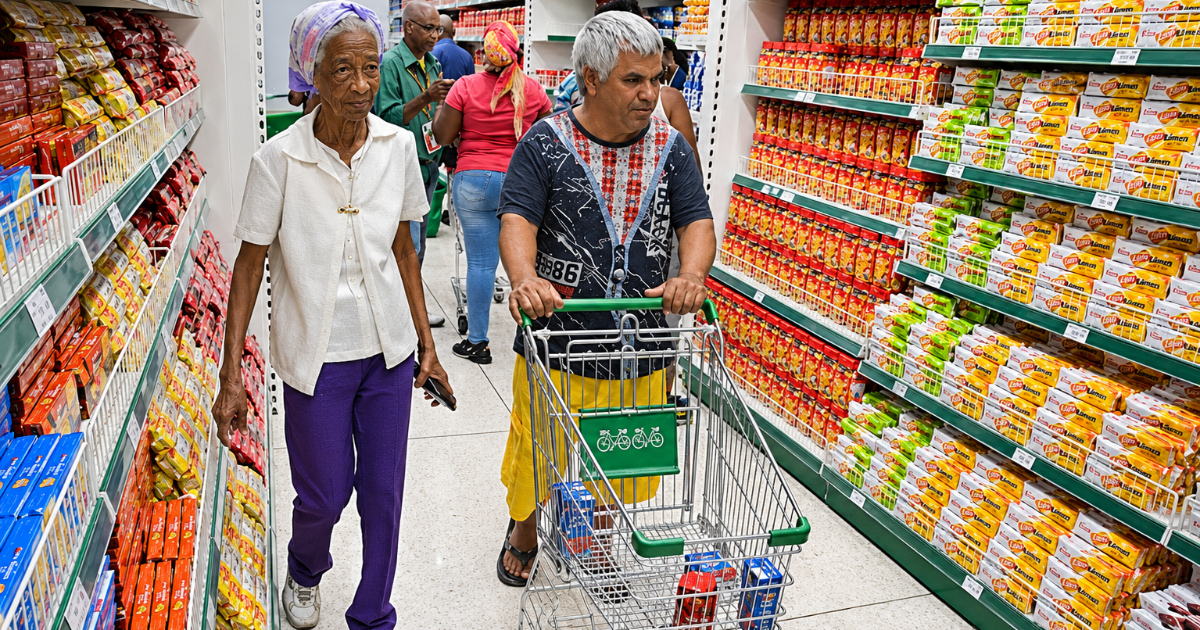
Receiving dollars from abroad no longer guarantees being able to eat and cover the most basic needs in Cuba.
38% of Cubans who receive money from family or friends living abroad claim that their income is not enough to cover even food or the most basic expenses, according to a national survey published this Wednesday by the International Republican Institute (IRI).
The figure reflects the extent to which purchasing power has deteriorated on the island, where remittances have been an important economic support for many families for decades.
The study, conducted within Cuba between July and September 2026, reveals that the situation is even more severe among those who do not receive money from abroad: 48% report that they cannot meet their basic needs, ten percentage points higher than among remittance recipients.
The difference confirms that foreign aid remains an important economic resource, but it also highlights its limitations in the face of rising costs of food, services, and other essential products.
In fact, 55% of those receiving money from abroad rate their household's economic situation as "very bad", a proportion that is even higher than the 51% recorded among those without that assistance. Although the questions measure different aspects, the results indicate that having remittances does not necessarily translate to a favorable perception of living conditions.
Food accounts for a significant part of the economic difficulties. According to the survey, 65% of participants identify food as the monthly expense that is hardest to cover. In the eastern provinces, this proportion rises to 73%, compared to 49% in Havana.
The magnitude of the problem is better understood when contrasting this data with the prices that families face on a daily basis.
In early November, CiberCuba documented the case of a food purchase in Baracoa that cost over 8,000 Cuban pesos and barely allowed for the acquisition of rice, beans, root vegetables, and some seasonings, with no meat or other animal protein foods included. The expense exceeded the average monthly state salary recorded in August, which was 7,354 pesos.
Even amounts that just a few years ago represented significant help have lost their purchasing power. In August, a Cuban doctor demonstrated how she spent 36,000 pesos of the 65,000 she received by exchanging 100 dollars on a grocery purchase that, as she explained, would not last her the whole month.
The IRI survey also reveals the extent of transnational family networks: 61% of participants have family or friends living outside of Cuba, and among those, the United States is the most frequently mentioned destination, with 76%.
However, the dependence on remittances introduces an additional inequality among households, determined not only by the income that can be generated within the country, but also by the existence of relatives abroad and their economic capacity to send assistance.
The economist Pedro Monreal has recently questioned the inadequacy of the Cuban social assistance system. In an analysis featured by CiberCuba, he pointed out the limitations of state subsidies to protect vulnerable sectors, in a scenario where remittances and humanitarian aid play a crucial role.
Food insecurity is also evident in other research. The IX Report on the State of Social Rights in Cuba, published in August by the Cuban Observatory of Human Rights, found that eight out of ten respondents had to skip a meal at some point in the previous six months due to a lack of money or food.
The results of the IRI add a particularly revealing dimension to this picture: the economic crisis is not only impacting those who rely on salaries and pensions in Cuban pesos but also a significant portion of households that receive resources from abroad.
The survey was conducted by NORC at the University of Chicago through in-person interviews with 1,199 adults residing in Cuba. It used a nationally representative probability sample and reports a maximum margin of error of ±4.2 percentage points for the mid-range estimates of the total sample, with a confidence level of 95%.
Related videos:
Filed under: