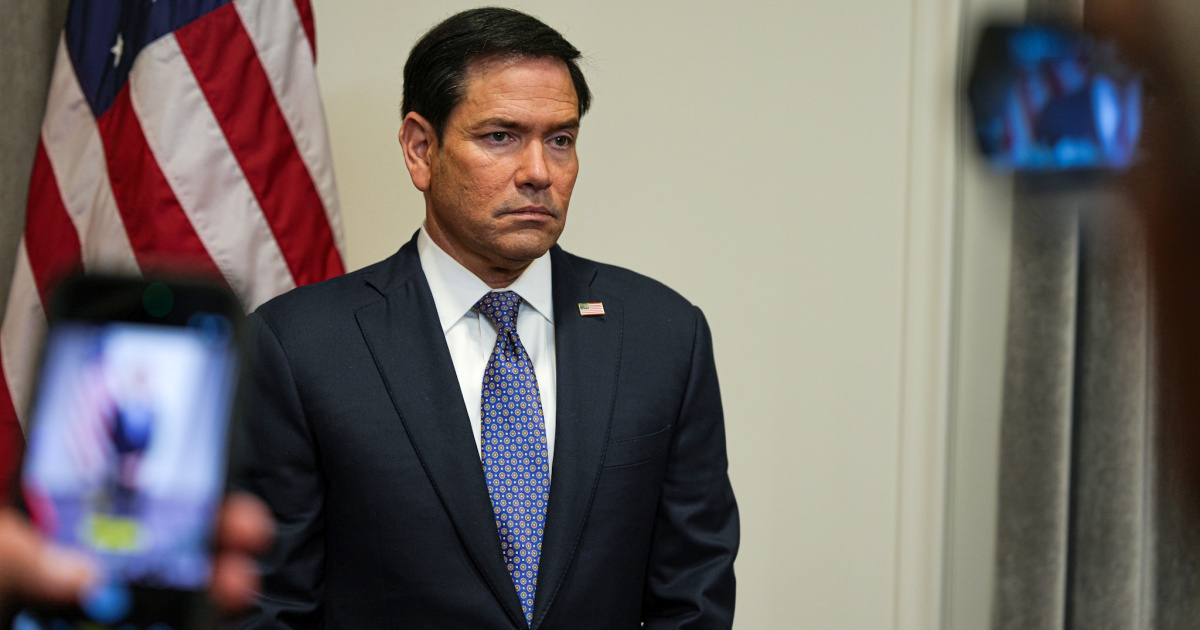
The U.S. Secretary of State, Marco Rubio, stated that the United States is not experiencing a massive cyberattack and that authorities have no evidence that the chain of technological failures recorded in recent days is due to a coordinated operation by malicious actors.
During a press conference in Manila, Philippines, Rubio addressed the suspicions that arose following the disruptions that affected Microsoft, the U.S. air traffic control system, banking services, and communications networks of national security agencies.
His message was clear: “We are not experiencing a systemic attack.”
Rubio explains why he rules out a coordinated cyberattack
The head of U.S. diplomacy stated that security services and the authorities responsible for the affected infrastructures have not found any elements linking the various incidents.
“We have zero evidence, no indications, no proof, and no reason to believe that these incidents are related to one another,” he stated.
Rubio also dismissed the possibility that, with the available information, there are indications of interference from foreign governments, groups of cybercriminals, or other actors that could be attempting to sabotage the country's technological systems.
"We have no evidence or reason to believe that any of these isolated or individual instances are connected to malicious actors, cybercriminals, another nation-state, any kind of malicious entity, or a disgruntled former employee," he stated.
Although he insisted that the incidents do not appear to be connected, the Secretary of State assured that authorities are maintaining constant vigilance against potential cyber threats.
“We are always hyper-vigilant about this, and we are always attentive to it. But we do not see indications that these things are interconnected, from one event to another, or that they are the work of malicious actors,” he emphasized.
Why are there so many technological interruptions?
Rubio provided an explanation regarding the apparent accumulation of technical failures and noted that some interruptions may occur during the maintenance and protection tasks of the systems themselves.
According to the explanation, when specialists detect vulnerabilities and implement updates to fix them, the interventions can cause temporary functionality issues.
“When you are going to fix your system because you have identified a vulnerability, it creates a short-term disruption in the operation of your system,” he pointed out.
The Secretary of State added that technology companies have changed the way they communicate these issues.
Currently, he explained, there is a greater tendency to quickly report vulnerabilities and disruptions rather than keeping them under wraps.
“We have entered a different era, in which companies share vulnerabilities immediately because they do not want to be accused of covering something up,” he stated.
In Rubio's view, this greater transparency allows for quick awareness of incidents that might have gone unnoticed by much of the public in the past, but it can also heighten the perception that a widespread technological crisis is occurring.
The statements were made during the Asian tour of President Donald Trump, which includes a visit to Shenzhen, China, for the Asia-Pacific Economic Cooperation (APEC) forum.
When asked about the image the United States projected while visiting one of the most technologically advanced cities in the world while facing these issues, Rubio responded that no developed economy is free from cyber risks.
“There is no advanced economy in the world that does not face some challenges in cybersecurity,” he stated.
The technological incidents that affected the United States over the past week
Rubio's statements came after several outages that, between November 12 and 17, affected digital services, banking operations, airlines, and communications systems of the U.S. government.
One of the first episodes was an outage of Microsoft 365 that began on Thursday, November 12, and affected users of Outlook, Teams, Copilot, and other company services.
The problems spread to dozens of countries and continued for much of Friday the 13th.
Numerous users reported difficulties accessing email, using collaboration tools, and working with business applications.
That same Friday, the United States experienced one of the most significant incidents of the week when the Federal Aviation Administration (FAA) ordered the temporary suspension of all departures within the national territory due to a technical issue in its telecommunications network.
The FAA's ruling and the thousands of flight cancellations
The suspension of air operations lasted approximately four hours and 45 minutes as technicians worked to identify the source of the disruption and restore communications.
According to the FAA explained later, the older equipment in its network began to experience instability due to an excessive volume of connections, which affected communications with aircraft and the transmission of radar information.
That Friday, there were 12,462 flight cancellations in the United States, although the agency itself clarified that not all of them were a direct result of the national grounding of flights.
The incident brought to the forefront the deficiencies of an aviation infrastructure that partially relies on outdated equipment and technological systems.
Banking issues and delays at United Airlines
On Monday, November 16, there were new interruptions, this time related to banking services and air operations.
A software error in the internal systems of JPMorgan Chase caused delays in certain operations and transfers. The issues also affected transactions of customers from other financial institutions when they involved Chase.
Although reports were received from users of Bank of America, Wells Fargo, and other banks, JPMorgan stated that the incident did not constitute a widespread failure of the financial system.
The Zelle payment network also clarified that it remained operational, although some transfers might experience delays due to issues with participating entities.
That same Monday, United Airlines reported a widespread computer failure in its internal systems, resulting in delays for hundreds of flights.
The airline worked to restore its operations while the issues caused delays and disruptions in flight schedules.
An interruption in the NSA's classified network
On Tuesday, November 17, the National Security Agency of the United States (NSA) also reported an interruption in its internal classified communications network.
The issue was related to maintenance work and software updates, and it temporarily affected the operation of certain communication services.
The agency assured that its essential capabilities to protect national security remained operational during the incident.
Related videos:
Filed under: