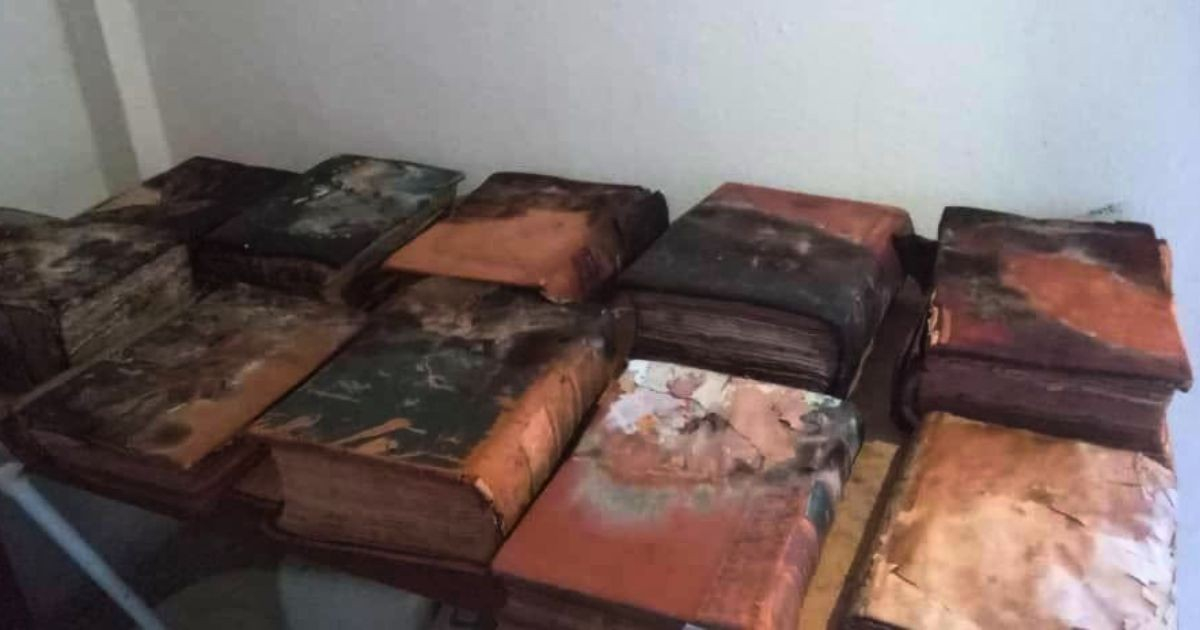
Documentary archives destroyed by humidity, disintegrated bindings, mold and fungi covering irreplaceable historical records: this is the image that historian and researcher Rolando Núñez Pichardo publicly denounced on Thursday regarding the current state of the Provincial Historical Archive of Santiago de Cuba, in a Facebook post titled "Chronicles of a Forewarned Death."
Núñez Pichardo, a research assistant at the Antonio Maceo Grajales Study Center, described the situation as "quite painful and regrettable, due to various structural factors and a lack of empathy for the defense of heritage not only in the region but also in the country."
According to the researcher, the current location of the archive "has never been suitable," and part of the collection still remains in the old Vivac, a building that was the historical headquarters of the institution until the authorities repurposed it for other uses.
The photographs accompanying the complaint show large-format volumes—possibly notarial, parish, or colonial records—with disintegrated bindings, dark moisture stains, and surfaces covered in mold. In one of the images, an institutional folder can be seen with the inscription "Republic of Cuba / Regional Historical Archive / Santiago de Cuba."
Núñez Pichardo was unequivocal in assigning responsibilities: "The alerts raised by various members and associations of civil society have never been heard, and government authorities have supported other projects to the detriment of safeguarding the nation’s heritage." He warned that the result is that "we have lost part of the memory of the Nation."
The most striking comment among the dozens generated by the post was from Eliades Acosta Matos, former director of the José Martí National Library and former head of the Culture Department of the Central Committee of the PCC. The historian, who was born in Santiago de Cuba, described the incident as "a slap to Cuban culture."
Acosta Matos demanded "extraordinary measures, immediately," an investigation and punishment for those who "could have decided and acted" but did not, clearly stating that he was not referring to the archive workers. He also called for "a public report on the causes and consequences of the disaster, the solutions as well as those responsible and the measures taken with them."
Another voice in the thread identified Milagros Salazar, the director of the institution, as someone who fought to prevent the disaster: “I am a witness to the sense of belonging and struggle of the director of the Provincial Historical Archive of Santiago de Cuba, Milagros Salazar, along with her staff, to ensure that this did not happen. [...] Today it hurts. I only ask that what has remained be saved in the best possible way,” wrote a netizen who presented herself as a direct witness.
Several commentators agreed that relocating the archive from the Vivac was a mistake with irreversible consequences, and one of them cautioned about the geographical risk posed by the proximity to the Yarayo River. Another warned that the Provincial Library "Elvira Cape" could face a similar fate if action is not taken in time, especially regarding its renowned Rare and Valuable Funds room.
The case fits into a pattern of heritage deterioration affecting all of Cuba. The Palacio de Aldama in Havana, home to the Institute of Cuban History with over 60,000 volumes, was at risk of collapse in 2026 after 92 cedar beams from its roof were stolen. The Civil Registry Archive of Las Tunas was closed due to unsanitary conditions in March 2025.
In Santiago de Cuba itself, the Cine Capitolio was dismantled in October 2026, and the benches in Plaza de Marte were destroyed as firewood during the outages of more than 20 hours a day recorded in August.
The climatic conditions of Santiago de Cuba exacerbate the problem: the city has a high average relative humidity, and a scientific study published in 2022 in the journal Journal of Atmospheric Science Research had already identified the presence of potentially harmful fungi in the air of the Provincial Historical Archive of Santiago de Cuba.
"A country without historical memory is prone to disappear," Núñez Pichardo warned as he concluded his statement, calling not only for accountability but also for "viable and immediate solutions, concrete and long-term," that would allow for the preservation of what remains.
Related videos:
Filed under: