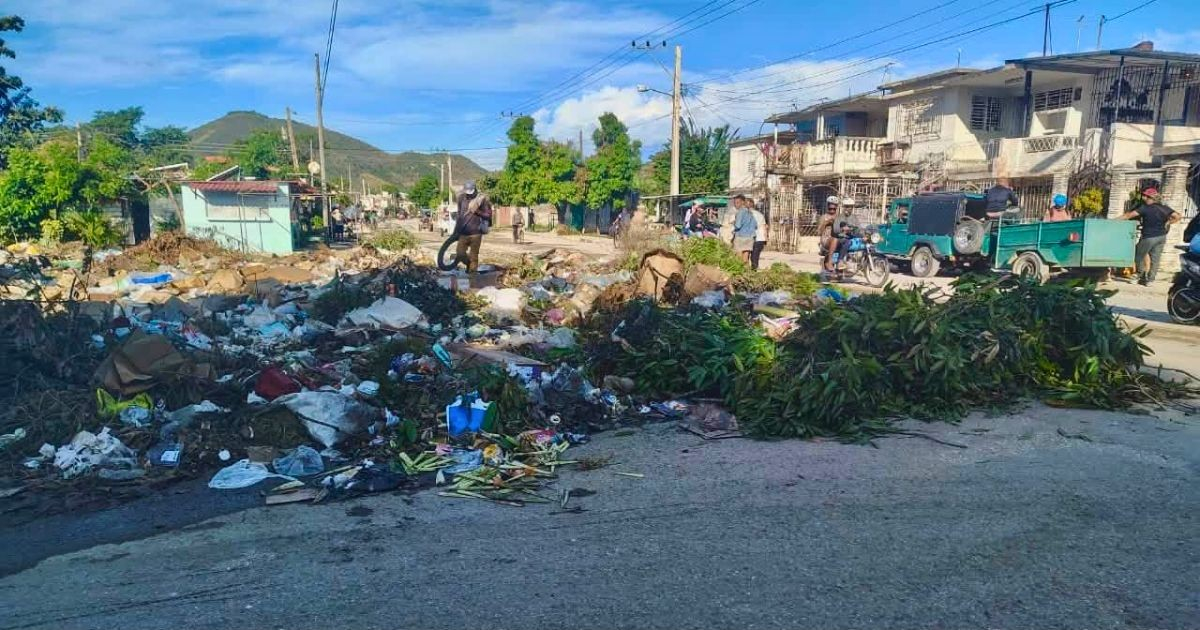
The state broadcaster Radio Holguín la Nueva published a photo report on its Facebook page titled “Holguín Amid Garbage and Sewage: A Reality That Cannot Be Normalized,” documenting with images the sanitary collapse of a city that for decades was popularly recognized as the cleanest in Cuba.
The publication, unusual for its frankness for an official media outlet, describes straightforwardly what residents have been reporting for months: "Uncontrolled trash piles, accumulated waste in public spaces, and sewage running through the streets are part of a problem that affects the image of the city, but above all, the health and quality of life of its inhabitants."
The state media did not just acknowledge the problem but also posed direct questions to the institutions: "What is being done to address these issues? Who is monitoring the sewage outflows? When will responses reach the affected communities?" It was explicit in pointing out responsibilities: "Ensuring waste collection and the proper functioning of the sewage system is also an obligation of the relevant institutions."
The public reaction in the comments was massive and indignant. One resident described a specific situation without a solution: "On Cervantes Street between Agramonte and Garayalde, there is a sewage overflow that, since the drain is also blocked, runs toward Agramonte Street, making the stench unbearable. It has been reported, and they haven't fixed it."
Another neighbor claimed to have gone "more than a month" without garbage collection in front of her home, adjacent to a landfill. From the Ibero-American neighborhood, a resident pointed out that they are "surrounded by garbage both on Nicio García Avenue and on Sol Street," unable to navigate. Residents of the buildings near the brewery added that in their community, "they haven't collected it in over a year."
Several commentators linked the health deterioration to the chronic blackouts that plague the island: "The countless hours without power have become normal; you tell me, isn't it to be expected that the garbage will spread everywhere?" Another internet user summed up the collective sentiment: "Unfortunately, we have gone from being the cleanest city in the country to, like many, existing in spaces marked by filth […] where parks once stood, only their ruins remain, dominated by trash […] more floods, more danger, more unsanitary conditions."
The deterioration is not sudden. The garbage dumps were practically on fire every night in residential neighborhoods in April, with plastics and expired medication containers burning. In June, the Marañón, Jigüe, Miradero, and Milagrito rivers accumulated bottles and debris that blocked bridges and worsened flooding. In September, improvised landfills appeared next to a primary school and a children's circle in the Lenin neighborhood. The Community Services Company has attributed the collapse to a lack of trucks, fuel, spare parts, and workers.
The problem overwhelms Holguín: in Havana, only 44 out of 106 garbage trucks were operational at the beginning of 2026, and in Camagüey, residents reported two months without collection. The consequences are direct: the Ministry of Public Health admitted in September to a simultaneous increase in dengue, diarrhea, hepatitis A, and respiratory infections linked to sanitation deficiencies.
The Global Dengue Observatory estimated that Cuba had accumulated 11,235 cases of dengue by October 4, 2026, a figure equivalent to 9.2 times the expected level based on historical records from the previous five years. The calculation combined available data and statistical estimates due to the lack of updated official reports from Cuban health authorities.
Radio Holguín la Nueva concluded its publication with a warning difficult to imagine in an official medium just a few years ago: "Holguín cannot get used to coexisting with what deteriorates its streets and affects the health of its people. The city needs solutions, not for its problems to become part of the scenery."
Related videos:
Filed under: