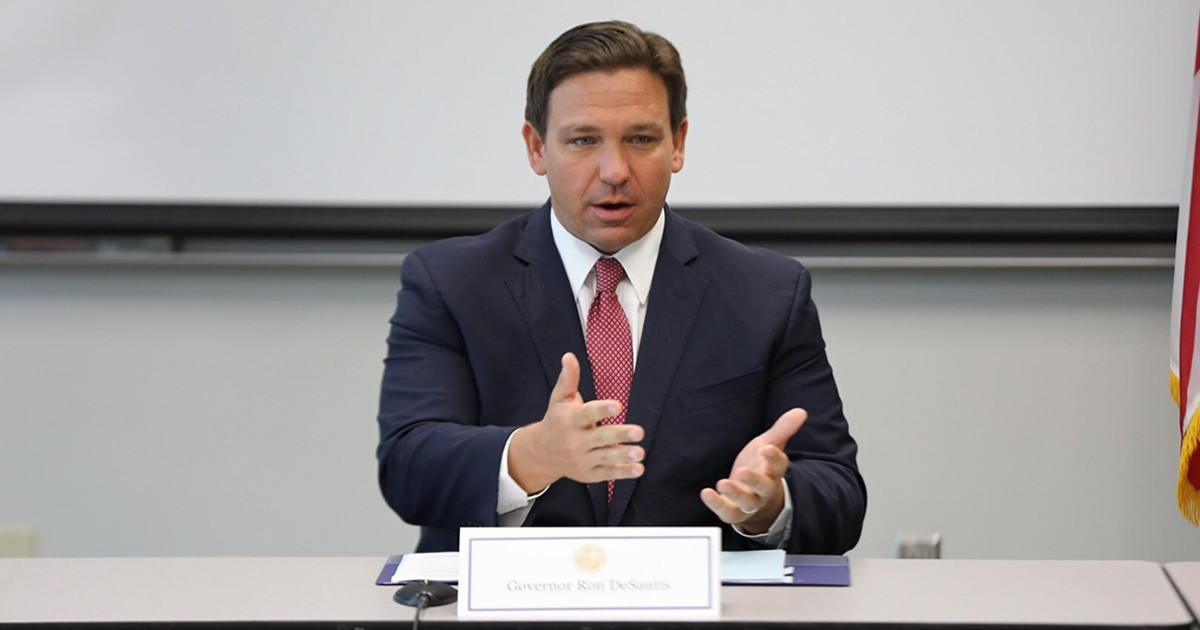
The governor of Florida Ron DeSantis proposed a "taxpayer bill of rights" to prevent cities and counties from offsetting the revenue loss resulting from Amendment 3 through new fees, charges, or local taxes.
The initiative emerged following warnings from the state financial director, Blaise Ingoglia, who cautioned that local governments could resort to "alternative means" — sales tax increases, new service fees, or special taxing districts — to recover the revenue they will lose when the amendment takes effect on January 1, 2027.
"No tax increases will occur if the Legislature stops them. Approve a taxpayer bill of rights, limit local spending, and protect against new taxes and local charges," DeSantis wrote on X.
The governor indicated that he will work with the Legislature before leaving office in January to approve that protection, although he clarified that he will likely allow the legislators themselves to choose the dates for a possible special session: "After all, at this moment I am in a position of outgoing functions."
What changes with Amendment 3 and from when?
The measure, approved on November 3 with nearly 62% of the votes, expands the property tax exemption on the primary residence (homestead) for non-school taxes in three phases: in 2027 it will cover the first $150,000 of assessed value; in 2028 it will increase to $250,000; and from 2029 that amount will be adjusted annually based on inflation.
The current system only exempts the first $25,000 from all taxes, and the next $25,000 to $50,000 from non-school taxes, making the jump quite significant.
The receipts for the fiscal year 2026, however, will not be affected: the amendment does not change any assessments that have already been calculated.
The key requirement for Cubans who recently purchased a home
To qualify for the expanded exemption from the first year, the owner must have established permanent residency in Florida and have an active homestead prior to January 1, 2027.
This is particularly relevant for Cubans who recently arrived in Miami-Dade, Hialeah, Doral, Kendall, or Broward and adjusted as permanent residents in 2025 or 2026: those who manage to register their homestead in time will be able to benefit starting in 2027; the rest will have to wait until their fifth year of residency with a homestead to access the larger exemption.
The application must be submitted to the county property appraiser by March 1, 2027, at the latest. Some counties, such as Broward, allow late submissions until September of that year.
The risk for your wallet: municipal fees instead of taxes
The central concern of DeSantis is that municipalities, facing severe budget deficits, may shift the burden to residents through other means. Hialeah, for example, projects a loss of up to $17 million in the first year and $28 million in the second year, and is considering salary cuts of up to 20% for non-unionized employees.
Miami-Dade estimates a loss of about $386 million in 2027 and nearly $697 million in 2028. Statewide, the Office of Economic and Demographic Research calculated that the cumulative impact could exceed $11.8 billion annually when the measure reaches its full effect.
The Amendment 3 also restricts what property tax revenue can be spent on: only on public safety, education, infrastructure, natural resources, approved bonds, labor obligations, and county officials' operations.
The elected governor Byron Donalds, who will take office on January 5, 2027, has expressed his intention to go further and completely eliminate the property tax on primary residences if financial calculations allow.
Related videos:
Filed under: