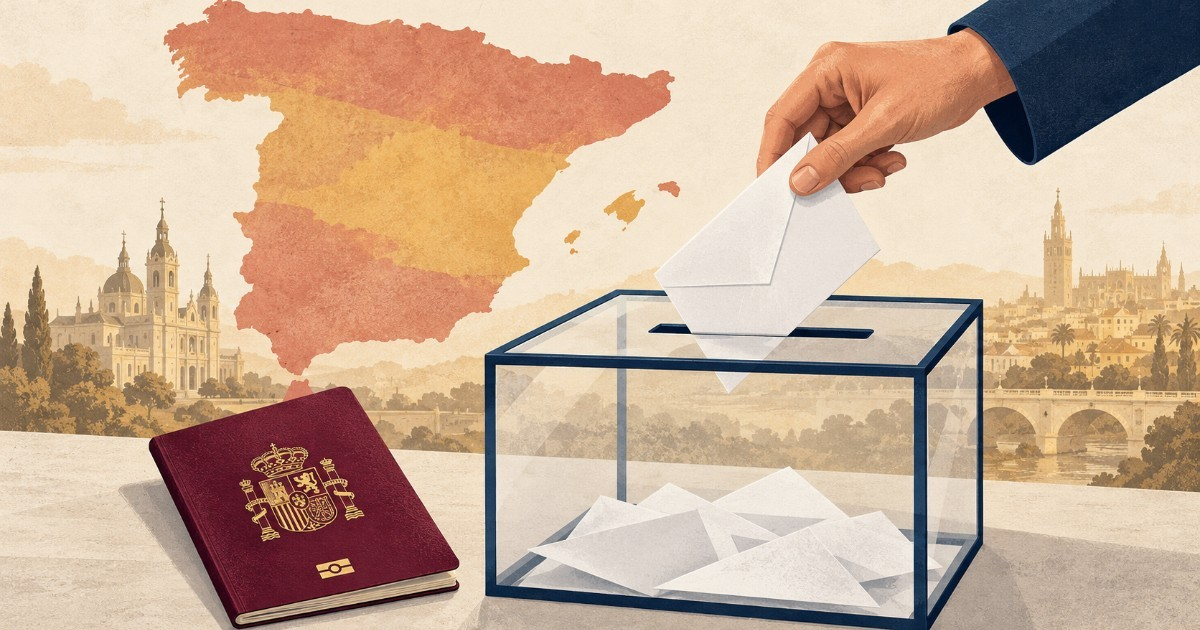
The Administrative Litigation Chamber of the Supreme Court of Spain confirmed that adult children of those who obtained Spanish nationality through the so-called Grandchildren's Law will indeed be able to vote in the general elections on November 29, by overwhelmingly rejecting the appeal filed by the Vox party.
The resolution confirms the decision made on November 9, when the high court for the first time rejected extending the precautionary suspension of the right to vote that affects their parents.
The benefiting group amounts to 189,678 individuals registered in the Electoral Census of Absent Residents (CERA) under Annex III of the ministerial instruction from October 2022, which expanded the criteria of the Democratic Memory Law.
For Cubans, the distinction is concrete and has direct family consequences: parents who nationalized through this route without providing documented proof of their status as descendants of exiles still have their voting rights temporarily suspended, while their children, who also acquired nationality under the same regulation, can vote on November 29th.
The central argument of the Supreme Court is not a substantive legal one, but rather a matter of procedural opportunity.
The document acknowledges that "if the measures now sought had been proposed at the beginning of this precautionary measure, the response may have been different."
He adds that the request arrived "after more than half of the electoral period had passed, a week before the start of the electoral campaign, and, concerning the votes of registered voters in the CERA, two weeks before the beginning of ballot submission in the consulates."
Modifying the census within that timeframe, the court reasons, would jeopardize legal certainty and the stability of the electoral process.
The ruling is not unanimous: Judge Antonio Jesús Fonseca-Herrero Raimundo signed a dissenting opinion in which he argued in favor of upholding Vox's appeal, considering that the necessary checks to identify the affected children were "quite simple and easy to carry out with the existing technological resources" and that their registrations in the CERA are "clearly flawed" as they derive from those of their parents.
Judge María Alicia Millán Herrandis issued a concurrent vote: she agrees with the ruling but does not support all the arguments used by the majority.
Vox had proposed as an alternative to separate and safeguard the ballots of the affected voters before the counting, without opening or counting them until the Supreme Court made a decision; the court also rejected that proposal.
Important for those who have Spanish nationality through this route: the precautionary suspension does not annul nationality nor revoke previously issued passports, it only restricts the right to vote from abroad and temporarily.
The Cuban residents registered in Spain can vote without any restrictions.
Spaniards living in Cuba who are registered in the CERA can vote in person at the General Consulate (Palacio de Velasco, Zulueta 2, Havana) between Saturday, November 21, and Thursday, November 26, from 9:00 a.m. to 5:00 p.m., or by mail until November 24.
The Supreme Court still needs to rule on the substantive legality of the Justice Ministry's instruction that expanded the criteria of the Law of Democratic Memory.
Related videos:
Filed under: