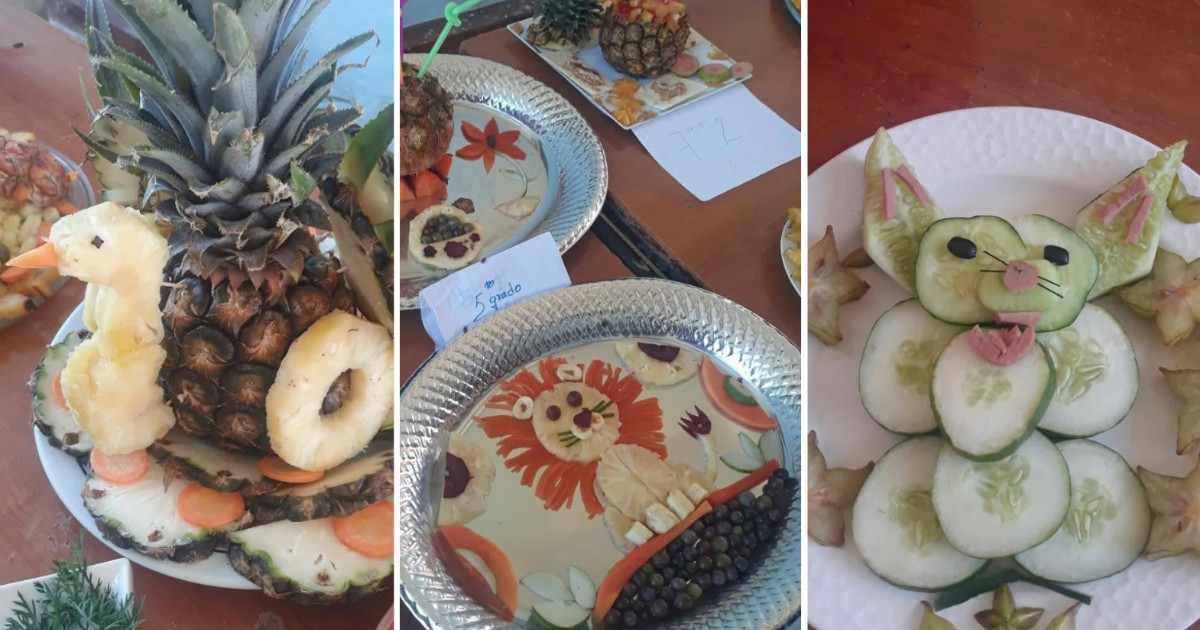
A post from the Municipal Education Direction (DME) of Alquízar, in the province of Artemisa, sparked a wave of criticism on social media by showcasing a culinary dishes exhibition organized at the Enrique Hart mixed center as part of Educator's Day.
The event, organized by the DME as a tribute to Physical Education teachers, showcased a long table adorned with carved watermelons, decorative pineapples, melons, salads with eggs, and other elaborate fruit presentations, surrounded by pioneer children in school uniforms.
The stated objective was “to highlight the importance of maintaining a healthy diet and the calories it provides to the human body”, according to the official publication on .
But the image of abundance collided head-on with the reality that thousands of Cuban families live, and the comments quickly reflected that.
"From the parents' pockets, there’s no other option," wrote one user. Another commenter was even more forceful: "This is an insult to Cuban mothers, who day by day have to struggle and be resourceful about what to give for breakfast, what to cook, and how to cook it without electricity or gas. To talk about healthy eating and calories for the human body in Cuba."
"Exactly, in Cuba there is neither variety nor good nutrition; children suffer from hunger and misery, having no snacks or lunch to take to school," another person commented.
Others, however, supported the activity: "It costs to do it with the support of the parents and for the children to feel a minimum of motivation... It's just that we have already gotten used to seeing everything negatively."
The Minister of Food Industry acknowledged in June 2026 that more than 100,000 children were not receiving their daily milk ration. In light of this situation, the WFP launched an emergency project on July 1 to feed 12,677 children in 74 educational centers across five eastern provinces, funded by resources from the debt swap between Spain and Cuba.
The practice of parents covering what the state does not provide is well documented. Cuban mothers have reported that they finance everything from paint and fans to uniforms and food to keep the schools running. Ensuring just breakfast and a snack for a child can exceed 10,000 Cuban pesos per month, nearly three times the minimum salary of 3,210 pesos.
This month, mothers in Santiago de Cuba were threatened with fines for not sending their children to school, claiming that the children were leaving home without eating and were also not receiving adequate food in the schools.
Related videos:
Filed under: