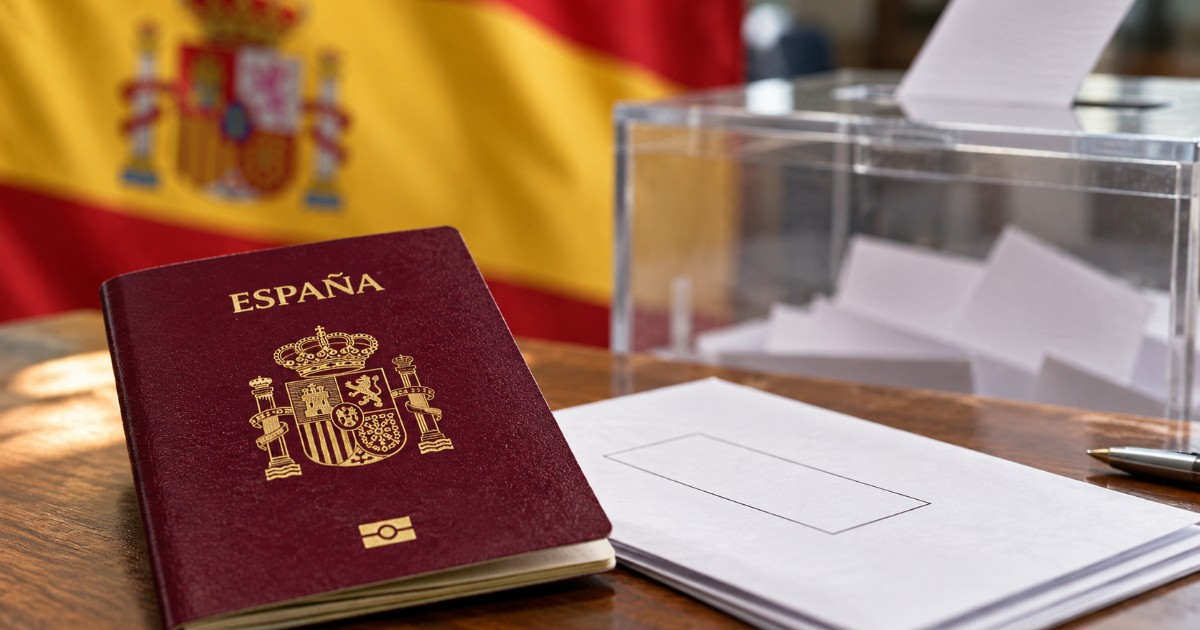
The Ministry of Foreign Affairs of Spain has instructed its consulates abroad to set up a second ballot box to collect votes from citizens who have been naturalized under the Law of Democratic Memory —commonly referred to as the "grandchildren's law"— for whom the Supreme Court has temporarily suspended the right to vote in the general elections on November 29.
The instruction, revealed exclusively by The Objective based on an internal document from the General Consulate of Spain in Buenos Aires, has sparked a new controversy between the Government and the high court.
The document, titled "Voting in the ballot box," outlines the procedure that officials must follow when one of the affected individuals comes to vote: the computer system will not recognize their registration in the census, so the worker must direct them to a specific table called "Mesa LMD Autos TS" —acronyms for the Law of Democratic Memory and Supreme Court rulings—. The instructions explicitly state that the "ballot envelope should be placed in the LMD box," meaning it goes into a second ballot box designated exclusively for this group.
The Supreme Court had foreseen that the documentation of those affected would be kept separately, but did not order the installation of a second ballot box. This difference is precisely what has caused discomfort among the consular officials themselves, who fear that the ballots from both boxes could become mixed or exchanged during the process.
According to elDiario.es, those ballots will be sent to Spain via diplomatic pouch, and there will be a record in the consular report, but they will not be counted unless the Supreme Court decides otherwise in the days leading up to November 29.
The suspension affects 163,355 people who obtained Spanish nationality through Annex I of the instruction signed by Sofía Puente in October 2022, which expanded the criteria of the law without requiring individualized proof of political exile. Of that total, only 901 have a certification that verifies the exiled status of their ancestor and can therefore vote. The adult children of those naturalized individuals — Annex III, approximately 189,678 voters — do have the right to vote following the Supreme Court's confirmation the day before.
The high court rejected the appeal from the State Legal Service seeking to lift the suspension, arguing that "the general interest prevails over individual voting rights." The Minister of the Presidency, Félix Bolaños, described that decision as "debatable." For his part, Santiago Abascal announced at a rally in Seville that he would file lawsuits for alleged disobedience against the Minister of Foreign Affairs José Manuel Albares, against Bolaños, and against the consuls who set up the second ballot box.
The Cuban angle is significant: Cuba is the fifth country in the world in terms of the number of voters on the electoral roll of absent residents (CERA) for the November 29 elections, with 169,290 registered, almost all of whom are Cuban-Americans. In-person voting at the Consulate General of Spain in Havana —located in the Palacio de Velasco in Old Havana— began precisely this Saturday and will continue until Thursday the 26th, from 9:00 AM to 5:00 PM. The deadline for mail voting is Tuesday the 24th.
A Cuban-Spanish nationalized directly under the Law of Grandchildren (Annex I) who goes to the consulate in Havana may submit their envelope, but it will not be counted unless the Supreme Court changes its position or the interested party provides certification of exile. Their child, who is also nationalized under the same regulation but through Annex III, can cast their vote with full validity. It is important to clarify that the suspension does not annul Spanish nationality nor revoke already issued passports; it only temporarily restricts voting from abroad.
There is no public confirmation that the consulate in Havana has received the same directives as the one in Buenos Aires, although El País notes that the protocol is applied in consulates across Latin America in general.
In the general elections of July 2023, only 1,184 people voted in person from Cuba out of a registry of over 152,000 registered voters, resulting in a participation rate of less than 0.8%. This reflects the significant logistical challenges faced by Cuban nationals in traveling to the consulate in Havana.
Related videos:
Filed under: