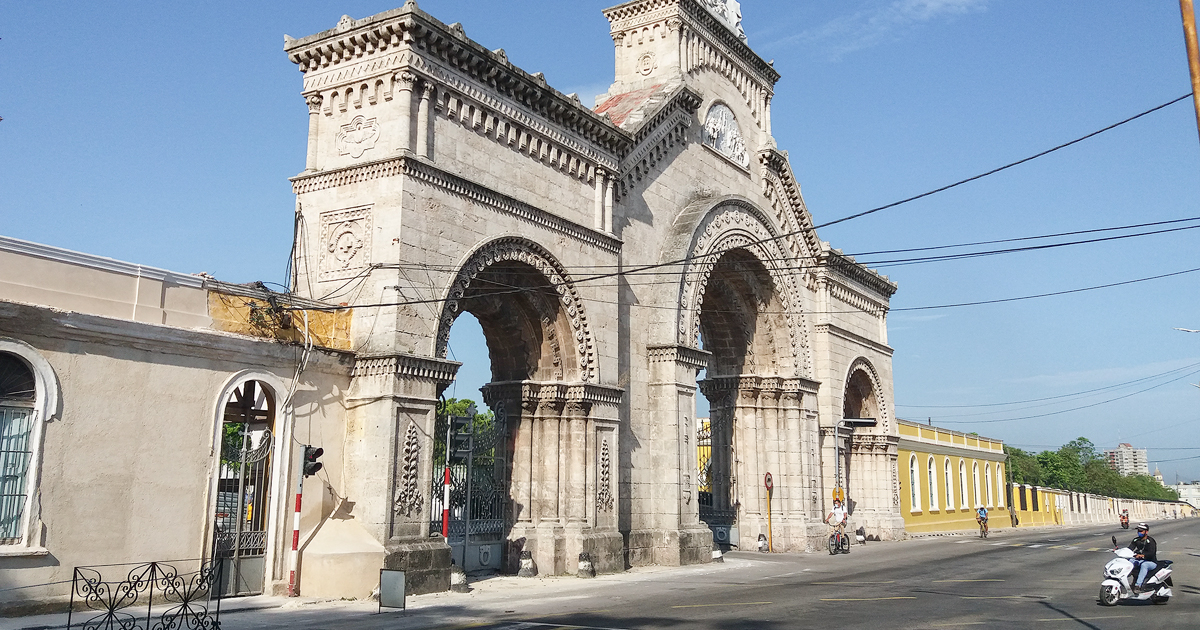
The Provincial Government of the People's Power of Havana issued an official statement this Saturday to partially refute the information circulating on social media regarding new rates for funeral services at the Cristóbal Colón Necropolis, clarifying that the information shared corresponds to a proposal that has not yet come into effect.
The official text, also disseminated by Canal Caribe and the state journalist Lázaro Manuel Alonso, described the original publication as "unauthorized" and warned that "the data published on this site is not official."
The controversy erupted on Friday when the Facebook profile of Colón Cemetery itself published a table with 12 services and their corresponding rates in Cuban pesos, allegedly based on Resolution 146 from November 12, 2026, which is set to take effect on November 23.
The publication caused alarm among the population and was also criticized for errors in writing and spelling.
The cemetery itself acknowledged in that publication that "so far, the city government has not published anything regarding this," leaving the responsibility to make it public to the cemetery authorities "through alternative channels."
Among the announced fees were 1,780 pesos for the cremation of bone remains with a basic urn —the highest in the list—, 1,760 pesos for the issuance of a title of ownership, 1,500 pesos for special certificates, and amounts ranging from 500 to 1,370 pesos for other procedures such as appraisals, certificates, exhumations, and specialized consultations.
You can view the original announcement regarding fees at the Necropolis for a complete breakdown of the rates.
The official statement does not deny that the institutional transformation is underway. On the contrary, it confirms that in January 2026, it was approved to convert the Necrological Services Directorate into a "budgeted unit with special treatment," a status that requires the institution to cover the costs of the services it provides with its own income, which until now have had "a significant element of state subsidy."
What the regime denies is that the specific "cost sheet" has been approved for implementation: "To secure funding for expenses, a proposal for a cost sheet has been worked on, which has not yet begun to be applied," states the official text.
The statement promises that "when all the steps outlined in its implementation are carried out, official information will be provided by the competent authorities," without specifying any timelines.
The episode occurs amid a structural crisis of the Cuban funeral system that has worsened throughout 2026. In October, analyst Frank Rodríguez reported that in several cities, people were being buried in mass graves because families could not afford coffins or funeral services.
In November, a family had to transport a coffin on a yoke of oxen due to the collapse of the system, and the cemetery in Cárdenas was reported for open vaults and exposed bones.
The Colón Cemetery itself has accumulated numerous reports of deterioration in 2026: in April, journalist Camila Acosta shared images of human remains mixed with debris within the grounds.
The self-financing policy for necrology services is not new: since 2023, the regime began to charge for additional services such as intermunicipal transfers, cremations, and home wake services, while keeping the basic coffin and local transfer free of charge.
The activist Lara Crofs summed up the situation in September with a phrase that encapsulates the daily drama of thousands of Cuban families: "Even death seems to have become a privilege for those who can afford it."
Related videos:
Filed under: