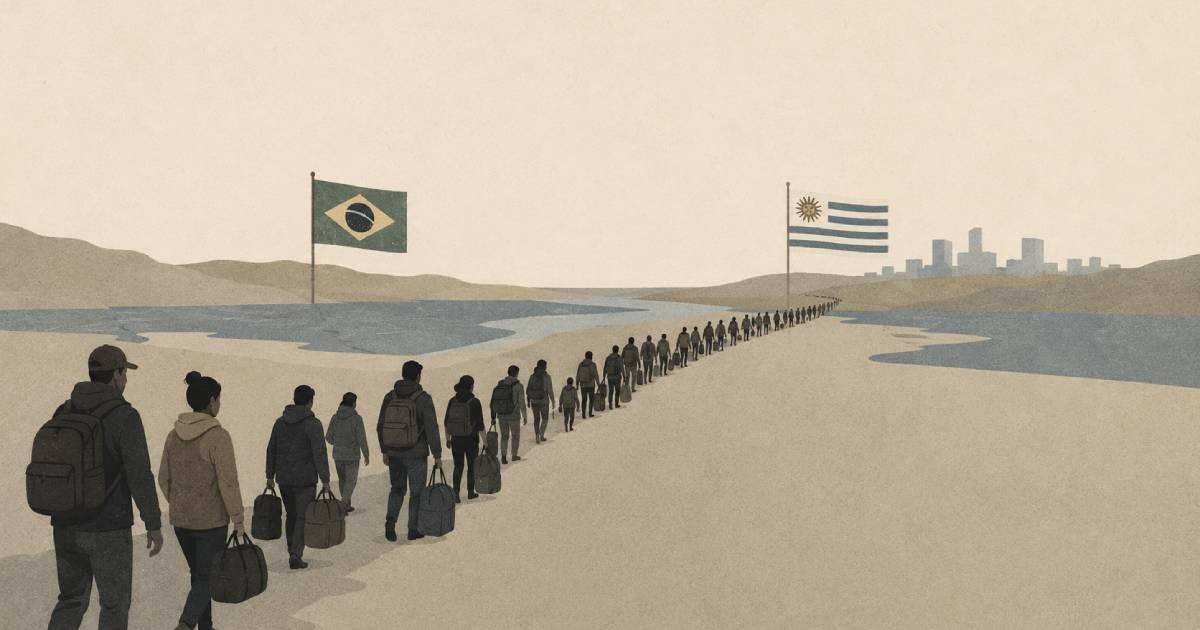
Nearly 6,000 Cubans settled in Uruguay in the first five months of 2026, according to a new report by the International Organization for Migration published on Wednesday from Panama City, which documents a significant shift in migration patterns in Latin America and the Caribbean.
The document, titled Regional Mobility Trends: Latin America and the Caribbean, January-June 2026, reports a positive migration balance of 5,946 Cubans in Uruguay between January and May, with an average of approximately 1,190 people per month, according to official statistics from the National Migration Directorate of that country cited by IOM.
The international organization identifies for the first time the Eastern South American Route as a fully established migratory corridor, connecting the Caribbean—mainly Cuba and Haiti—with northern South America, Brazil, and the Southern Cone.
The route taken by Cubans combines flights and land travel: many travel from the Island to the Dominican Republic and then to Georgetown, Guyana—the only South American country that does not require a visa for Cuban citizens—before crossing irregularly into northern Brazil and continuing south to Uruguay.
Parallely, about 3,000 Cubans entered Brazil each month during the first four months of the year, and that country recorded 16,982 asylum applications from Cuban nationals between January and May 2026.
This massive flow to the south can be partly explained by the collapse of the Central American route: crossings through the Panamanian Darién fell by 90% in the first half of 2026 compared to the same period in 2025, and by 97% compared to the first half of 2024, with only 280 people crossing northward between January and June.
"The sudden drop in crossings through the Darién only tells part of the story. Migration has not stopped. People are finding new routes, going in different directions, and making difficult decisions about where they can build a future," stated Juan Francisco Espinosa, regional director of IOM for the Americas.
The structural causes of the Cuban exodus are well known: an economic crisis marked by power outages of up to twenty hours daily, shortages of food and medicines, political repression, and a lack of prospects—all stemming from more than six decades of communist dictatorship.
"South America is becoming an increasingly important destination for migrants, rather than simply a transit region," concludes the statement from the IOM, which warns that the response of receiving countries—including access to legal status and employment—will determine what these migrants can contribute to the communities that welcome them.
The phenomenon has a significant institutional dimension in Uruguay. As of the end of June 2026, the country had a total of 30,715 pending asylum applications, of which approximately 89% were from Cuban citizens, amounting to around 27,300 applications.
However, Uruguay had only formally recognized 52 Cubans as refugees by October 2026.
To unblock the system, the Uruguayan government approved in October 2026 a permanent residence decree based on ties aimed at foreigners who had entered regularly before January 1, 2026, and who would renounce their pending asylum application.
The year 2025 had already set a record: over 22,000 Cubans entered Uruguay, with a net increase of about 15,000 people, and 13,852 Cubans obtained the Uruguayan ID for the first time, more than any other foreign nationality.
Related videos:
Filed under: