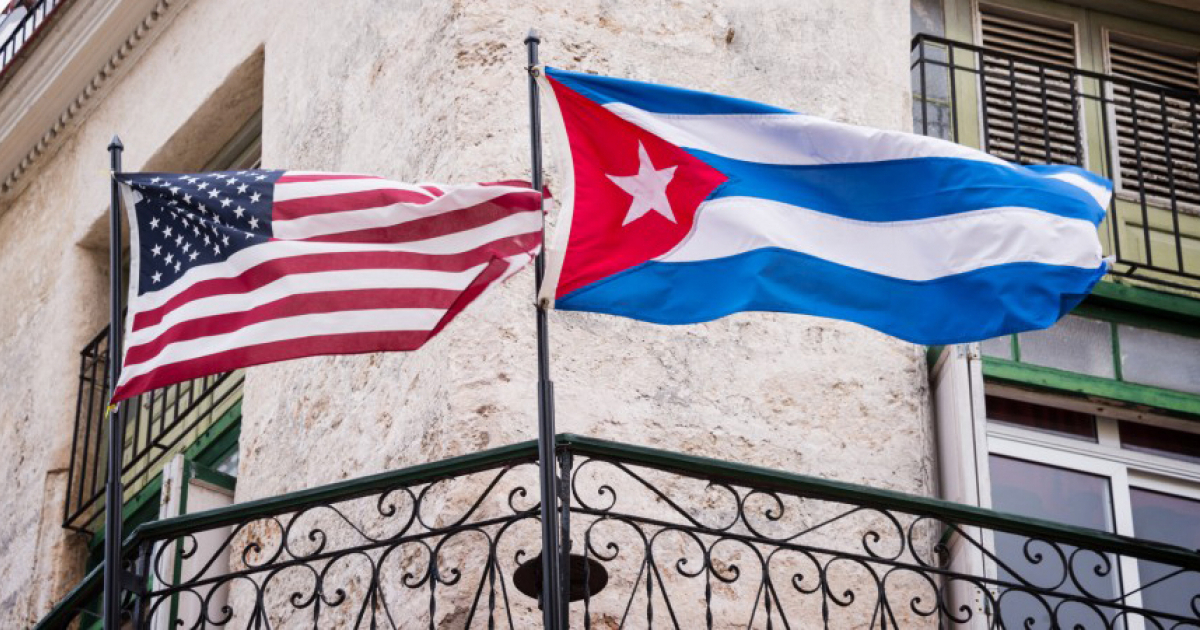
The Embassy of Cuba in the United States published a message on X this Saturday reiterating the regime's willingness to negotiate with Washington, but under its usual conditions: mutual respect, sovereignty, and non-interference in its internal affairs.
"That offer is still on the table," stated the official account of the diplomatic mission, under the hashtag #CubaNoEsUnaAmenaza.
The message comes a day after Miguel Díaz-Canel made a similar offer to university students during the University Student Bastion, although with an explicit condition: any approach must occur "without pressure, without conditioning, and without questioning our political system."
In its publication, the embassy accuses Washington of historically responding with "more sanctions, more restrictions on fuel and trade, and continued isolation," and poses a rhetorical question: "After six decades, it is valid to ask whether it has produced the results intended by its authors or if, primarily, it has caused suffering for the population."
The regime omits, however, that the main cause of the Cuban economic deterioration is 67 years of dictatorial management, not the American sanctions.
Havana's stance —an open dialogue, but the political system remains untouched— is not new. In 2009, Raúl Castro offered to talk with Obama about "everything," except for sovereignty and socialism. This position was constitutionally safeguarded in 2019, when Article Four of the Constitution declared socialism irrevocable.
Washington, for its part, has consistently hardened its stance. On November 5, Secretary of State Marco Rubio announced new sanctions against Cuban oil and military networks, including suppliers based in China linked to the regime's armed forces.
In September, Rubio had been emphatic: "No one is going to invest in Cuba under its current model of government. They simply will not do it."
The bilateral tension reached its peak on November 12, when Donald Trump declared in an interview that he would "definitely consider" a brief military campaign against Cuba and that he wanted to "end Cuba" before leaving office. The next day, the State Department warned that a Cuba considered a "failed state" off the U.S. coast would pose a direct threat to national security.
In that context of maximum pressure, the regime has combined a rhetoric of resistance—declaring 2026 as the "Year of Preparation for Defense" and conducting the Moncada Strategic Exercise at the beginning of the month—with diplomatically conditional messages of openness, such as the one published this Saturday.
The channels of communication between both countries exist, but they are limited. In October, the Cuban chargé d'affaires in Washington, Lianys Torres Rivera, confirmed to Reuters that the contacts are limited to meetings, calls, and WhatsApp messages, with no formal negotiations.
The chancellor Bruno Rodríguez had acknowledged in July that the discussions "show no progress."
Related videos:
Filed under: