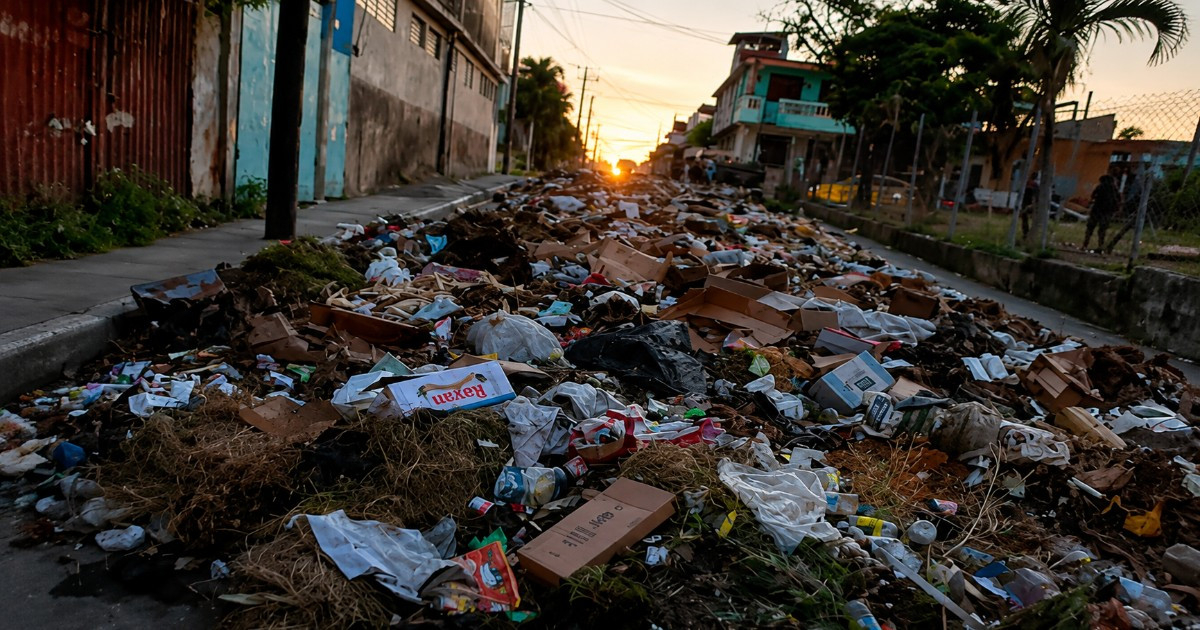
Streets covered in garbage for days and weeks, blocked sidewalks, and unpleasant odors are part of the reality faced by the residents of Guantánamo, where the accumulation of waste threatens public health and highlights the challenges of the sanitation system.
A social media post highlighted this Saturday the complaints about the situation in the eastern city, describing the daily deterioration experienced by its residents. "You leave your home in Guantánamo, and the first thing you see is not a clean street, but a pile of garbage. A day goes by, two days go by, a week goes by, and no one picks it up," stated the text shared on the Facebook profile of Mary Canela Tudela, who clarified that the reflection came from a follower.
The author identified six factors behind the crisis, including the aging trucks of Communales and the lack of spare parts, fuel shortages, a deficit of workers due to low wages, the proliferation of illegal dumps, debris from abandoned construction sites, and the absence of containers in numerous neighborhoods.
The reactions to the publication reflected the discomfort of those who claim to have become accustomed to walking in the middle of the streets because the sidewalks are occupied by waste, enduring unpleasant odors, and seeing children play near dumpsters.
"Sorrow and shame. Because Guantánamo is a beautiful city, with good, hardworking people, and it pains me to see it like this, abandoned among rubble... we used to be one of the cleanest cities in Cuba... today I believe the whole of Cuba has turned into a large dump," lamented the text.
In May, a meeting on circular economy confirmed that around 1,600 cubic meters of waste ended up in landfills and streets in the province.
Residents have raised concerns about the proliferation of mosquitoes, flies, mice, and cockroaches, as well as the risk of dengue, diarrhea, and skin diseases. The accumulation of waste can block the sewers, exacerbate flooding, and hinder the passage of ambulances.
For months, Guantánamo remained under Epidemiological Alert due to dengue, while dumpsters near daycare centers and primary schools were identified as possible breeding sites for the mosquito Aedes aegypti.
In June, a resident reported the presence of a huge garbage dump infested with rats and insects on 1 Norte Street, between Cuartel and San Gregorio. "The rats come into our houses and the stench makes it impossible to live," they warned.
Due to the halt of trucks caused by a lack of fuel, the authorities also turned to pushcart vendors and animal-drawn vehicles in an effort to maintain waste collection.
Institutional responses have also failed to change the situation. In October, the Municipal Sanitation Company received five electric tricycles through the project My Ecological City, a addition that stands in stark contrast to the scale of accumulated waste.
On his part, the First Secretary of the Communist Party in Guantánamo, Yoel Pérez García, called on organizations and mass groups to participate in cleanup efforts, arguing that "contributing to the collection of solid waste should be a task for everyone."
Related videos:
Filed under: