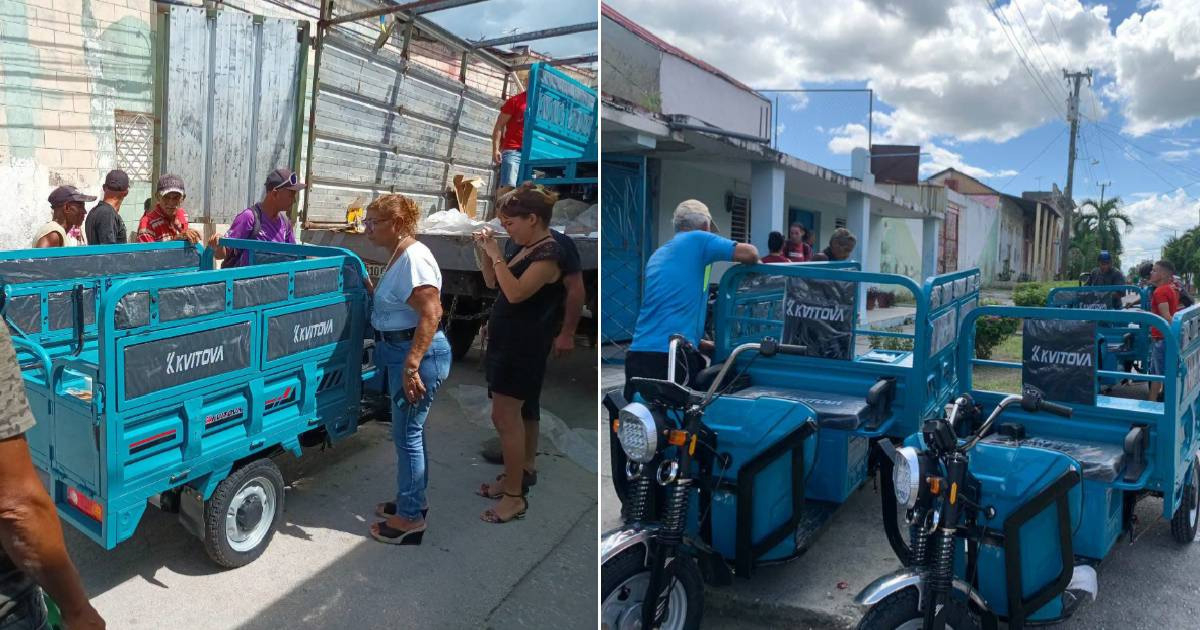
The Guantánamo Public Works Company received five electric tricycles to assist in solid waste collection in the city center, a measure that authorities present as part of the My Ecological City project.
Through its official page on Facebook, Mi Guantánamo, the Municipal Assembly of Popular Power in the eastern territory announced the delivery and published images on Monday of the vehicles being unloaded from a truck in front of the headquarters of the Municipal Company of Sanitation and Recreation, Basic Unit Valparaíso.
The authorities described the incorporation as "a step in the efforts to move towards a cleaner, more organized, and sustainable city," although the arrival of the equipment comes amid a sanitation problem that has remained unresolved for years.
In 2023, the city generated around 1,200 cubic meters of waste daily, but only between 400 and 600 cubic meters were collected, according to official data. This discrepancy left a considerable amount of garbage uncollected and contributed to the persistence of makeshift landfills.
The announcement of the new vehicles elicited reactions of hope, but also doubts about their ability to improve the service. "I hope it's true," wrote a resident in a comment that reflects the citizens' distrust of promises for improvements in urban cleaning.
Another user directly questioned the effectiveness of the measure. "With just five tricycles, nothing is solved in a city that discards more than 1,000 cubic meters of garbage a day," he pointed out.
The delivery of the tricycles expands the resources available for waste collection in the center of Guantánamo, but the information released does not specify when they will begin operating, what volume of garbage they will be able to transport, or how they will be integrated into municipal services. It also does not provide data on a plan to determine whether their integration will have a sustained impact on the sanitation crisis.
The fuel shortage has halted specialized collection trucks, forcing authorities to successively resort to emergency solutions: cart pullers and animal-drawn means in June, along with calls for citizen participation.
In recent days, Governor Alis Azahares publicly called attention to the mayor of the capital municipality and the Community Services Company regarding the proliferation of dumpsites and the neglect of tree pruning and gardening.
The accumulation of waste has direct health consequences. In September, three municipalities in the province —Imías, Baracoa, and Guantánamo— remained in active dengue transmission, with simultaneous circulation of serotypes two, three, and four.
In April, the Alternative Energy Local Development Project was announced, managed by the small and medium-sized enterprise R&R Soltec, which proposed electric vehicles with solar panels and a generation capacity of 10 kilowatts.
The background in other provinces is also not promising. In Havana, a project for 30 tricycles for the Rampa Popular Council failed because the solar charging station was still not completed in August, when only five units were in operation.
In February, Prime Minister Manuel Marrero called for a massive sanitation campaign, in a context marked by the accumulation of solid waste, the deterioration of community services, and growing health concerns in the capital.
The following month, the Ministry of Labor and Social Security announced the reassignment of workers affected by job interruptions to sanitation tasks, a measure that specialists consider insufficient given the structural deterioration of the system.
Related videos:
Filed under: