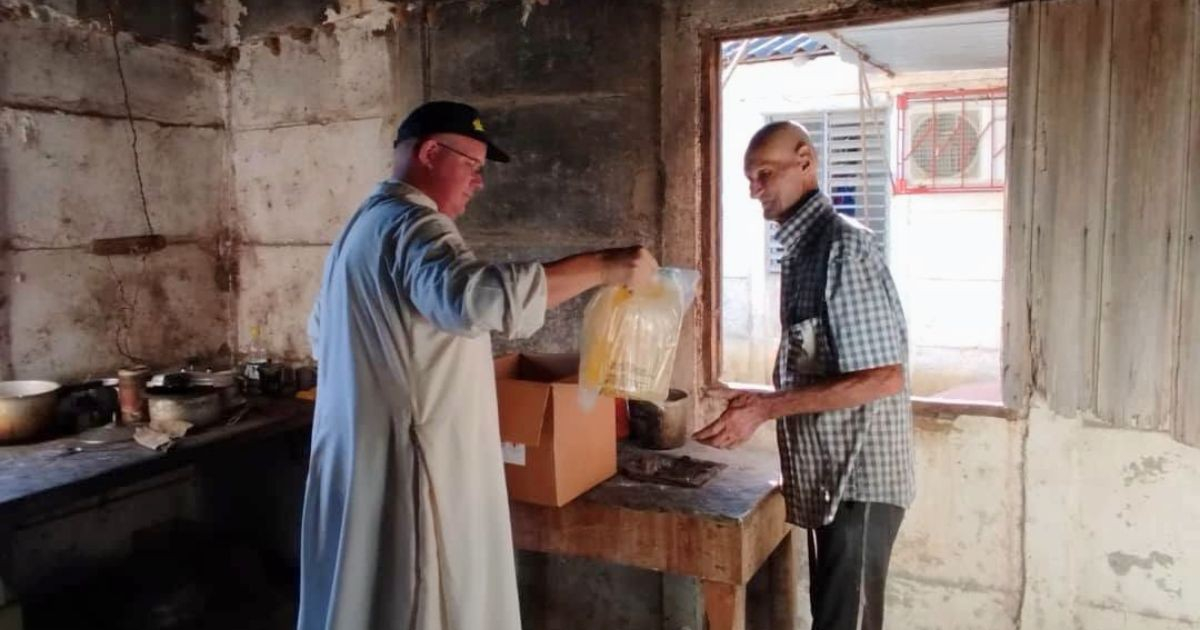
A resident of Sancti Spíritus who did not receive any aid module approached the priest leading the mission to thank him for what they were doing for their neighbors. That scene, which took place on Thursday during the second day of distribution of Cáritas Santa Clara in Sancti Spíritus, captures the emotional atmosphere that has characterized this humanitarian mission funded with U.S. money and executed without the involvement of the Cuban government.
Father Yoan Ernesto Bonet Espino, who accompanied the journey alongside volunteers from Caritas and nuns from the Missionaries of Charity, recounted the episode: "Today a man from a village, who did not receive assistance, approached me and expressed his gratitude for the Church's efforts in showing human kindness by supporting those who suffer the most. He said to me: Father, this does not affect me directly, but I sincerely appreciate what you are doing for my neighbors.”
On that second day, the group set off after attending a mass and traversed mountainous areas and the southern coast of the province, reaching the settlements of Güira, Pozo Colorado, Puerta de Zamora, Los Limpios, Banao, Maizal, Suspiro, and La Quinta. A total of 266 food and hygiene product packages were distributed, coming from the third shipment of U.S. humanitarian aid received by the Diocese of Santa Clara, which had arrived on November 17 at the Abel Santamaría International Airport.
The Thursday event was the second day of the mission in the province. On Wednesday, 37 volunteers traveled through remote areas of the Escambray in Sancti Spíritus and provided assistance to 286 families from eight communities in the San Ignacio de Loyola parish in Banao. Father Bonet Espino described that first day as an experience of “many people crying, a lot of gratitude from men, women, and children,” and emphasized that families were given not only material aid but also a word of encouragement, affection, comfort, and hugs.
The reaction on social media to Cáritas' publication was widespread. While most comments expressed gratitude and blessings, some pointed out the limitations of the operation in light of the needs of many. One commenter specifically thanked the government of the United States and described the aid as "a ray of light to so many needy families [...] in a country where poverty, hunger, and needs grow every day." There were also calls for the mission to reach communities that have yet to be served, such as Itabo, in the municipality of Yaguajay.
This tension between gratitude and the magnitude of need reflects the reality facing Cuba. According to estimates from the Cuban Observatory of Human Rights (OCDH) based on over 1,300 interviews across 79 municipalities, 94% of Cubans found themselves in a state of extreme poverty. Furthermore, 33.9% of the surveyed households reported that at least one of their members went to bed hungry at least once in the 30 days prior to the survey, compared to 24.6% reported in 2024.
The distribution in Sancti Spíritus is part of the humanitarian aid program of 100 million dollars announced by Secretary of State Marco Rubio on May 8, 2026, of which 60 million is being channeled through Catholic Relief Services (CRS) and Cáritas Cuba, aiming to reach approximately 200,000 households. This Friday, the mission will continue in the towns of Pinto, Capitolio, Entronque, and Banao centro.
Related videos:
Filed under: