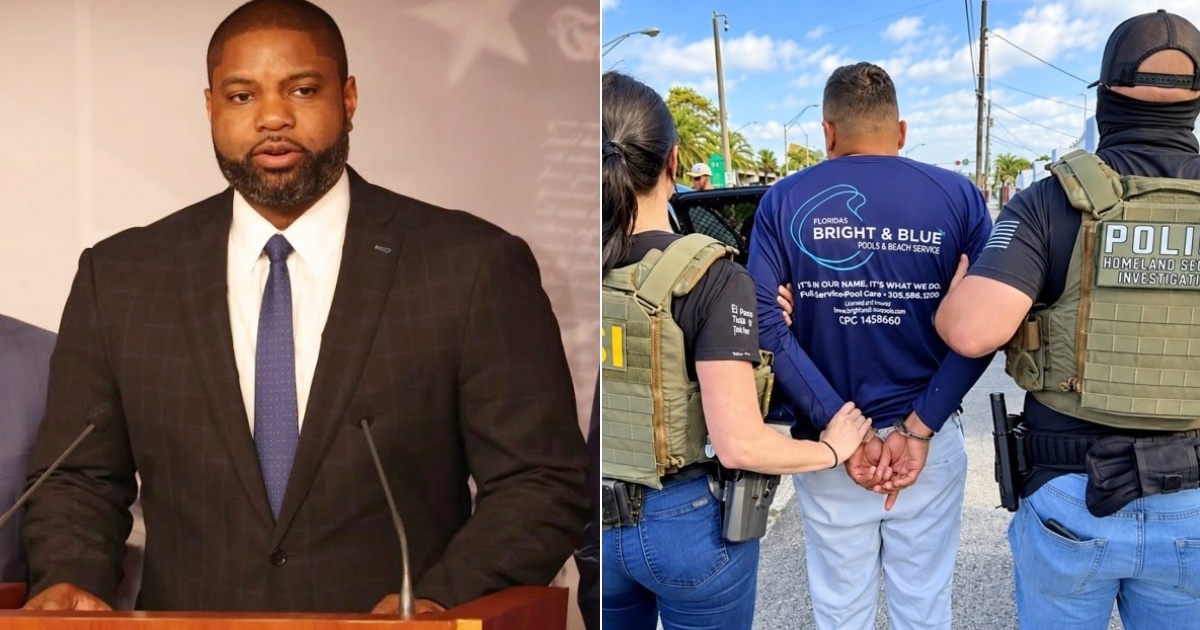
The elected governor of Florida, Byron Donalds, issued a warning to cities in the state that are looking to cancel their immigration cooperation agreements with the Immigration and Customs Enforcement (ICE), following Tallahassee's decision to consider withdrawing from the federal 287(g) program.
“Florida is not a sanctuary state, and as governor, I will never allow it to be. Florida cities must comply with federal and state laws. End of story.”, wrote Donalds on Thursday, November 19, on X, in response to information shared by journalist Gary Fineout from Politico.
The reaction from the Republican came after the Tallahassee Municipal Commission unanimously voted, five to zero, on Wednesday, November 18, to include in the agenda of an upcoming meeting a plan to evaluate the withdrawal from the 287(g) agreement signed by the city's Police Department.
The vote does not cancel the agreement with ICE.
The commission will need to review the procedure for a potential withdrawal and its possible legal consequences before making a final decision, according to local media.
Donalds, winner of the gubernatorial elections on November 3 against the Democrat David Jolly, will take office in January 2027.
Her stance contrasts with that of Jolly, who during the campaign defended local authorities making decisions about their participation in the 287(g) program.
What are the 287(g) agreements with ICE?
The 287(g) program, established by federal immigration legislation, allows ICE to authorize certain state and local law enforcement officers to perform federal immigration enforcement functions, after receiving training and under the supervision of federal authorities.
Responsibilities depend on the model of the subscribed agreement and may include identifying individuals subject to immigration procedures, accessing federal information, certain actions during policing functions, and executing administrative immigration orders.
Governor Ron DeSantis's administration has promoted cooperation between Florida law enforcement agencies and federal authorities, making the enforcement of immigration laws one of its priorities.
In Tallahassee, the municipal commission will need to decide whether to maintain the current agreement or move towards its cancellation. For now, no definitive date has been announced for that decision.
Tallahassee reopens the debate on its agreement with ICE
The initiative came from Commissioner and Interim Mayor Jacqueline "Jack" Porter, who stated during the municipal meeting: "I am ready to move forward with the exit from the 287(g) agreement," as reported by the Tallahassee Democrat, cited by Newsweek.
Mayor Jeremy Matlow stated that, in his interpretation, state legislation did not require Tallahassee to sign that agreement.
Commissioner Dianne Williams-Cox responded by warning about the possible repercussions: "They may not have demanded it, but there are penalties."
Police Chief Lawrence Revell explained that the department's participation in the program is limited. According to his remarks, only one officer has received training and has access to an immigration control database. "That is our level of participation," he stated.
The debate is not new in Tallahassee. In 2025, the city commission had voted three to two in favor of maintaining the agreement with ICE. The new unanimous vote opens the possibility of revisiting that decision.
Doral and Key West, other scenes of the dispute
In Doral, the City Council postponed the debate on its agreement with ICE again, with a vote of four to one.
Councilwoman Maureen Porras was the only one opposed to postponing the discussion, while activists who attended the session expressed their opposition to the decision.
Another precedent is that of Key West, whose city commission voted in June 2025, six votes to one, to cancel its 287(g) agreement, but reversed the decision nine days later, following warnings from state authorities about potential sanctions and removals.
The attorney general warns of potential legal consequences
The Attorney General of Florida, James Uthmeier, also intervened in the controversy and supported the position of the elected governor, alluding to a similar dispute in the city of Doral, in Miami-Dade County.
"As we told the Doral City Council yesterday, reversing an agreement under 287(g) would demonstrate the implementation of prohibited sanctuary policies and a lack of maximum efforts to support the enforcement of federal immigration law. Supporting our federal partners and protecting our sovereignty is not optional; it is the law," Uthmeier wrote on X.
The office of the attorney general had sent a communication to the mayor of Doral, Christi Fraga, in which deputy attorney general Greg Slemp stated that rescinding a 287(g) agreement without sufficient justification could constitute a sanctuary policy contrary to Florida legislation.
State law does not necessarily require all local governments to enter into 287(g) agreements, but it does prohibit policies that prevent certain forms of cooperation with federal immigration authorities.
Chapter 908 of the Florida Statutes governs that cooperation.
Its section 908.107 contemplates the possibility for the governor to act against officials who fail to meet their legal obligations, including a potential suspension from office.
It also allows the attorney general to go to court to enforce the law and seek measures against illegal sanctuary policies.
The position of the Prosecutor's Office reflects its interpretation of municipal obligations, but the cancellation of a 287(g) agreement does not, by itself, equate to a judicially established violation.
The consequences would depend on the circumstances and the applicable legal provisions.
Related videos:
Filed under: