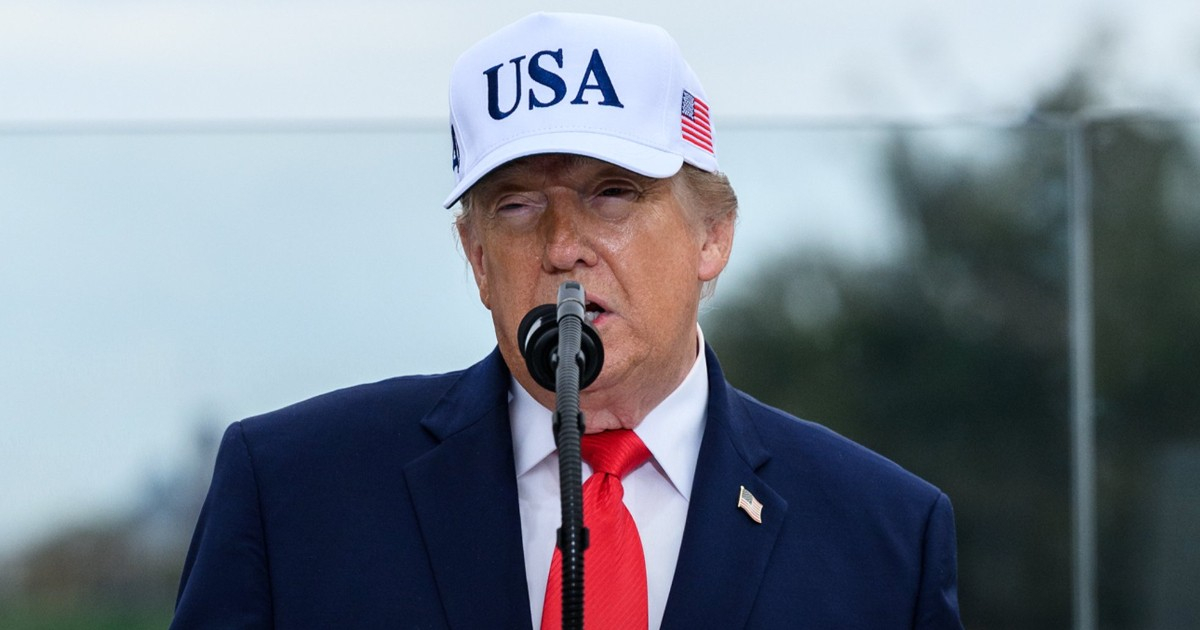
The President of the United States, Donald Trump, asserted this Sunday that open borders destroy countries and stated that the United States was very close to becoming one of them, until he came to power.
With this statement, the leader once again claimed credit for having avoided the consequences that, according to his speech, the immigration policy of his predecessors would have had.
“Open borders destroy nations! The United States was very close to being one of them until I arrived!”, Trump wrote in a post on his Truth Social account.
The message, written entirely in capital letters, does not mention a specific migrant caravan nor announce new border control measures.
However, it appears after several days of warnings from the White House against groups of migrants crossing Mexico with the intention of reaching U.S. territory.
On November 12, Trump threatened to immediately double tariffs on Mexico if Claudia Sheinbaum's government did not stop the progression of the caravans.
In that post, also made on Truth Social, he described those migratory movements as an "invasion" and stated that its members would not be admitted into the United States.
Four days later, last Monday, he reiterated his warning to reporters at the White House, before boarding the presidential helicopter.
"They will not be allowed to enter, and Mexico will stop them," he stated at the time.
He also stated that the Mexican authorities had committed to preventing their progress and reiterated the possibility of imposing high tariffs if they did not fulfill this supposed commitment.
The Migrant Caravans and Mexico's Response
Trump's statements coincide with the movement through southern Mexico of the caravan named God with us, primarily composed of Central American migrants seeking to reach the U.S. border.
The contingent left Tapachula, Chiapas, on November 10. Initial estimates of its size ranged from 1,500 to 2,000 people, according to information from Reuters and EFE.
On Friday, media reports from Chiapas indicated that nearly a thousand migrants had resumed their march from Pijijiapan towards Tonalá, after some members of the group either left the procession or accepted assistance from Mexican authorities.
President Claudia Sheinbaum has rejected Trump's claims about a massive arrival of caravans at the U.S. border.
On November 12, she stated that no migrant caravan had reached the northern border since the Republican returned to the White House in January 2025.
The official explained that her government informs migrants about the existing restrictions for entering the United States and offers them alternatives to return to their home countries or to remain legally in Mexico.
On Tuesday, the Secretary of the Interior, Rosa Icela Rodríguez, reiterated that Mexican authorities had attended to approximately 24 caravans during the current U.S. administration, none of which managed to reach the northern border.
A policy of deportations and asylum restrictions
Trump's new statements come as his administration maintains a policy of arrests, deportations, and restrictions on the irregular entry of migrants.
On Wednesday, the Secretary of Homeland Security, Markwayne Mullin, warned migrant caravans that their irregular entry into the United States would not be allowed and that they must adhere to the legal pathways established by Congress.
The migratory hardening is also reflected in the official figures. The Department of Homeland Security recently reported that the Immigration and Customs Enforcement (ICE) had carried out 483,200 deportations and over 491,000 immigration arrests during the fiscal year 2026, which ended on September 30. According to the agency, both figures represented historical highs for ICE.
On the other hand, the Supreme Court recently agreed to review the legality of the asylum restrictions imposed by the Trump administration at the southern border.
The case examines the president's authority to suspend access to the asylum procedure for migrants crossing the border irregularly, a matter that directly impacts those seeking international protection in the United States, including Cubans.
Related videos:
Filed under: