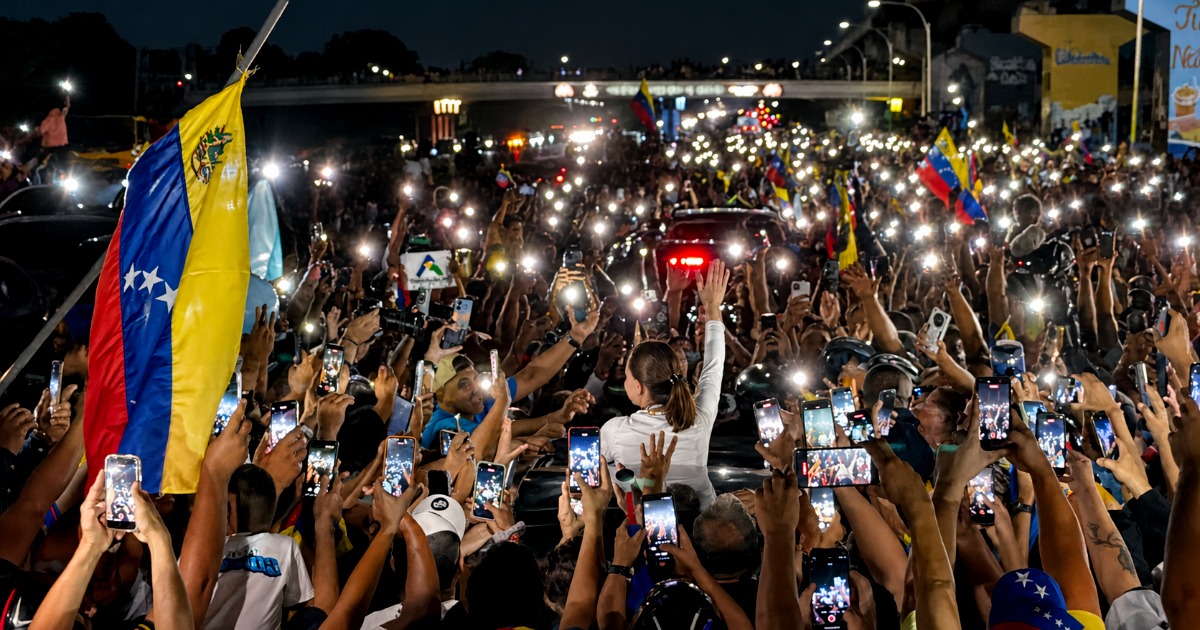
Almost a month after her return to Venezuela, María Corina Machado maintains a deliberately low-profile public presence, a strategy that political analysts consulted by EFE describe as the most appropriate given the current situation in the country, marked by a negotiation process between chavismo and the opposition.
The opposition leader and 2025 Nobel Peace Prize winner returned to Venezuela on October 25 after nearly ten months in exile and approximately 16 months in hiding, welcomed by thousands of supporters who spontaneously took to the streets.
Since then, Machado has favored private meetings over large public appearances: he has met with family members of political prisoners, victims of alleged human rights violations, members of his party Vente Venezuela, and members of the Democratic Unitary Platform coalition.
The political scientist Piero Trepiccione believes that this moderation is strategically sound. "It tempers expectations, and I think it also emphasizes measuring the organic nature of her support," he told EFE, adding that the former congresswoman is assessing whether the support reflected in the polls can translate into real organization and mobilization.
According to Trepiccione, the underlying goal is to create a strong connection between all political and civic factors: "To drive a sort of meta movement that encourages those significant changes rooted in the collective hope of Venezuelans."
One of the few public appearances by Machado since her return was an interview granted to Radio Rumbos, a station founded in 1949 with national coverage on AM, an unprecedented event for her, having been excluded from traditional Venezuelan media for years. In January 2024, Machado herself reported that she had gone between four and ten years without being interviewed by private channels such as Venevisión, Televen, or Unión Radio.
Trepiccione emphasized that this interview marked a turning point compared to the past. "It's important for her to start appearing in some media spaces, not saturating or overwhelming her image, but rather presenting narrative lines and connections with citizens' expectations," the analyst added.
Regarding the negotiation table between chavismo and the opposition —which began its fourth cycle on November 13 in Caracas—, Machado still has not participated directly. She was not invited to these discussions, which are structured around former deputies of the National Assembly of 2015 and led by Dinorah Figuera for the opposition and Jorge Rodríguez for chavismo. Nevertheless, she has reiterated several times that she will not obstruct the process.
One of the central issues on that agenda is precisely the review of political disqualifications, including the one affecting Machado: the General Comptroller's Office disqualified her for 15 years in June 2023, a sanction that the Supreme Court confirmed in January 2024, preventing her from registering as a presidential candidate in the elections of July that year.
His first mass rally since returning is an "immense pilgrimage" scheduled for December 5 in Guanare, Portuguesa state, framed within a call from the Catholic Church to the basilica of the Virgen de Coromoto, patroness of Venezuela, with the support of Cardinal Baltazar Porras.
Related videos:
Filed under: