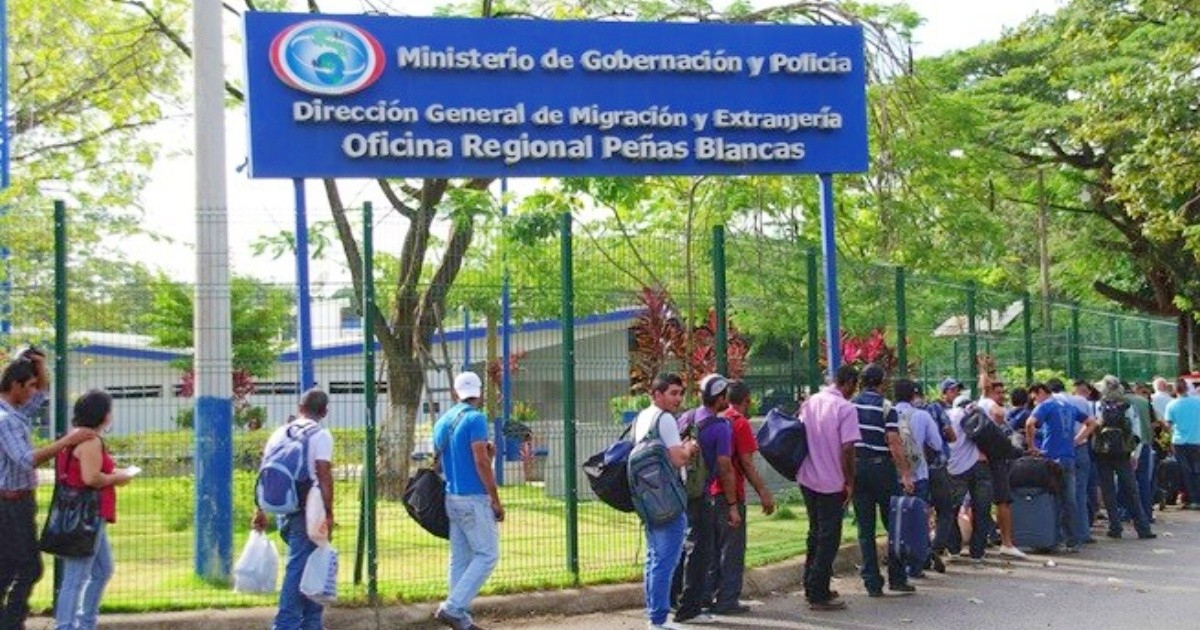
Costa Rica has ceased to be just a stopping point for Cuban migrants and has transformed into a place of prolonged transit or temporary settlement, according to the Regional Mobility Trends Report in Latin America and the Caribbean for the first half of 2026, published by the International Organization for Migration (IOM).
The document, based on data from the Displacement Tracking Matrix (DTM), indicates that migration flows along the Central American route transformed radically starting in 2025, when irregular movements to the north collapsed and patterns of stay in intermediary countries began to gain visibility.
The most revealing data from the report is that 100% of the Cubans interviewed by the IOM in Costa Rica during February 2026 stated that this country was their final destination, not a stopover to the United States.
This trend is reinforced by a survey conducted by the IOM in Costa Rica between January and February 2026: 94% of the Cubans surveyed expressed their intention to stay, citing better economic conditions, political stability, and access to international protection.
In terms of volume, between September 2025 and February 2026, the IOM recorded 1,541 entries of Cuban citizens from Nicaragua to Costa Rica, which accounted for 28% of the total migrants registered in that flow.
In February 2026, the DTM recorded approximately 1,200 movements southward in Costa Rica, with 856 people stranded in public spaces and 361 in shelters, equivalent to 71 cases in public spaces and 30 in shelters for every 100 estimated arrivals.
Cubans accounted for 10% of the migration flow to the south monitored in Costa Rica that month, while Venezuelans made up 86%.
This phenomenon is linked to the collapse of the Darién route: irregular crossings to the north fell by 97% in the first half of 2026 compared to the same period in 2024, dropping from over 200,000 to just 280 registered crossings.
Due to the practical impossibility of reaching the United States through that route, Cubans redirected their destinations towards Latin America. Brazil and Uruguay also emerged as new settlement hubs: approximately 3,000 Cubans per month entered Brazil via Guyana between January and May 2026, and that country recorded 16,982 asylum applications from Cubans during that period.
In Uruguay, the positive migration balance of Cubans reached 5,946 people between January and May of 2026.
In response to this reality, Costa Rica created a Special Temporary Category to regularize Cubans, Nicaraguans, Venezuelans, and Colombians with pending or denied asylum applications.
The program, which began accepting applications on September 1, 2026, will be open until September 1, 2027, and grants renewable two-year permits that allow individuals to work and travel abroad.
According to figures cited when announcing the measure, approximately 10,000 Cubans currently live in Costa Rica, and between June 2014 and May 2026, the country received 7,292 asylum applications from Cuban citizens.
The IOM concludes that mobility systems in Latin America and the Caribbean "are not simply contracting, but becoming more complex, fragmented, and multidirectional," with transit, return, circular migration, and remigration increasingly overlapping on various routes.
Related videos:
Filed under: