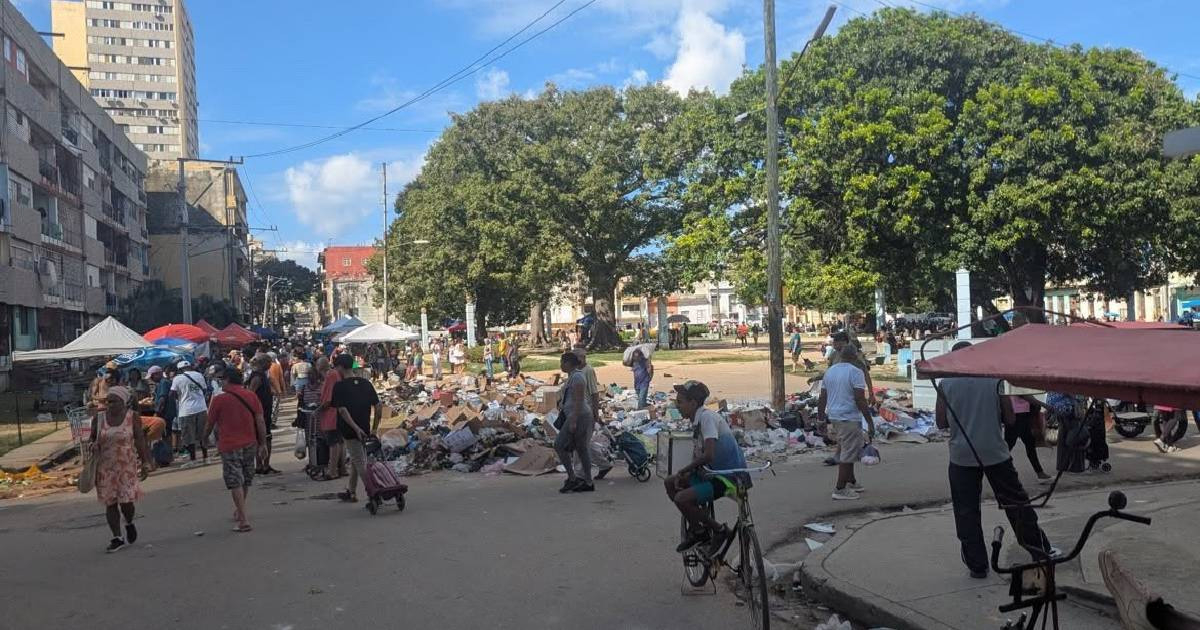
Photographs from a food fair in Trillo Park, Centro Habana, show stalls selling root vegetables and meat set up alongside large accumulations of waste on the streets surrounding that public space.
The images shared this Saturday by the profile on Facebook La Cubanísima show tents where, according to the description, onions, sweet potatoes, vegetables, and meat are sold, with some products placed on bags on the ground. A few meters away, an overflowing container, black bags, cardboard, and organic waste remain piled up without being collected.
The scene contrasts commercial activity with the precarious hygiene conditions of the surroundings, through which families with children pass. The exact date when the photographs were taken was not specified by the page that shared them.
"In any normal country, that is a public health emergency; in Cuba, it's just another day at the fair," wrote La Cubanísima alongside the images.
The publication sparked outrage among users. "We are living like anything but human beings," commented one person. Another expressed their confusion, stating, "I thought it was Haiti; that's how it is everywhere."
A third user summed up their perception of the institutional response with a blunt phrase: "And the government doesn't care at all."
In August, a video shared by the user Maykel Chapotín showed cardboard, plastic bags, and organic waste piled up in the same area. "With the smell and the worms, where are we heading?" he questioned at that time.
The Cuban activist Guillermo Rodríguez Sánchez showed images in June of how fruits and vegetables were sold on a street in Havana, amid piles of garbage, in what the author himself ironically described as the "exquisite hygiene conditions under which food is sold to the population."
Havana is experiencing a crisis in garbage collection, maintenance, and public hygiene. In recent weeks, complaints have surged regarding the proliferation of dumps and infestations of rats and insects in areas of the capital such as Monte y Fernandina, in the Cerro municipality, Neptuno Street, the Sevillano neighborhood, and Vedado.
The retired Cesáreo Navas y Morlanes, former audiovisual producer of the Cuban Institute of Radio and Television (ICRT), demanded on Saturday the resignation of the First Secretary of the Communist Party in Havana, Liván Izquierdo Alonso, and the governor Yanet Hernández López due to the neglect and lack of cleanliness in the city.
The Food Monitor Program warned in July that flies, cockroaches, rats, and other vectors can carry pathogenic microorganisms to the food consumed by the population. In June, a biologist alerted about the risk of a gastroenteritis epidemic in Havana.
Cuba closed 2025 with at least 81,909 cases of dengue and chikungunya and 65 officially recognized fatalities. The newspaper The New York Times linked the rise of these diseases to the waste crisis.
In December 2025, the government acknowledged the challenges of keeping the capital clean. The so-called Clean-Up Operation, carried out between October and November of that year, managed to collect nearly 396,157 cubic meters of waste in just over 20 days. However, the accumulation of garbage once again occupied public spaces in the following weeks.
Related videos:
Filed under: