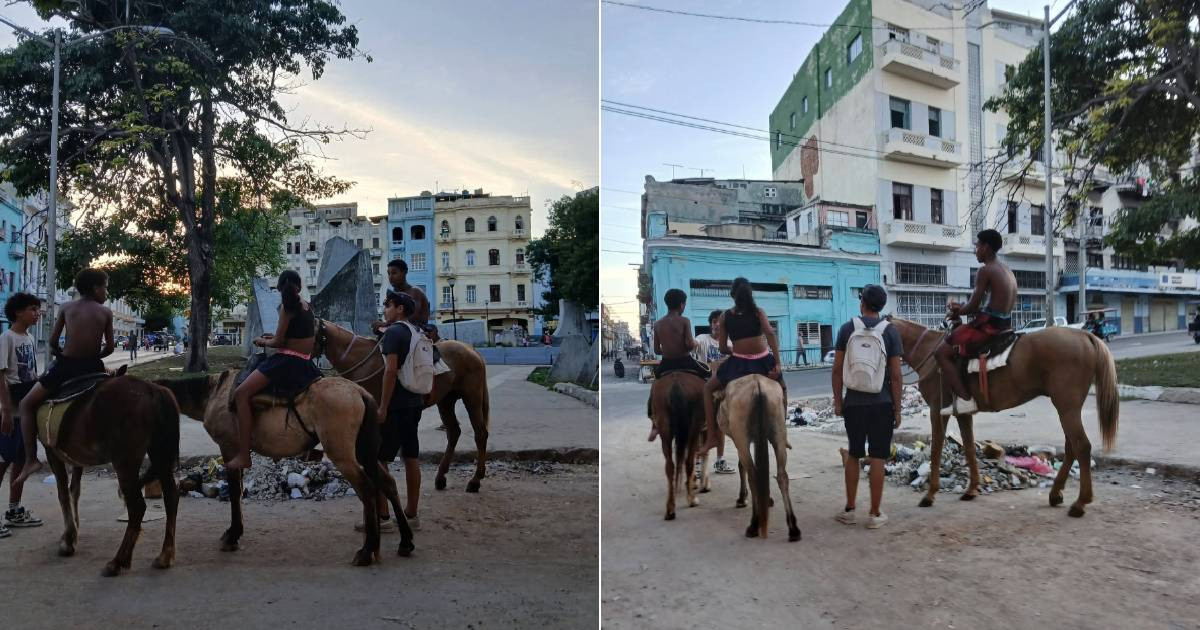
The Cuban filmmaker Marilyn Solaya questioned the regression of the Cuban capital this Friday by sharing photographs of people on horseback near the University Martyrs Park, at the boundary between Vedado and Centro Habana, an image she compared to a return to the 18th century.
The post on Facebook sparked reactions of outrage, dark humor, and sadness among its followers. "Mambí cavalry. In times of regression. They will soon reach 1492," wrote one user. Another commented that the capital seemed to be living in the 12th century, while a third person sarcastically remarked that that time had "less garbage."
"We are witnessing the ruralization of the capital," summarized a commentator. Other messages expressed frustration over the city's decline. "Everything is lost," wrote one user, while another follower admitted that many times she felt like crying at the sight of Havana's situation.
The publication appeared a few days after the 507th anniversary of Havana, celebrated on November 16, amid issues of infrastructure, collapses, waste accumulation, power outages, and difficulties with water supply.
The presence of horses, oxen, and carts in the streets is not an isolated phenomenon either. In response to the fuel crisis, the authorities in Havana proposed in February to use animal-drawn equipment for garbage collection in areas such as East Havana and Boyeros. Months later, the president of the Agricultural Business Group acknowledged that Cuba was reverting to technologies from the 19th century.
This situation is compounded by a sewage system built between 1908 and 1914 for a population of 600,000 inhabitants, which currently serves nearly two million people without any comprehensive modernization.
In July, historian Julio César González Pagés documented that residents of Old Havana, Centro Habana, and Cerro were resorting to nylon bags for defecation due to the lack of water, a situation he compared to conditions in the 18th century.
The comedian Ulises Toirac also questioned the state of the capital during the anniversary celebrations. "Abandonment and garbage want to consume it," he reported.
Solaya, the director of the film Estrés, which premiered in March, has also addressed issues of emigration, precarity, and poverty in Cuba through her work. Her film faced obstacles from the Cuban Institute of Art and Cinematographic Industry (Icaic) after, according to reports from the Assembly of Cuban Filmmakers, the institution made the budget for completing the film contingent upon the removal of scenes that the director refused to cut.
Related videos:
Filed under: