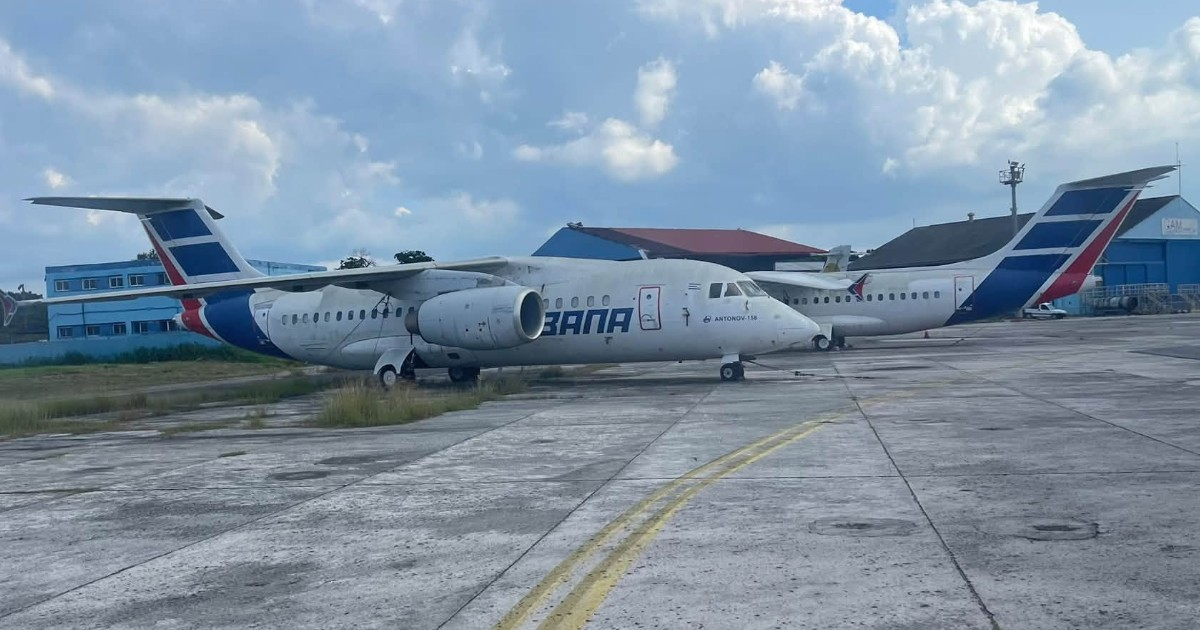
Photographs taken last Friday at the José Martí International Airport in Havana and shared in the Facebook group «Lovers of Cuban Aviation» show several aircraft from Cubana de Aviación parked and clearly in a state of disrepair, with vegetation growing alongside the landing gears and cracked concrete platforms.
Alberto Pavel Saint-Blancard, who posted the images, wrote: "I am still suffering as I witness firsthand how those airplanes, which we proudly saw soaring through the skies, are further deteriorating." The post garnered over 1,000 reactions and dozens of comments from Cubans who described the scene with a striking phrase: "The only aviation organization in the world that has a cemetery at the airport itself."
Among the aircraft visible in the photos, there are at least five with the distinctive livery of Cubana, a Cubana Cargo plane, and an Antonov An-158 that has already had its registration numbers removed. "They have removed the registration numbers from the Antonovs. What comes next?" asked a user. Another commented, "And this is the Antonov-158, the newest in that fleet. What a disastrous country, my God."
The image reflects the near-total collapse of the fleet. According to data from Planespotters updated on November 17, 2026, the airline has eight registered aircraft: only two in service and six grounded. A Wikipedia table from that same month lists three active —one ATR 42-500 and two ATR 72-200— with an average age of 29 years. One of the ATRs operates as government VIP transport under Aerogaviota, not on regular commercial routes.
The six Antonov An-158 aircraft that Cuba acquired since 2013 have been grounded for years. The Cuban aviation authority kept them on the ground in 2018 due to mechanical, hydraulic, electrical, and structural failures. With nearly 70% of their components made in Russia, obtaining spare parts became virtually impossible. One commentator summed it up like this: "They bought those An-158, which I believe are the only six that were manufactured for Cuba, without spare parts or anything and with navigation defects, the ladder, which is the door, and there you have the result. Brand new, they had to park them."
The causes of the collapse are structural and have been accumulating for decades. Another user pointed out that "76% [of the income from airport operations and international flights] was taken by GAESA, while ECASA kept 24%. That destroyed everything [...] from 1998 until 2017." In addition, there are the million-dollar lawsuits filed by the Russian company ARK-Technic against Cubana and the Cuban Aviation Corporation (CACSA) for maintenance debts exceeding 6.2 million dollars, with a second lawsuit filed in September 2026 for over 188 million rubles in additional claims.
The Jet A-1 fuel crisis at ten Cuban airports, in effect since February 2026 and with notices extended until December 1, further exacerbates the operational landscape.
Many comments rejected the idea that the U.S. embargo is the cause of the collapse. "No one feels it. Very poor management and failure to address the problems. And it's not the blockade because all these planes are of Russian manufacture," wrote one user. Others expanded the diagnosis beyond aviation: "If it were only the airplanes, but it's everything: the streets, roads, buildings, houses, farms, sugar mills, factories, stores, pharmacies, hospitals. The country is destroyed."
Founded in 1929 and nationalized after the 1959 revolution, Cubana de Aviación today receives a seven out of seven star rating in AirlineRatings.com's safety assessment and is not listed in the IATA Operational Safety Audit (IOSA) program. In January 2025, the president of CACSA himself acknowledged that the airline was operating with only two planes.
Related videos:
Filed under: