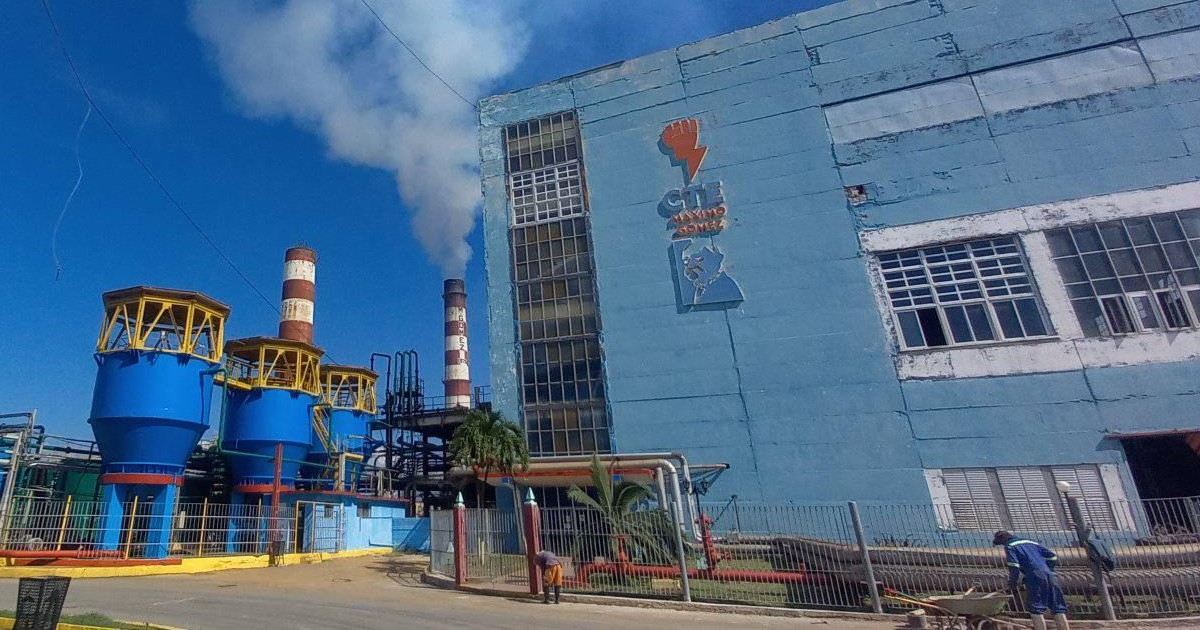
«Finally a believable justification,» a Cuban commented ironically after learning about the outage of unit 6 of the Máximo Gómez Thermoelectric Power Plant in Mariel, Artemisa province, due to a lack of fuel.
The Electric Union (UNE) reported this Tuesday, November 24, about the new decline in the National Electric System (SEN) through a brief post on Facebook, without providing details on the causes of the supply shortage or an estimated date for the return of the unit.
“Unit 6 of the CTE Máximo Gómez is offline due to a lack of fuel, ” announced the state-owned company.
The explicit acknowledgment of fuel scarcity as the reason for the unit's shutdown prompted numerous sarcastic reactions among internet users, many of whom expressed their distrust towards the company's usual explanations for the interruptions in electricity generation.
“For the first time, they are telling the truth”, “First credible news in so many years from the UNE”, “Finally a true justification” or “First real news they are providing”, were some of the comments.
Several users ironically celebrated what they considered a more honest explanation from the authorities: “And the award goes to #UneCuba for telling the truth”, one of them wrote.
Among the main concerns raised by internet users was the use of national crude oil in the Mariel thermoelectric plant: "I understand that the crude they use is Cuban crude... I really don't understand," commented another user.
"But that plant, doesn't it use domestic crude? If so, what went wrong?", asked another internet user, while several questioned whether the issues were due to difficulties in production, transportation, delivery, or the availability of suitable fuel for its operation.
Others sought precise information about when the supply would be restored and when the unit could return to the electrical system: "And when will the fuel be supplied? Please, this is a sensitive issue and must be communicated with certainty."
Criticism of the use of fuel in the regime's recent military exercises was also present, while the population continues to endure prolonged power outages: "It doesn't matter, there is no deficit for military exercises," one user ironicized.
The concern among Cubans intensifies over the adverse weather conditions forecasted for the coming hours in the western part of the country, where the lack of electricity hampers access to information and the heavy cloud cover limits solar panel generation.
"When we need electricity the most to stay informed, we don't change for God's sake," and "Well, neither sun nor power, what a lovely view," were other reactions.
Some internet users expressed their fear that the situation could worsen in the coming weeks: "The worst December in history is coming," lamented one of them.
Although the admission of the fuel shortage particularly caught the attention of users, it is not the first time that Cuban authorities have acknowledged its impact on electricity generation.
In September of last year, UNE executives acknowledged that the country lacked imported fuel to operate the distributed generation plants, the trucks in Havana, and other sites, a situation that left over 1,200 megawatts (MW) of generation capacity idle.
Similarly, in June, during one of the most critical periods of the year for the electrical system, marked by the outage of the Felton thermoelectric plant, the UNE also reported 106 distributed generation plants (installations of generator sets) halted due to lack of fuel, equivalent to 890 MW.
Days later, on June 15, when the Antonio Guiteras thermoelectric plant was disconnected from the SEN again, the generation capacity unavailable due to fuel issues rose to 1,203 MW.
The problem dates back to previous years. In November 2024, as Cuba prepared for the impact of Hurricane Rafael, authorities acknowledged that the shortage of fuel, along with the breakdowns of several thermal units, contributed to a shortfall of 1,750 MW and blackouts of up to 20 consecutive hours in some regions of the country.
Related videos:
Filed under: