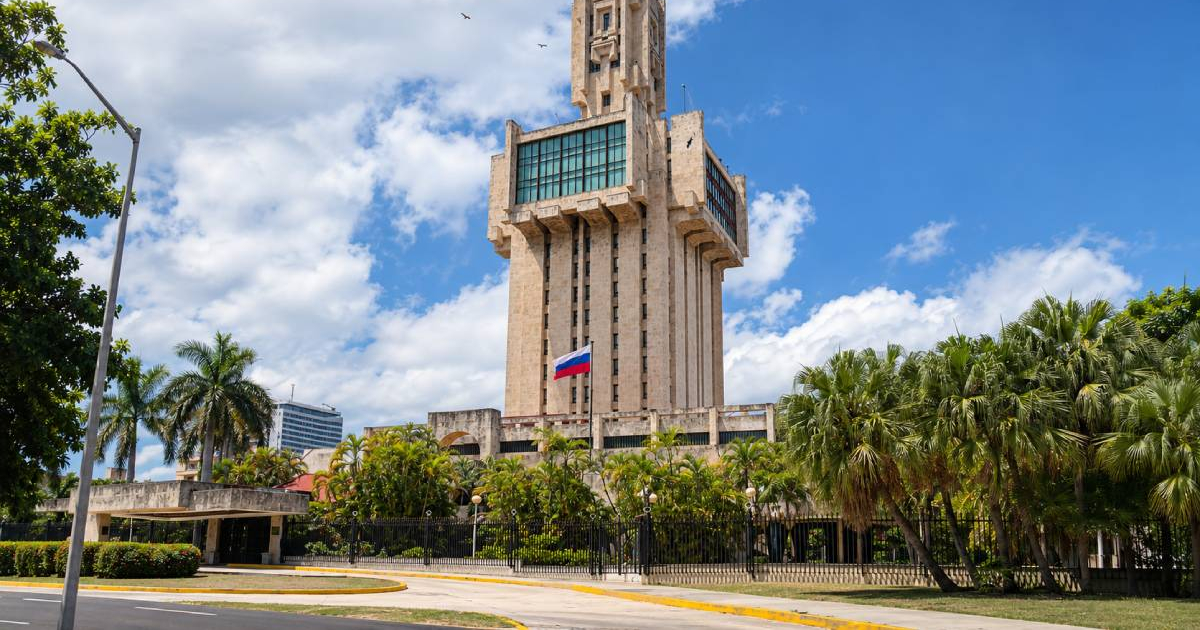
The Russian ambassador to Cuba, Víctor Koronelli, acknowledged this Monday to the state agency TASS that Russian tourism on the island has reduced to “isolated cases” and that the lack of aviation fuel prevents the reinstatement of direct flights. The diplomat also provided details about the limited supply of Russian oil to Cuba during 2026.
The statements, gathered in five pieces published by TASS throughout the day, are an involuntary admission of the gap between the rhetoric of "firm and unconditional support" that Moscow has been repeating for months and the limited material assistance that has actually reached Cuba.
Russian tourism, practically extinct
Koronelli explained that traveling from Russia to Cuba currently requires at least two stops, via Turkey and Panama or Turkey and Mexico.
"This is expensive and lengthy. That's why our travelers in Cuba are isolated cases now. There are no organized tourist groups from Russia here," he stated.
In 2024, Russia was the second largest source market for tourists to Cuba, with 185,816 visitors, following Canada.
The decline of Russian tourism is reflected in the official statistics. Between January and August 2026, Cuba received 21,563 visitors from Russia, compared to 80,653 during the same period in 2025, a decrease of 73.3%. The collapse coincides with the suspension of direct flights since February, due to a shortage of aviation fuel on the island.
The ambassador also acknowledged that "many large foreign hotel chains have left Cuba, and the number of operating hotels has drastically decreased."
The Cuban government confirmed in July the departure of seven international hotel operators, including Meliá, Iberostar, and Barceló. In October, the Gaviota hotel empire was operating only 11.6% of its rooms.
No kerosene, no flights, no date
Regarding the absence of a direct air connection, Koronelli was explicit: "The main problem is that in Cuba, due to the severe fuel shortage, there is no aviation kerosene." He noted that only airlines that do not need to refuel there operate to the island.
Representatives from Cuban civil aviation and the Russian aviation authority, Rosaviatsia, held discussions in Moscow regarding the possible resumption of direct flights. According to Koronelli, both parties confirmed their interest in reestablishing the connections, although no date for this was announced.
Only one tanker throughout the year
In the energy sector, Koronelli boasted that the only tanker to deliver oil to Cuba in 2026 was Russian: it arrived in March with 100,000 tons of crude. What the ambassador omitted is that this shipment, as acknowledged by the Cuban ambassador in Moscow in October, only reduced blackouts for about two weeks. A second Russian tanker changed course in the South Atlantic in May and never reached the island.
The International Affairs Committee of the Russian Duma acknowledged in early November that Cuba has been "practically" without fuel imports since August 2026.
The promises: oil, medication, and a 10 MW solar plant
Regarding Russian material aid to Cuba, Koronelli mentioned two shipments of vitamin-enriched vegetable oil purchased through contributions from Moscow to the UN World Food Program.
He also reported on a shipment of medication being prepared by the government of Saint Petersburg and a project to build a solar plant of about 10 MW intended for a water pumping station in Havana. This latter initiative is still in the study phase by the Russian Ministry of Energy.
"On various platforms, Russia constantly provides Cuba with strong political support, as well as the material assistance within its reach, and will continue to do so," said Koronelli.
Just five days earlier, Russian Deputy Minister Ryabkov had met with the Cuban ambassador in Moscow and reaffirmed the "strong and unconditional" support without specific commitments for fuel to the island.
Related videos:
Filed under: