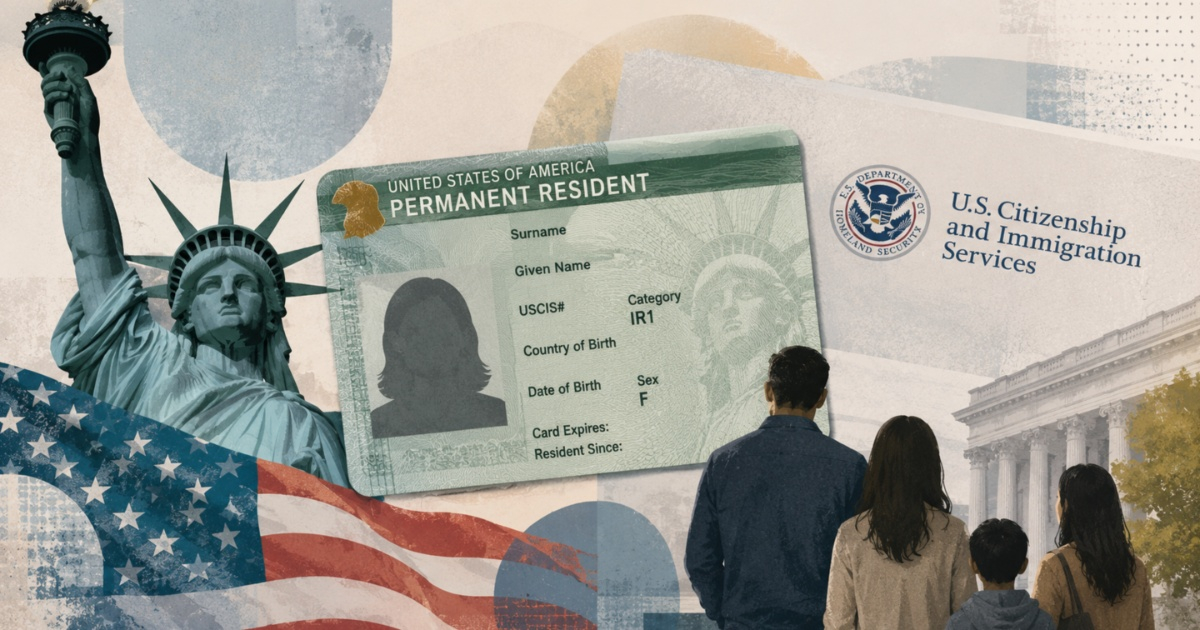
The United States Supreme Court will examine next Monday a case that could determine the immigration future of Cubans and other immigrants who obtained asylum in the country but later lost that protection without having secured permanent residency.
According to the official Supreme Court record, the justices will hear oral arguments in the case Wassily v. Blanche (No. 25-842), in which two immigrants are claiming the ability to obtain permanent residency despite having their asylum status terminated due to criminal convictions.
The legal controversy revolves around whether a foreigner who received asylum retains the ability to apply for a green card through that avenue after losing such protection.
The ruling could have consequences for both the primary beneficiaries of asylum and their spouses and children, when these have obtained their immigration status derivatively.
What is at stake before the Supreme Court?
The dispute centers on the interpretation of section 209(b) of the United States Immigration and Nationality Act, which allows for permanent residency to be granted to foreign nationals who have been granted asylum and meet certain requirements.
Among those conditions are having accumulated at least one year of physical presence in the United States after receiving asylum, continuing to meet the corresponding legal requirements, and being admissible as an immigrant, except for the exceptions provided by law.
The federal courts of appeals for the Second and Fourth Circuits have determined that those who lose their asylum are automatically excluded from the possibility of adjusting their status through that route.
The Fifth Circuit, on the other hand, has considered that the termination of asylum does not necessarily prevent one from applying for permanent residency.
In its submission made on October 2, the Department of Justice argued that the legislation reserves that possibility for immigrants who maintain their asylum status.
The plaintiffs' lawyers argued in their reply on November 2 that the law does not explicitly establish that restriction and that the prior grant of asylum can still serve as a legal basis to apply for status adjustment.
A favorable ruling for the plaintiffs would not guarantee the acquisition of permanent residency, but it would allow for the individual evaluation of applications from those who have lost their asylum and meet the other legal requirements.
The cases that reached the Supreme Court
The protagonists of the litigation are Tamer S. Wassily, an Egyptian citizen who obtained asylum in the United States in 2000, and Byron E. Velasquez Arreaga, a Guatemalan citizen who received that protection in 1996.
Wassily lost his status after being convicted of harassment and endangering the welfare of a minor. An immigration judge initially granted him permanent residency, but that decision was later overturned by the Board of Immigration Appeals.
Velasquez Arreaga, for his part, lost his asylum after convictions related to driving under the influence of alcohol and also saw his opportunity to adjust his immigration status thwarted.
Both appealed to the Second Circuit Court of Appeals, which ruled against them on August 7, 2025. The Supreme Court agreed to review the case on June 29.
Why could family members also be affected?
One of the most sensitive aspects of litigation is that its consequences could extend to people who have not committed any crime.
The U.S. federal regulations stipulate that the termination of the principal beneficiary's asylum also means the loss of derivative asylum for their spouse and children.
If the Supreme Court supports the Government's interpretation, those relatives could also be prevented from applying for permanent residency through asylum, even if they are not responsible for the circumstances that led to the loss of the holder's status.
The plaintiffs' lawyers even warned about the potential consequences for victims of domestic violence who obtained immigration protection through the asylum granted to their aggressors.
The regulations allow, however, that affected family members can submit their own asylum applications if they meet the legal requirements.
How could the decision affect Cubans?
The upcoming ruling is particularly important for Cuban immigrants who have already received asylum in the United States but have not yet obtained permanent residency, as well as for those who have relatives protected by derivative asylum.
However, Cubans have a migratory alternative that sets them apart from most foreigners: the Cuban Adjustment Act of 1966.
This legislation allows nationals or naturalized citizens of Cuba who have been inspected and admitted or have received a temporary stay permit known as parole, to apply for permanent residency after accumulating at least one year of physical presence in the United States and meeting the other legal requirements.
Therefore, losing asylum does not necessarily mean that a Cuban is deprived of the possibility of obtaining permanent residency through other means.
The impact of the future ruling could be greater for those Cubans who obtained asylum but do not meet the requirements of the Cuban Adjustment Act, as well as for those with criminal records that hinder their access to residency.
Among those potentially affected are certain holders of Form I-220A who have been granted asylum but lack a valid admission or parole to qualify for Cuban adjustment.
The case that the Supreme Court will examine does not directly challenge the Cuban Adjustment Act nor alter the requirements of that legislation.
It also does not represent an immediate change for those with pending asylum applications, as the controversy specifically concerns immigrants who were granted that protection and subsequently had it revoked.
What can Cubans do who are still waiting for their residency?
Those who already have approved asylum can check if they meet the requirements to apply for permanent residency using Form I-485 and determine which of the available pathways is most suitable for their circumstances.
It is advisable to consult an immigration attorney, especially if there are criminal records, ongoing deportation proceedings, or notifications regarding a potential termination of asylum.
Submitting an application for permanent residency does not, by itself, prevent authorities from initiating a procedure to revoke that immigration protection.
Other pending migration cases before the Supreme Court
The hearing next Monday will take place while the U.S. Supreme Court examines other immigration controversies that could have implications for the Cuban community.
The Supreme Court has already agreed to review whether Donald Trump can ban asylum applications at the southern border of the United States.
It is also pending a decision on whether to agree to review a Government resource that could restrict access to habeas corpus for detained immigrants, including Cubans confined in centers like Krome in Florida.
Related videos:
Filed under: