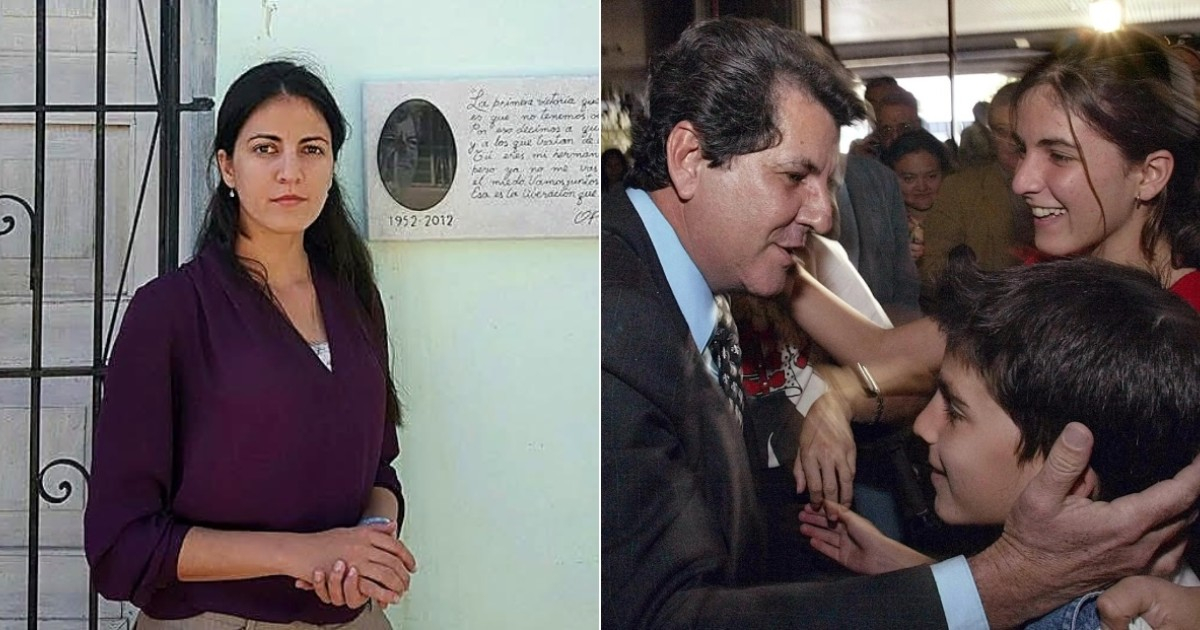
Rosa María Payá, commissioner of the Inter-American Commission on Human Rights (IACHR) and founder of Cuba Decide, published a message on X this Wednesday in which she reaffirms her commitment to the freedom of Cuba and asserts that this freedom "is closer than many imagine."
The text begins with a declaration of principles: "I was born in a Cuba without freedom, which is why I dedicate my days to ending that slavery."
Payá recalls his childhood in the Cerro neighborhood of Havana, in a house where, as he writes, "faith and freedom were spoken loudly, while outside many learned to speak softly."
In the message, he remembers his father, Oswaldo Payá, founder of the Christian Liberation Movement and promoter of the Varela Project, which in 2002 gathered more than 35,000 citizen signatures demanding political reforms from the Cuban regime.
"I saw thousands of people signing their names on a piece of paper, fully aware of the potential consequences. And I witnessed what the regime does to those who do not remain silent: they murdered my father," writes the activist.
Oswaldo Payá died on July 22, 2012, alongside activist Harold Cepero when the car they were traveling in crashed in the province of Granma. The family maintains that a vehicle belonging to State Security intentionally rammed their car. In June 2023, the Inter-American Commission on Human Rights concluded that there was "serious and sufficient evidence" of the involvement of Cuban state agents in both deaths, and the U.S. Department of State publicly classified the events as a crime of the regime in July 2025.
Payá also recalls in his post the return to Cuba in February 2017 to present the Oswaldo Payá Award: "We did it under harassment and intimidation. The awardees were not allowed to enter the country."
The message emphasizes that their work is not an individual effort: "I do it with the mothers of political prisoners, with those who take to the streets in Cuba not knowing if they will return home, with the Cubans outside who do not forget the island."
One of the central themes of the text is the transition plan "Cuba on the Threshold", presented on November 3 in Madrid by Cuba Decide and Pasos de Cambio, just days before the XXX Ibero-American Summit.
The document, consisting of over 50 pages, proposes four phases —liberation, stabilization, reconstruction, and democratization— and includes the release of more than 1,000 political prisoners, a provisional government lasting between 18 and 36 months, a provisional Parliament of 51 members, and, as a final goal, free elections with international oversight.
The plan is based on the Liberation Agreement signed in Miami on March 2, 2026, by more than 30 Cuban opposition and civic organizations, and ratified in Madrid on June 1 of that same year.
Payá serves as commissioner of the IACHR since January 2026, after being elected by the General Assembly of the OAS with 20 votes for the period 2026-2029, becoming the first person of Cuban origin to be part of that organization.
In October, she received the XIII FAES Freedom Award in Madrid, shared with Yulia Navalnaya and Masih Alinejad, presented by former Spanish President José María Aznar.
"Cubans, both inside and outside the country, have not given up on being free, and that freedom is closer than many imagine," Payá concludes in his message.
Related videos:
Filed under: