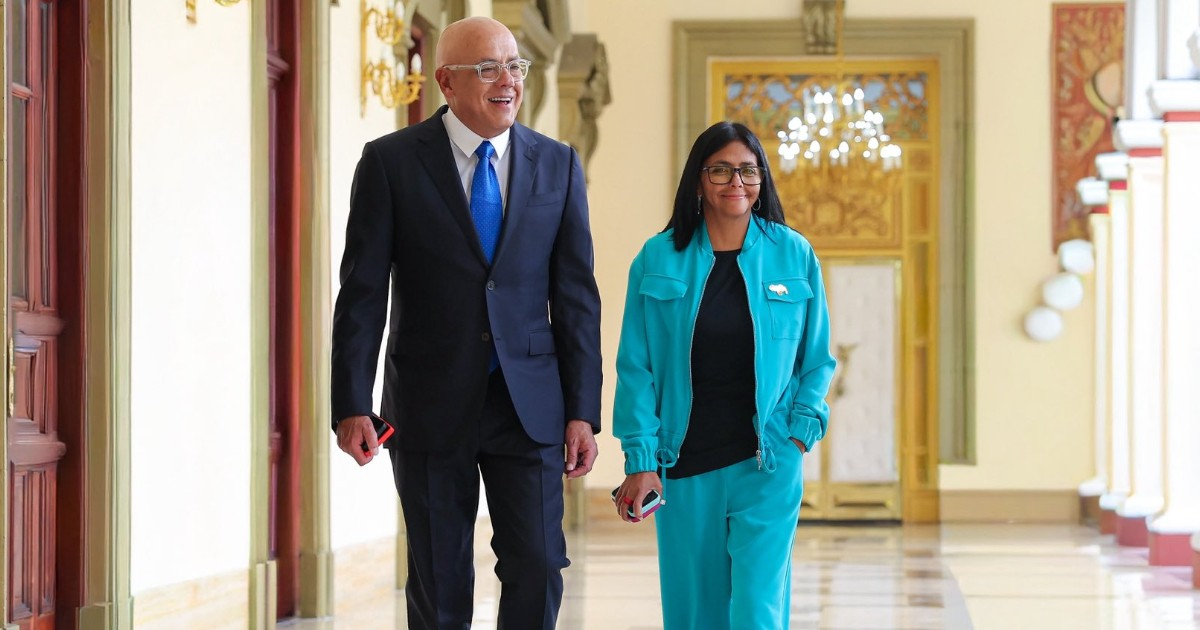
A report from the Congressional Research Service, updated this Tuesday, concludes that the Trump Administration has focused its influence over Venezuela on securing extractive agreements and a military alliance with the current government of Delcy Rodríguez, while the democratic transition and elections remain without a specific date.
The document, titled "Venezuela's Post-Maduro Political Transition and U.S. Policy" (R49186), explicitly states that Washington "has primarily used its influence to maintain stability and secure extractive agreements with current officials," rather than prioritizing pressure for an immediate political transition.
After the arrest of Nicolás Maduro by U.S. forces on January 3, 2026, the Administration backed Rodríguez as acting president, sidelining Edmundo González Urrutia, whom the State Department itself had recognized as the legitimate winner of the 2024 elections, and the opposition leader María Corina Machado.
The sanctions against Rodríguez, imposed in 2018 for corruption, were lifted on April 1, 2026, by the Office of Foreign Assets Control of the Treasury. According to a report from the AP agency included in the document, the Administration also instructed prosecutors to "take no legal action" against her, even though she had been a "priority target" for the DEA.
In the energy sector, Venezuelan production reached 1.2 million barrels per day in September 2026, and exports to the United States grew from 439,000 barrels per day in March to 708,000 in August. In the same month, Trump announced the largest oil deal in history, through which Washington gained majority control over more than 65 billion barrels of Venezuelan reserves via the company NABEP, with a 35% stake for the Department of War.
In military matters, Secretary of Defense Pete Hegseth signed a technical-military cooperation agreement in Caracas last week that restores the bilateral alliance interrupted in 2005 and includes joint training, intelligence sharing, and potential supply of defense equipment. The CRS report warns that increased cooperation could raise concerns about sovereignty.
Regarding the political process, Secretary of State Marco Rubio clarified this month that once the new Supreme Court and the National Electoral Council are established, "a vacancy in the presidency would be declared, triggering a six-month period for an election." U.S. officials are aiming for "late 2027 or early 2028."
The negotiations between chavismo and the opposition concluded their fourth round this week with commitments regarding legal reforms and press freedom, but without setting an election date. The State Department reported over 1,000 releases since January, although Foro Penal still recorded 321 political prisoners as of November 9. The UN Fact-Finding Mission acknowledged some improvements, but warned that the repressive structures "have not been dismantled."
The Congress approved 50 million dollars for democracy programs in Venezuela and is promoting legislation that would prohibit using those funds to lift sanctions without certifying free and fair elections. Meanwhile, the Senate is investigating whether Vice President JD Vance favored an electoral donor in obtaining licenses for Venezuelan crude oil.
The fifth cycle of dialogues is scheduled for December 10, a date that the opposition chief negotiator Dinorah Figuera described as an engagement with "the historical responsibility we have and that the people are waiting for."
Related videos:
Filed under: