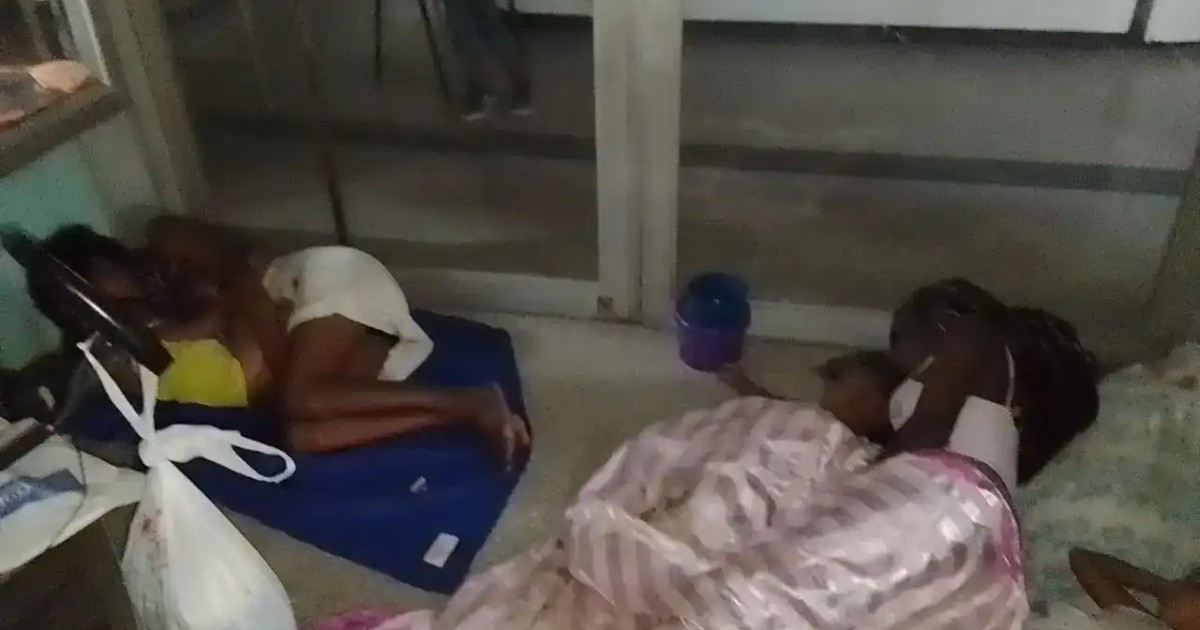
Two women with their underage children have been surviving in the open air in Havana for almost a month, sleeping in doorways on mats and spending the day in public spaces, according to a report by CubaNet.
Ariacna, 35 years old and originally from Santiago de Cuba, came to the capital escaping the misery she describes in her province. “Children there are suffering, facing hunger and need. Women are almost selling everything because the children have nothing to eat,” she reported.
The authorities refuse to address her case, arguing that she does not have official residency in Havana, and she has been deported to Santiago de Cuba four times. Despite this, she returns to the capital each time, where she claims she can at least access some form of assistance.
Ariacna went to several government institutions, including the Plaza de la Revolución, without getting any solution. The social assistance she receives—just over 4,000 Cuban pesos per month—falls far short of providing enough food for her four children.
To survive, she has had to sell the milk allocated for minors and even their cribs. The group's food largely depends on the soup distributed from Monday to Friday by the Quisicuaba project, a community kitchen in Centro Habana that has become a refuge for thousands of people in vulnerable situations, as well as what passersby give them.
To that situation is added an even harsher blow: one of her sons, a minor with autism, was taken away by Child Services during an intervention on the Havana boulevard. "And since that day, I haven't seen my child," the mother lamented. Ariacna insists that she does not want to be deported again. Her only wish, as she stated, is to stay in Havana, find a job, and provide for her children.
Yamila, who is about 19 years old and from Havana, has been living on the street with her one-year-old baby for a month. According to her account, her parents emigrated to Italy and the father of her child was murdered. The young woman claimed that she had to turn to prostitution in order to feed the child.
Due to the lack of sanitary facilities, both mothers and children relieve themselves in the parks where they spend the day, Cubanet reported.
The phenomenon of internal deportations is legally supported by Decree 217 of 1997, , which establishes restrictions for establishing residency in Havana. Those without residency—mostly individuals from the eastern part of the country—can be detained and forcibly transported back to their provinces of origin. Activists have documented cases of forced deportations in recent months, and at the beginning of November, a police operation in San Miguel del Padrón resulted in 71 detainees, including individuals classified by the authorities as "undocumented and illegal in the capital."
The CEPAL projected a contraction of the Cuban GDP by 10.3% in 2026, the worst in Latin America and the Caribbean, while the Cuban Observatory of Human Rights estimated that 94% of the population lives in extreme poverty. The average monthly salary in Cuba reached 7,354 pesos in August, according to the ONEI, a figure that makes it impossible to meet even the most basic needs.
Related videos:
Filed under: