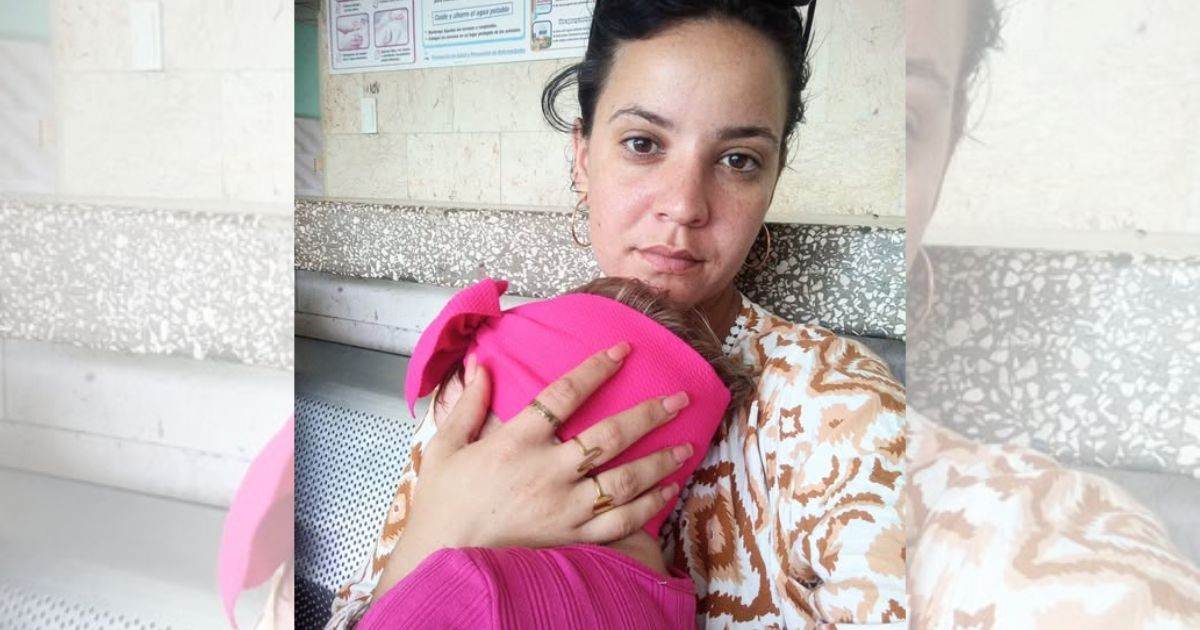
The independent journalist Vivi Guerra published on Saturday on Facebook a report regarding the state of the Provincial Pediatric Hospital "Mártires de Las Tunas" in eastern Cuba, after taking her daughter —apparently diagnosed with dengue and very low platelets— to that children's health center.
Guerra recounted that, in the absence of private hospitals in Cuba, he had no choice but to go to the pediatric ward. There, he waited for hours in the waiting room until he questioned the situation and found out that they had treated more children than those listed on the official roster.
The situation escalated when the staff denied her quick access to a sheet so that the doctors could examine her daughter, claiming they were "cleaning." Guerra's response was direct: "If you expect me to wait until you finish cleaning, you are mistaken; she will be examined now, and in the meantime, clean the restrooms."
Regarding the hygienic conditions of the center, the complaint left no room for doubt: "The restrooms were disgusting. Full of urine, foul odor, and [...] The waiting room was unbearable." Guerra emphasized that in an institution aimed at children, hygiene should be a minimum priority.
Once the minor was admitted, the mother observed that the medical treatment was appropriate, although she assumes it was not for equal reasons: "My daughter was never treated poorly; it would be a lie to say otherwise. She received preferential treatment solely for being the daughter of a dissident journalist, at least from the doctors, because the service staff leaves much to be desired."
The author also pointed out that, as usual, she had "a tail behind her," referring to the constant surveillance by the Cuban state over her and independent journalists in general.
The food provided to hospitalized children also raised concerns. For patients with dengue and very low platelet counts, the diet consisted of "syrup soda for breakfast, pea stew with black beans, white rice, and boiled plantain, even flour croquettes and white soup"—a menu that Guerra clearly deemed insufficient given the severity of those cases.
The complaint also included other warnings: the first regarding the use of inmates to clean the children's wards without any knowledge of whether they have a history of sexual offenses; the second concerning the possible diversion of medications from the hospital to the informal market. "This investigation is just beginning," he cautioned.
Guerra's testimony is not an isolated incident. The same hospital promoted the use of coconut water and homemade solutions in September to hydrate children with diarrhea, due to the scarcity of oral rehydration salts in pharmacies. In August, the center reported that it regularly lacked food for children under two years old, and a family-owned business donated 50 boxes of natural juices to help meet that need.
The structural problems of the building date back further: in March 2021, a section of the ceiling was supported by beams to prevent a collapse.
The epidemiological context exacerbates the situation. In September, the circulation of dengue serotype 4 in Las Tunas was confirmed, posing a special risk to children. On a national level, estimates from the Global Dengue Observatory reported nearly 15,859 accumulated cases in Cuba as of October 2026, which is approximately 9.2 times the historical five-year average.
The practice of employing inmates for hospital cleaning tasks is not new either: it also came to light in May 2024 at the Saturnino Lora Hospital in Santiago de Cuba, where incarcerated individuals were cleaning restrooms due to a shortage of aides.
The Cuban healthcare system is experiencing its worst crisis in decades. Guerra summed it up with a phrase that captures the indignation of thousands of families: "A country that cannot guarantee a dignified institution to care for its children must take a hard look at itself."
Related videos:
Filed under: