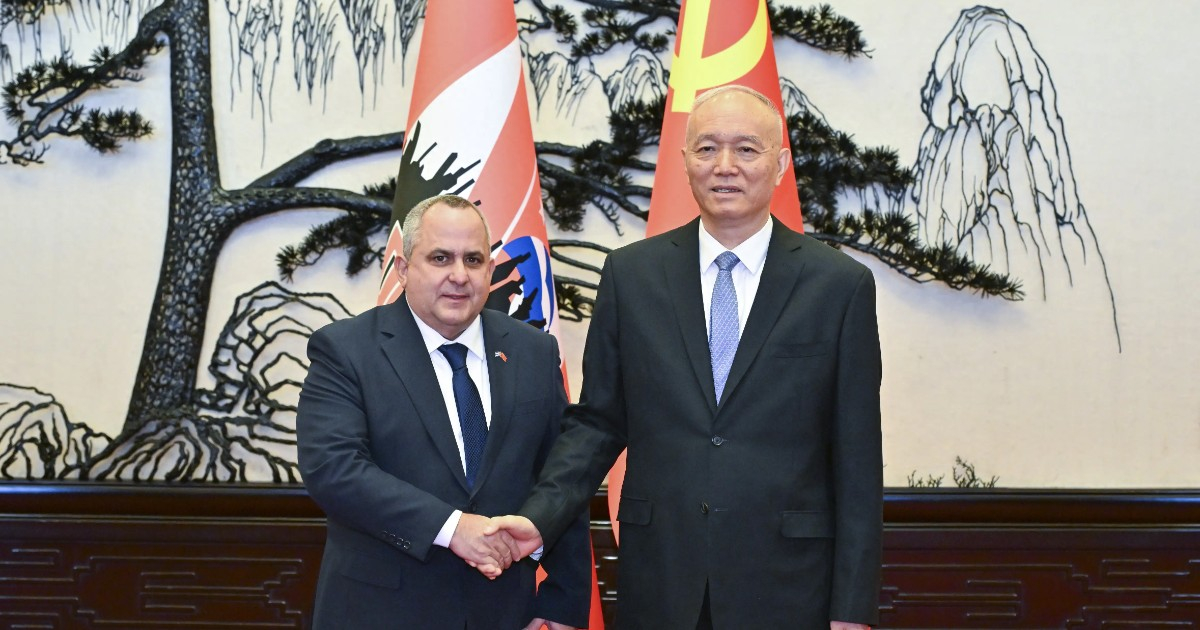
While Cuba is experiencing its worst economic crisis in decades, with power outages lasting over 20 hours and hospitals delivering babies with flashlights, the economic leadership of the Communist Party of Cuba traveled to Beijing to "study" the Chinese model.
According to an official announcement from the Chinese state agency Xinhua, reproduced on Sohu, on Wednesday Jorge Luis Broche Lorenzo —secretary of the Secretariat of the Central Committee of the PCC and head of its Economic-Productive Department— led a "study delegation of officials" received in the Chinese capital.
The information comes exclusively from official sources of the Communist Party of China and has not been confirmed by independent media.
The host of the meeting was Cai Qi, the fifth man in the hierarchy of the CPC and secretary of the Secretariat of the Central Committee, one of Xi Jinping's closest collaborators.
That a official of that rank would receive a "study" delegation —rather than a head of state or a foreign minister— underscores the partisan and ideological nature of the relationship between the two regimes, rather than that of a conventional diplomatic meeting.
According to the official Chinese statement, Broche "expressed Cuba's interest in studying the experience of the CPC in leading reform and opening up, as well as in economic and social transformation," and "thanked the Chinese assistance and support in light of the situation Cuba is facing."
Cai Qi, for his part, informed the visitors about the results of the fifth plenary session of the 20th Central Committee of the Communist Party of China, held in October and focused on internal discipline and anti-corruption. The official announcement does not detail specific agreements or economic commitments resulting from the meeting.
The following day, the delegation was also received by Liu Haixing, head of the International Department of the Central Committee of the CPC, as reported by the Chinese Embassy in Cuba.
The visit of Broche transforms November 2026 into a month of intense Cuban diplomatic activity in Beijing. Just two weeks earlier, Foreign Minister Bruno Rodríguez Parrilla traveled to China as a special envoy of the PCC and the government, where he met with senior officials of the Communist Party of China and signed three biopharmaceutical agreements in Shanghai. In August, Liu Haixing had visited Havana to meet with PCC leaders.
The regime has been invoking the "Chinese model" as a reference for its reforms for months. In June, Díaz-Canel announced more than 176 economic transformation measures —including converting state-owned enterprises into joint-stock companies and allowing private banking— citing China and Vietnam as examples of countries where communist parties maintained power while partially liberalizing the economy.
However, Vice President Óscar Pérez-Oliva Fraga clarified in July that Cuba "is not replicating the Chinese or Vietnamese model," although he acknowledged that both experiences have been studied.
Critics point out that the regime mimics the opening discourse without the accompanying freedoms and that the promises of reform have remained unfulfilled for years. Meanwhile, economist Omar Everleny Pérez estimated a contraction of the Cuban GDP of 10.2% for 2026, annual inflation reached 28.44% in September—with food prices rising by 42.66%—and blackouts exceed 20 hours a day in some areas.
The Chinese ambassador in Cuba, Hua Xin, acknowledged in the People's Daily that healthcare personnel at a clinic in Havana reported that they used flashlights to assist with childbirth during power outages.
One day after the meeting with Broche, Díaz-Canel inaugurated the "Habana 220" battery system —50 MW built with Chinese technology— as part of an energy cooperation program that includes up to 92 solar parks with an approximate capacity of 2,000 MW by 2028.
Related videos:
Filed under: