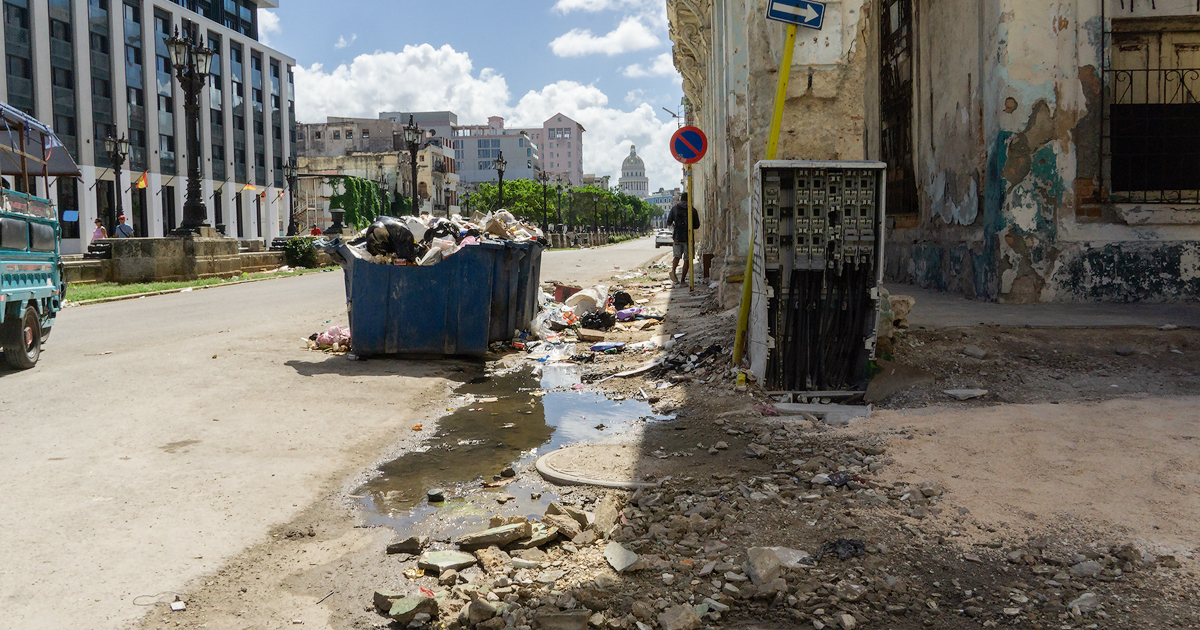
A columnist from the Chinese outlet Guancha, published in the state media of Shanghai The Paper, wrote a chronicle about Cuba that reaches an uncomfortable conclusion for the Havana regime: the revolution that promised to end dependence on the United States now primarily supports its families thanks to relatives who moved to Miami.
The text, signed by Li Yun and titled "In Cuba, remittances from Miami and Chinese cargo ships," is based on six days of travel to the island in October, with a Cuban sociologist as a guide. Its news value lies in the origin of the outlet: Guancha is a nationalist publication aligned with the Communist Party of China, and The Paper is state-owned.
That both spread a critical portrayal of Cuba —without solely blaming the embargo— is a sign that the regime itself can hardly afford to ignore.
Li Yun opens with the demographic data for 2025: 68,064 births compared to 136,214 deaths. "For every newborn, the country bids farewell to two people," he writes. The total population decreased by more than 313,000 individuals in just one year, combining a negative natural balance with a net emigration estimated at around 245,000 people.
The columnist describes the ration book—active since 1962—based on a copy shown to him by his guide: 14 pounds of rice per month for two adults, about 106 grams of raw rice per person per day, and with months of delay: in February 2025, some areas were still receiving the allocation from December 2024.
The World Food Programme noted that in 2023, the standard basket covered only 46% of the recommended caloric intake.
The economic contrast is devastating. The average salary in 2025 was 6,930 pesos, equivalent to just over 9 dollars at the informal exchange rate of October —when the dollar was already trading at 750 pesos, compared to about 42 in 2020—. The estimated monthly cost of basic living was around 96,060 pesos, fourteen times that salary. "The products are on the shelves," writes Li Yun, "but those living on a salary or a pension cannot afford to buy them."
The deterioration extends to the pillars that the regime has always showcased as achievements. In education, before the start of the 2026-2027 school year, only 73% of teaching positions were filled; the government moved around 3,000 teachers from the eastern provinces to Havana, and the national school uniforms barely met 12% of the demand.
In health, up to 70% of essential medications were unavailable, and the UN reported over 100,000 patients on the surgical waiting list, including around 11,000 children. The official housing deficit exceeded 805,000 homes, with only 5,493 units completed throughout 2025.
The columnist does not reduce the embargo to a single explanation. "The external blockade and the accumulated internal problems are intertwined," he writes; "neither socialism, nor the U.S. embargo, nor market reform alone explain the current situation." He points out that sugar production has fallen to historic lows and that the infrastructure has lacked sufficient investment for decades.
The historical irony that concludes the chronicle is the harshest: "A revolution born to eliminate privilege and dependency has, sixty years later, reached a point where what one can eat or access once again depends on whether one has relatives abroad, who they know, and whether they have dollars in their pocket."
The USSR was the first protector, Venezuela the second; now China sends solar panels and electric tricycles that beep in Mandarin. But on a family level, Li Yun concludes, "the most reliable support for many families is precisely Miami, the relatives who left."
The text is published days after the Chinese ambassador in Cuba admitted to power outages of over 20 hours and childbirths assisted with flashlights, and while a delegation from the Communist Party of Cuba was traveling to Beijing to declare that it wanted to "learn in depth from the successful experience" of China's economic reform and opening.
Related videos:
Filed under: