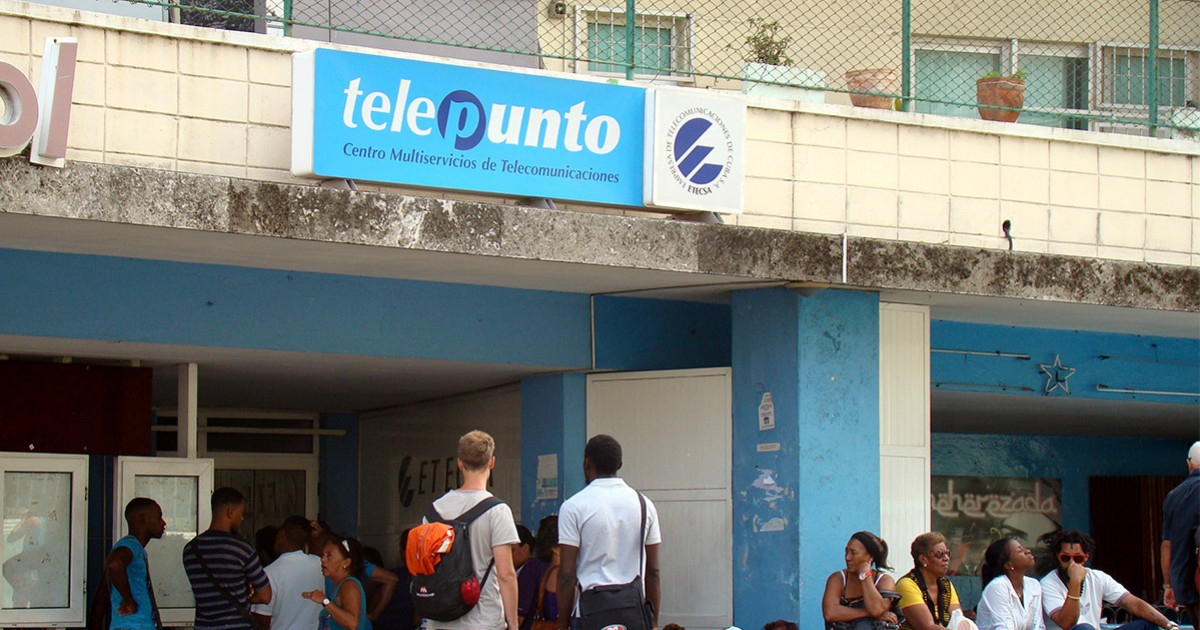
The photojournalist Roberto Suárez, from the official newspaper Juventud Rebelde, proposed this Saturday that the state-owned and sole Telecommunications Company of Cuba S.A. (Etecsa) sell part of its shares due to the lack of improvements in the quality of its services, a criticism that sparked extensive debate on social media.
"Etecsa should begin to sell part of its shares. It has been demonstrated that under the current circumstances, no improvements in services are being observed," Suárez wrote on his public profile on Facebook.
In the comments, the journalist himself expressed his dissatisfaction with the prices and the quality of the connection. "The prices of the international packages being paid and I don’t have 4G, who checks that? This money being paid and the service isn’t provided, who is responsible for that? I don’t want explanations, I want good service," he questioned.
The proposal to partially open the company’s capital also did not find consensus among the participants. One user argued that the problem would not be solved by the entry of private shareholders and attributed the deficiencies to the company's investment priorities.
"The service lacks quality because Etecsa invested more in its transportation fleet than in the energy backup for its repeaters and its servers, and no one seems to care," he wrote. He also warned that a potential partial privatization could drive up service costs without guaranteeing improvements and reduce internet access for a large portion of the population.
Another commentator recalled that Etecsa had foreign participation at its inception and that the State ultimately concentrated all shares. In 2011, the Cuban government purchased 27% that belonged to Telecom Italia for 706 million dollars, bringing the company fully under state control.
The criticisms also pointed to the company's revenue and the lack of visible results for its clients. "Where are the millions and millions in international recharges? They said they were going to invest and improve communications. What have they done? Because things are worse," a user asked.
Another participant referred to Etecsa as the "golden goose" of the regime and questioned why the income generated from services to hotels, embassies, and foreign businesses does not result in better connectivity conditions for Cubans.
Suárez insisted on the need to change the management model. "We have to change because it's clear that the state can't manage it. For example, Etecsa is getting worse every day," he responded to those who defended keeping the company under state control.
The discussion takes place in a context where the state monopoly holds the exclusive concession for public telecommunications services, extended by decree until 2036, with the possibility of extending it to 2066.
The company's infrastructure figures highlight its difficulties. Etecsa recently acknowledged issues that impact the quality of its services and indicated that approximately 180 mobile sites are affected by illegal amplifiers. Of its 2,520 radio bases, barely half have any form of backup power.
During the national blackout in September, over 80% of those radio bases went out of service, and internet traffic dropped by 58%.
This is not the first time that Suárez has publicly questioned the response of state-owned companies. In November 2025, he reported that the gas company did not respond to emergency calls during a massive leak in his building.
In April, he also highlighted the discrepancy between food prices and Cuban salaries.
Related videos:
Filed under: