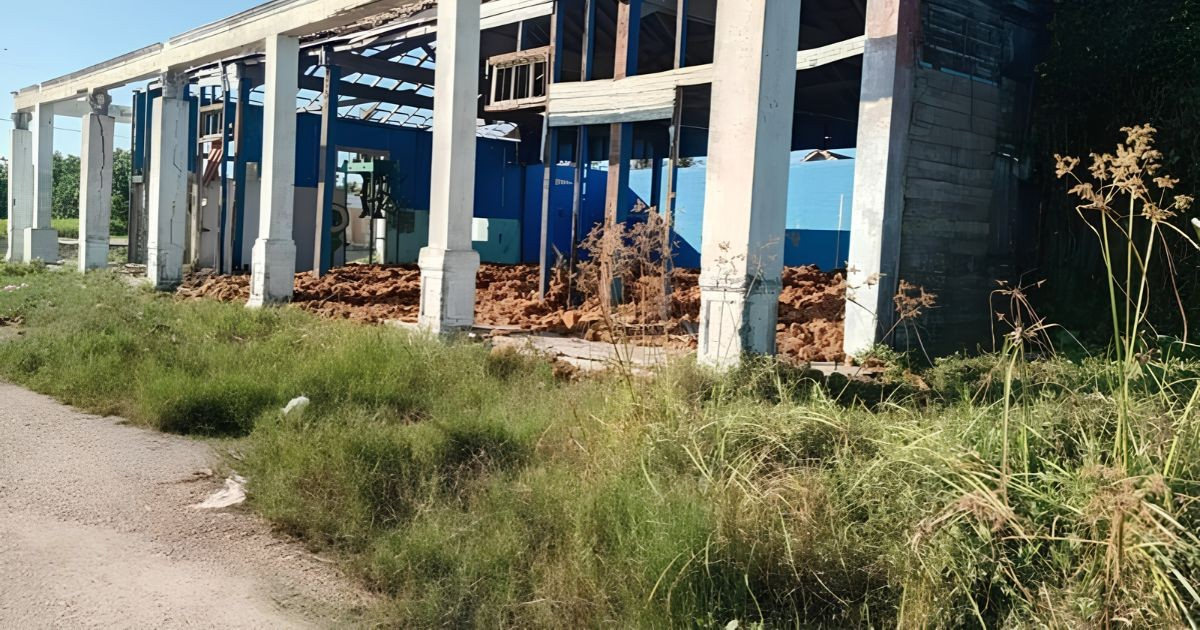
The poet and improvisational performer Juan Carlos García Guridi published on Tuesday on his Facebook profile a report regarding the state of complete ruin in which the sponge industry of Surgidero de Batabanó, a coastal town in the province of Mayabeque, finds itself.
The images accompanying the post show a high-roofed building with a collapsed ceiling, exposed concrete columns, piles of red brick debris inside, rusted metal, and wild vegetation growing among the remnants of what was one of Cuba's most unique production centers.
García Guridi, born in Batabanó in 1968 and the author of more than a dozen books, points out that inside the ruins lies an object steeped in history, exposed to the elements: "If you look closely inside, you will find – exposed to the elements – the scale, an instrument that has served multiple generations of sponge divers."
For the author, the deterioration goes far beyond the economic aspect: "For our people, more than a business, the sponge industry is a cultural matter; nonetheless, despite the shortages, what this industry generates economically makes it self-sufficient for much more than anyone can imagine. (And don't talk to me about Blockade, Climate Change, or hurricanes)."
García Guridi also takes the opportunity of the complaint to raise awareness about other heritage properties at risk: the Liceo de Batabanó and the Railway Terminal, where Mariano Martí—father of José Martí—worked, which was traversed by José Martí himself and Antonio Maceo.
The writer rejects any institutional excuses and demands direct action: "The homeland is not defended from an office or a car, nor in a meeting or with a speech; the homeland is defended with actions and above all with honesty. [...] Responsibility is necessary, and if it requires changing everything that must be changed, so be it."
The publication sparked a wave of reactions among Cubans who identify institutional neglect as the main cause of the collapse. An internet user who was directly involved in the research, capture, and certification processes for sponge exports remarked that "the quality of the species captured in the fishing areas served by Surgidero de Batabanó [...] is unique in the world; neither in the Caibarién area nor in the Greek islands do they possess the quality of ours, and the French market acquired them all [...] this product was a gold mine due to its high value and unique quality."
Another internet user who visited the site about 45 years ago remembered it as "a wonderful workplace and a source of pride for the nation," and described it as "another traditional industry lost due to institutional neglect." Someone was even more blunt: "we are a country falling apart."
The commercial fishing of sponges in the Gulf of Batabanó intensified in 1884, and by 1898, according to historian William G. Clarence-Smith, the production value in the area reached approximately $600,000. Between 1920 and 1929, Cuba recorded an average annual production of 505 tons of sponges, with international marketing offices in London and Paris since 1886.
The species of highest commercial value, Hippospongia lachne, known on the island as "female eye," was among the most valued varieties in the Antillean region.
The collapse of the sponge industry is part of a broader deterioration that threatens the very existence of the community. Surgidero de Batabanó faces the risk of disappearance due to the rising sea, the destruction of over 80% of its mangroves, and the impact of recurrent cyclones.
In 2026, most fishing vessels remained inactive due to a lack of fuel, and national catches of fish and seafood fell by more than 50% between 2020 and 2024, according to the Food Monitor Program.
García Guridi has been denouncing the Cuban crisis through poetry and public discourse for months, and his publication regarding sponge fishing is the latest in that series. An internet user bitterly summarized the collective sentiment: “Soon, upon arriving at Surgidero, we will find as a last remnant a tombstone: Here was Surgidero / Rest in Peace.”
Related videos:
Filed under: